
Table of Contents
- What Drives Paintless Dent Repair Cost in 2026
- Hail Damage Repair Cost 2026: What to Expect
- PDR vs. Traditional Body Shop Repair
- Paintless Dent Repair Insurance Claims: How the Process Works
- How Long Does Paintless Dent Repair Take?
- DIY Kits vs. a Professional PDR Technician
- How to Get an Accurate Paintless Dent Repair Estimate
- Conclusion
Last Updated: August 17, 2026
What Drives Paintless Dent Repair Cost in 2026
Paintless dent repair removes dents from vehicle body panels without sanding, filling, or repainting, preserving the original factory finish. It's one of the most cost-effective cosmetic repairs available, but pricing varies significantly based on technical factors most vehicle owners don't understand until they receive quotes.
At 888 PDR, we've worked with thousands of customers, and the most common frustration is: "I got wildly different quotes and had no idea why." This guide breaks down exactly what drives paintless dent repair cost in 2026 so you can evaluate any estimate with confidence.
Dent Size, Depth, and Location on the Panel
Size matters, but depth and location matter more. A shallow dent the size of a golf ball on a flat hood is far simpler than a smaller but deep dent on a body line. Sharp creases are significantly harder to work out because the metal has been stressed beyond a simple flex point; technicians must work the metal back incrementally to avoid cracking the paint.
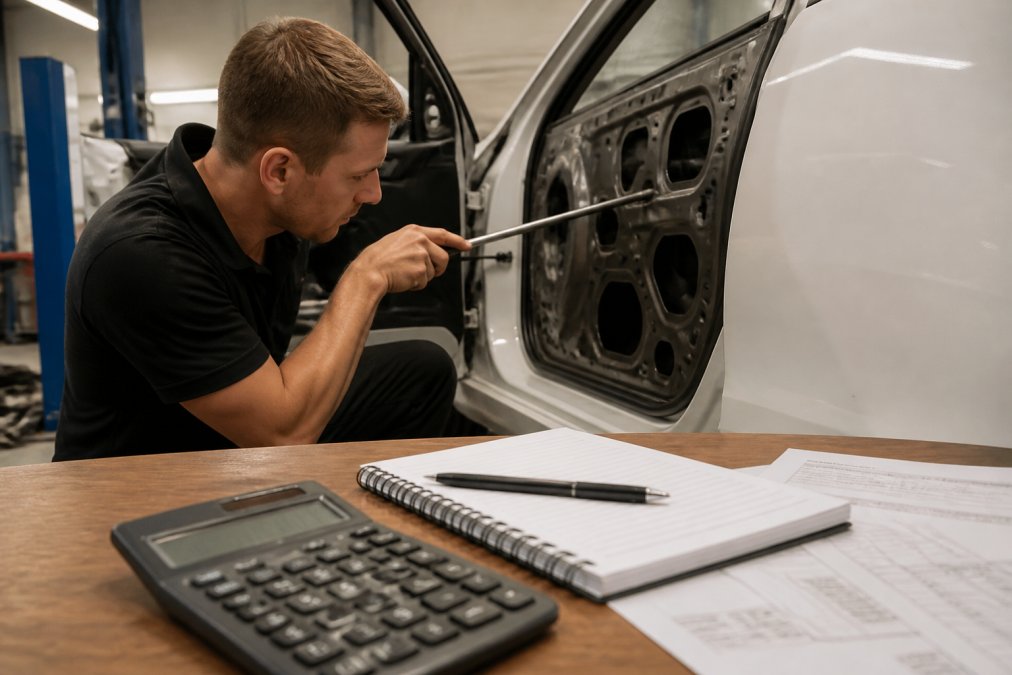
Location drives up labor cost through accessibility. Dents near edges, door frames, or beneath trim require partial disassembly before a technician can position a rod behind the panel. Dents in the center of flat panels, where rod access is straightforward, take a fraction of the time.
| Dent Type | Technical Difficulty | Key Cost Driver |
|---|---|---|
| Minor door ding, flat panel | Low | Minimal rod access work |
| Moderate dent on body line | Medium | Sharp crease, incremental correction |
| Deep dent near trim or frame | High | Trim removal, limited accessibility |
| Multiple overlapping dents | High | Volume and precision required |
Steel vs. Aluminum Panels: Why Material Matters
Steel panels have a memory and respond predictably to PDR techniques, flexing back toward their original shape with consistent tool pressure. Aluminum panels are stiffer and more brittle under manipulation, requiring technicians to work more slowly and carefully to avoid cracking or tearing the metal. That technical difficulty translates directly into higher labor cost.
Many newer trucks and SUVs use aluminum for hoods and doors to reduce weight. If your vehicle falls into this category, expect the repair estimate to reflect added complexity. A dent straightforward on steel may take significantly longer on aluminum, with higher risk of paint damage.
How to Identify Dents That PDR Cannot Fix
Not every dent is a PDR candidate. Paint damage and dent geometry are the most common disqualifying factors.
If the paint is cracked, chipped, or has separated from the metal at the dent site, PDR cannot restore the finish. Similarly, dents with sharp creases that have stretched the metal beyond its elastic limit cannot be fully corrected without leaving a visible trace. Dents in locations where tools cannot physically reach, such as certain roof pillars or areas behind structural reinforcements, are also outside PDR's scope.
A reputable technician will tell you this upfront. If a shop promises to PDR a dent with cracked paint, that's a red flag.
Hail Damage Repair Cost 2026: What to Expect
Hail damage repair cost depends on storm severity, the number of dents across the vehicle, and which panels were affected. Unlike a single door ding, hail events typically leave dozens to hundreds of individual dents distributed across the hood, roof, trunk, and body panels.
According to the Insurance Information Institute's guidance on comprehensive auto coverage, hail damage is covered under the comprehensive portion of an auto insurance policy, meaning your insurer typically absorbs the bulk of the cost.
Minor, Moderate, and Severe Hail Events
Minor events involve small hailstones under an inch in diameter, leaving shallow, high-count dents on horizontal surfaces like the hood and roof. These are generally the most PDR-friendly scenarios.
Moderate events involve larger stones and more dents per panel, often affecting vertical surfaces like doors and fenders. The dent count climbs, and some dents may sit on body lines or near trim, adding complexity.
Severe events produce golf ball-sized or larger hailstones, leaving deep dents with potential paint cracking. In the worst cases, a combination of PDR and conventional repair may be necessary.
Repair timeframe scales with severity. Minor hail jobs may be completed in a day or two; severe damage can take a week or more.
PDR vs. Traditional Body Shop Repair
PDR preserves what traditional body shop repair cannot: your vehicle's factory finish.
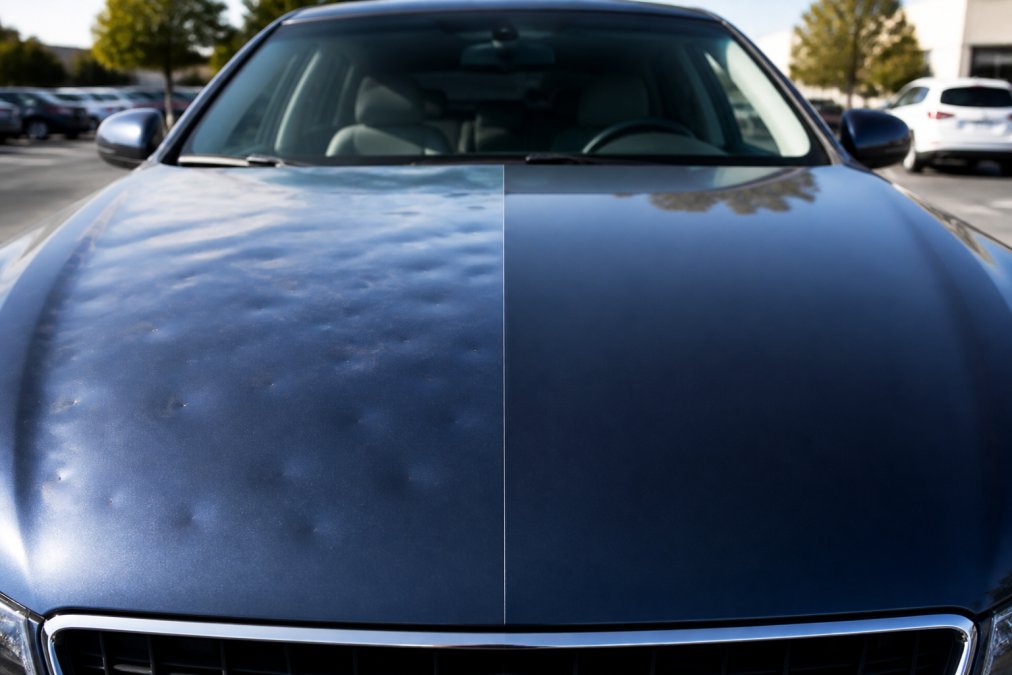
Traditional body shop repair involves sanding the damaged area, applying body filler, priming, and repainting. The repainted panel will never perfectly match the factory color, especially on vehicles more than a few years old where the original finish has weathered. Filler can also shrink or crack over time, causing the repair to telegraph through the paint surface years later.
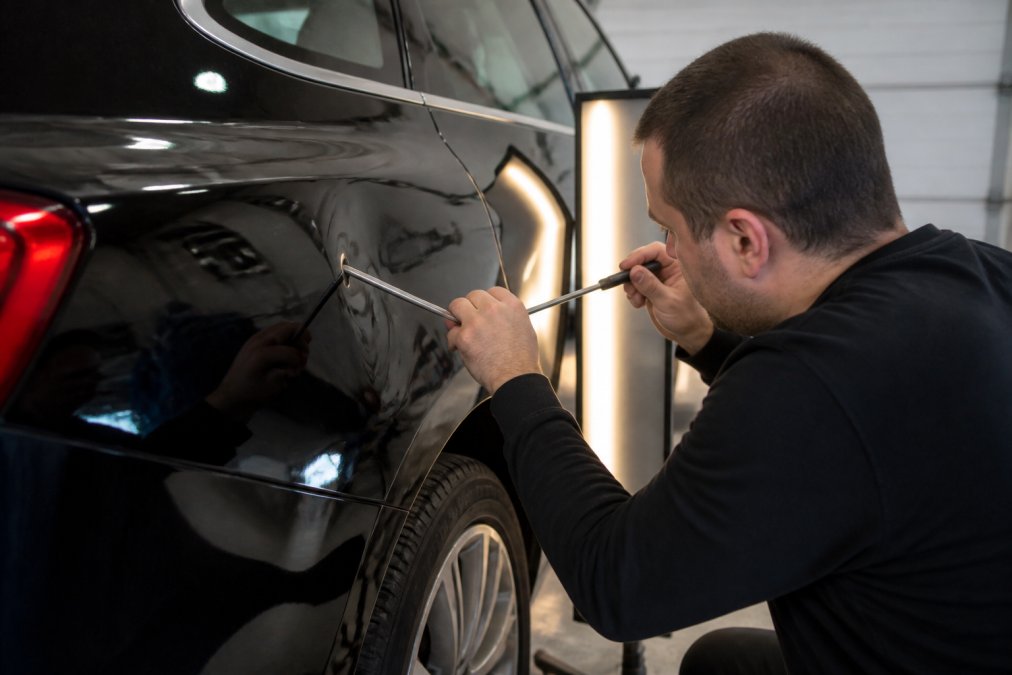
PDR works the metal back to its original shape from behind the panel using specialized tools, with no material added or removed. The factory finish stays intact.
Factory Finish, Resale Value, and Warranty Implications
Preserving the factory finish has real financial consequences at resale. Used vehicle buyers and dealers routinely check for paint work, and a repainted panel reduces trade-in or private sale value.
PDR leaves no paint record because no painting occurs. The vehicle's finish history remains clean.
According to the National Highway Traffic Safety Administration's vehicle safety and recall information, some automakers include warranty language that can be affected by non-factory paint or body modifications. PDR, because it doesn't alter the paint or add materials, avoids this issue entirely.
Paintless Dent Repair Insurance Claims: How the Process Works
Filing an insurance claim involves notifying your insurer, having the vehicle inspected, receiving an estimate, and authorizing repairs. The complexity lies in negotiation between the shop and insurer over scope and pricing.
Many vehicle owners don't realize they have the right to choose their own repair facility. You are not legally required to use your insurer's preferred shops. Choosing a shop that actively manages the claim process on your behalf makes a significant difference in both repair quality and experience smoothness.
Deductibles and Out-of-Pocket Costs
Your deductible is the amount you pay before insurance coverage applies. Comprehensive deductibles for hail damage vary widely; common amounts range from a few hundred dollars to over a thousand.
The repair shop works directly with your insurer on the remaining balance. A shop with insurance claim experience will review the insurer's initial estimate, identify overlooked damage, and negotiate a supplement if necessary.
No legitimate repair shop can legally waive your deductible. If someone offers to "cover your deductible," that arrangement typically involves inflating the invoice, which is insurance fraud.
Lease Return Inspections and PDR
Leased vehicles are held to strict cosmetic standards at return. Most lease agreements include a damage allowance threshold; dents and hail damage exceeding this threshold result in charges from the leasing company's inspector.
Getting PDR completed before a lease return inspection is one of the most cost-effective ways to avoid end-of-lease bills. Schedule repairs well in advance and keep documentation for the return appointment.
How Long Does Paintless Dent Repair Take?
Paintless dent repair takes anywhere from one hour to several days, depending entirely on damage scope. A single minor door ding on a steel panel with good accessibility can often be completed in under an hour. Moderate hail damage across multiple panels typically requires one to three days. Severe hail damage may take a week or longer.
Repair time is also affected by trim removal requirements, panel material, and technician workload. Shops specializing exclusively in PDR tend to turn vehicles around faster because the workflow is optimized for this repair type.
If you rely on your vehicle for work, ask about rental vehicle assistance when booking.
DIY Kits vs. a Professional PDR Technician
DIY dent repair kits appeal to anyone trying to avoid a shop visit. Glue pulling, the most common type, uses a bridge or slide hammer attached to a glue tab to pull the metal outward.
Glue pulling works reasonably well on very shallow, simple dents in flat panel centers. For anything more complex, dents on body lines, deeper depressions, aluminum panels, or areas near trim, DIY attempts frequently make damage worse. Overpulling creates a high spot that is often harder to correct than the original dent.
A professional PDR technician has years of training, specialized tools worth thousands of dollars, and the ability to assess dent geometry before deciding on the correct approach. For anything beyond a very minor ding, professional repair is the better investment, especially when resale value or a lease return is on the line.
How to Get an Accurate Paintless Dent Repair Estimate
The single most important step is an in-person or photo-based inspection by a qualified technician, not a phone quote based on description.
Here's a practical checklist for getting a trustworthy quote:
- Photograph the damage in natural daylight from multiple angles
- Note the vehicle make, model year, and affected panels
- Confirm whether any paint damage is present
- Ask whether any panels on your vehicle are aluminum
- Request an itemized estimate breaking down cost by panel or dent group
- Ask about repair timeline and rental vehicle availability
- Confirm whether the shop handles insurance claim management directly
According to the Federal Trade Commission's consumer guidance on auto repair, you have the right to a written estimate before any repair work begins. Don't skip this step.
888 PDR offers free estimates and manages the insurance claim process from start to finish. With a lifetime warranty on all repairs and vehicle pickup and delivery available, the goal is to make the process straightforward from first contact to final inspection.
| Step | What to Do | Why It Matters |
|---|---|---|
| Document the damage | Photos in natural light, multiple angles | Supports insurance claim and estimate accuracy |
| Identify panel materials | Check owner's manual for aluminum panels | Affects repair complexity and cost |
| Get an itemized estimate | Request breakdown by panel or dent | Lets you compare quotes accurately |
| Confirm insurance handling | Ask if shop manages claims directly | Reduces paperwork stress |
| Ask about rental assistance | Confirm availability before booking | Prevents schedule disruption |
Compare estimates on scope, not just price. An estimate that misses half the damage will look cheaper until supplements arrive.
Hail damage and dents don't have to derail your week or your vehicle's value. 888 PDR handles the insurance claim management from start to finish, backs every repair with a lifetime warranty, and offers vehicle pickup and delivery so the process fits around your schedule. Get a free quote and find out what your repair actually involves before committing to anything.
Frequently Asked Questions
How much does paintless dent repair cost?
PDR pricing varies widely based on the number of dents, their size and depth, the panel material (aluminum costs more to repair than steel), and the technician's access to the damage. A single small door ding is far less involved than widespread hail damage across multiple body panels. Because every vehicle and every dent is different, the most reliable way to get an accurate figure is to request a free, on-site estimate from a qualified PDR specialist.
Will insurance pay for paintless dent repair on hail damage?
Comprehensive auto insurance typically covers hail damage repair, including PDR. You'll be responsible for your deductible, and the insurer pays the remainder of the approved estimate. A shop that manages insurance claims directly can submit the documentation, negotiate with the adjuster, and coordinate payment on your behalf, which removes most of the administrative burden from you. Always confirm your policy's comprehensive coverage before filing a claim.
Why does paintless dent repair cost vary so much between quotes?
Several variables shift the price significantly: the total number of dents, whether the damage crosses a body line or sharp crease, the vehicle's make and model year, panel accessibility for rod access or glue pulling, and whether trim removal is required. Aluminum panels on newer vehicles also demand more technical skill than steel, raising the labor cost. Two vehicles with visually similar damage can require very different repair times, which is why quotes differ.
Is paintless dent repair worth it compared to a traditional body shop?
For dents where the paint is intact, PDR almost always makes more sense. It preserves the factory finish, avoids filler and repainting, costs less than conventional body shop repair, and takes significantly less time. Maintaining the original paint is also important for resale value, since repainted panels can be flagged on vehicle history reports. The main exception is when a dent is too deep, has a sharp crease, or has already cracked the paint, making conventional repair necessary.
This article was written using GrandRanker