
Last Updated: November 23, 2026
Quick Summary
A roof usually needs roof replacement after repeated hail damage when the impacts have compromised the shingles' ability to shed water, or when a single major storm has damaged most of the roof. A few cosmetic dings rarely justify replacement on their own. The number of functional impacts, the roof's age, and whether damage is spread across the roof drive the decision.
- Functional damage, such as cracks, punctures, or exposed mat, is what usually leads to leaks and replacement.
- Repair often suffices when damage is limited to a small area and the roof is relatively young.
- Replacement becomes stronger when damage is widespread, the roof is near end of life, or repairs repeat often.
- Photograph roof slopes and close-up impacts with a reference object, and log storm dates and hail size.
- Multiple hail claims can affect renewal premiums, so ask your agent before filing.
Table of Contents
- How Much Hail Damage Means a Roof Needs Replacing?
- Signs of Hail Damage on Roof Shingles
- Repair vs. Replacement: How to Decide After Repeated Storms
- Documenting Roof Hail Damage for Insurance Claims
- How Multiple Claims Affect Your Insurance Premiums
- Material Durability and Long-Term Insurability
- Booking Your Roof Inspection and Next Steps
- Frequently Asked Questions
How Much Hail Damage Means a Roof Needs Replacing?
A roof usually needs roof replacement after repeated hail damage when the impacts have compromised the shingles' ability to shed water, or when a single major storm has left damage across most of the roof. A few cosmetic dings rarely justify replacement on their own, but a roof that has been hit several times, especially with functional damage, often reaches the point where repairs no longer make economic sense. The deciding factors are the number of functional impacts, the age of the roof, and whether the damage is spread across the roof or limited to one area.
Hail damage accumulates. Each storm strips a little more protective granule coating and weakens the mat beneath it, so a roof that survived one event may fail after the next. Homeowners in Texas and Nebraska see repeat hail seasons often enough that this pattern is common, and it is why the decision should be based on the roof's total condition rather than the most recent storm alone. A qualified roofing contractor or licensed adjuster can document the damage and tell you whether the roof is still serviceable.
Signs of Hail Damage on Roof Shingles
Hail damage on asphalt shingles is not always easy to see from the ground. The most reliable signs are visible from a close inspection, and many homeowners first notice them on gutters, downspouts, window screens, or the siding of the house. Dented metal vents, flashing, and soft metal components are good indicators that the roof took a hit.
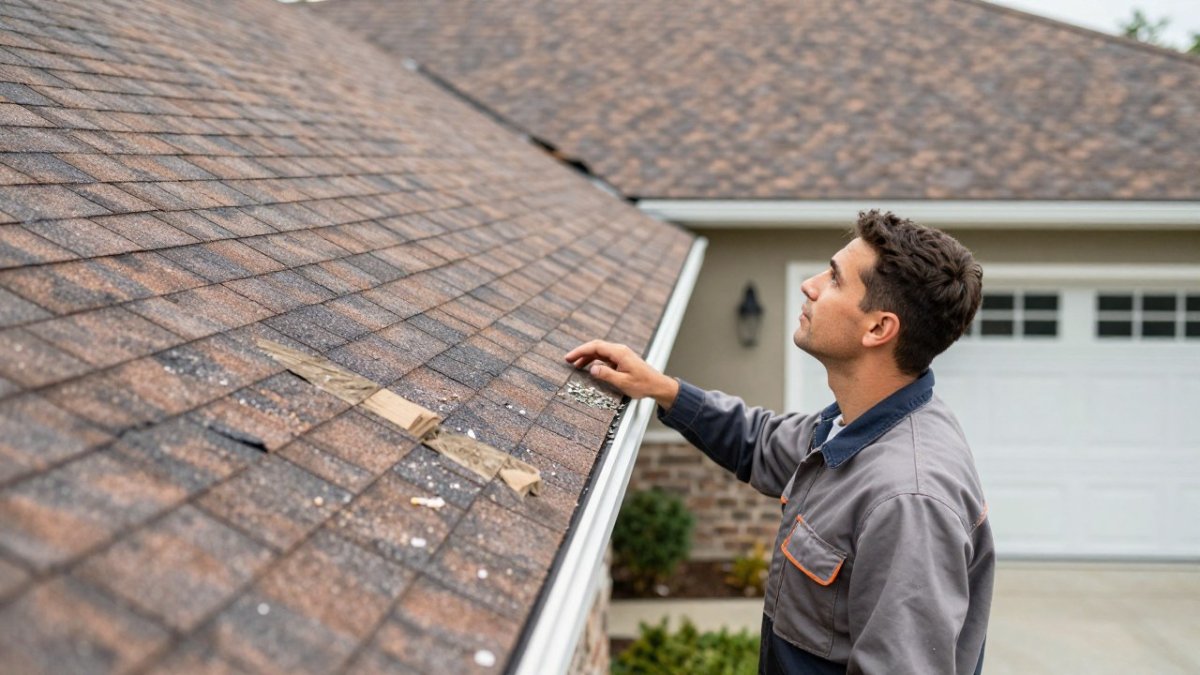
When you inspect the roof, look for bruising where the shingle feels soft when pressed, dark spots where the granules have been knocked loose, and small circular fractures or cracks. Hail often leaves impacts clustered on the windward side of the roof and on slopes facing the storm.
Functional Damage vs. Cosmetic Damage
The distinction between functional and cosmetic damage drives most replacement decisions. Cosmetic damage affects appearance only: granules are scuffed but the shingle still sheds water and the mat is intact. Functional damage compromises the roof's ability to protect the home, such as cracks, punctures, torn shingles, or exposed mat. Functional damage is what insurers typically count toward a covered claim, and it is the damage that most often leads to leaks.
A simple test is to lift the shingle and check the underlayment and the mat for cracks or exposed fiberglass. If the shingle is cracked through or the mat is fractured, the damage is functional. If the damage is limited to surface granule loss, the shingle may still be serviceable, though repeated granule loss will shorten its life.
Granule Loss and Shingle Integrity
Granules protect the asphalt from ultraviolet light and physical wear, so their loss directly affects how long the shingle lasts. Check the gutters and the downspout outlets for accumulated granules after a storm. A heavy buildup of granules is a sign the roof is losing its protective layer. Once enough granules are gone, the asphalt begins to degrade, and the shingle becomes brittle and prone to cracking. Granule loss from hail often shows up as bare or dark patches on the surface, and when it is widespread, the roof's remaining life is significantly reduced.
Repair vs. Replacement: How to Decide After Repeated Storms
Repair is usually the better choice than roof replacement when damage is limited to a small area, the roof is relatively young, and the underlayment and decking are sound. Replacement becomes the stronger option when the roof is near the end of its service life, when functional damage is widespread, or when repairs would need to be repeated often.
| Factor | Favors Repair | Favors Replacement |
|---|---|---|
| Damage area | Small, localized section | Most of the roof surface |
| Roof age | Relatively young | Near or past expected lifespan |
| Damage type | Isolated functional damage | Widespread functional damage |
| Underlayment and decking | Sound | Soft, wet, or deteriorated |
| Repair frequency | One-time fix | Repeated repairs needed |
Patching pros: lower upfront cost, quick to complete, keeps a serviceable roof in place. Patching cons: does not address widespread granule loss, can mismatch aging shingles, may need repeating after future storms. Full replacement pros: restores a uniform, fully protected roof, resets the warranty clock, and simplifies future claims. Full replacement cons: higher upfront cost and more disruption, and it only makes sense if the rest of the house is structurally sound.
Documenting Roof Hail Damage for Insurance Claims
Good documentation is the foundation of a successful claim, and the quality of your file often matters more than the size of the storm. Photograph the roof, gutters, downspouts, siding, window screens, and any soft metal components as soon as it is safe to do so.
Keep a written log that records the storm date, the reported hail size from a weather service or local news report, and the date you first noticed the damage. Save every contractor estimate, inspection report, and correspondence with your insurer. Ask the inspector to classify each area of damage as functional or cosmetic and to photograph both, because the functional-versus-cosmetic call is where many claims are won or lost.
Understand the policy mechanics before you file. Most homeowners policies cover hail damage to the roof under the dwelling coverage, subject to your deductible. Because the deductible and settlement terms matter only after damage is documented, compare what you see on the roof with the signs Fraley's Home Improvement identifies before deciding whether to file a claim.
A common pattern is for the first adjuster visit to produce a partial scope that covers only the obvious slopes. If your documentation shows functional damage on additional slopes, you can request a re-inspection and submit your photos and the contractor's report as supporting evidence. Keep the original damaged materials available until the claim is settled, since some carriers ask to inspect shingles that have been removed.
Watch out: signing a contract or authorizing repairs before the insurer has inspected and agreed to a scope can complicate the claim, because the carrier may treat the work as evidence that the damage was already accepted.
A second opinion is worth the cost when the adjuster's scope seems low or when the damage is concentrated on slopes the adjuster did not walk. An independent roofing inspector or a licensed public adjuster can re-document the roof and, in the case of a public adjuster, negotiate the claim on your behalf for a fee that is typically a percentage of the settlement. Confirm the fee and the contract terms in writing before engaging anyone.
How Multiple Claims Affect Your Insurance Premiums
Filing several hail claims can affect your insurance in ways that are worth understanding before you file. Insurers look at claim history when they set renewal rates, and multiple claims in a short period may lead to higher premiums, a surcharge, or in some cases a non-renewal, depending on the carrier and your state's rules. Some insurers also apply separate deductibles for wind and hail, which can make each claim more expensive for you.
Because the effects vary, ask your agent how a claim would affect your renewal before filing, and compare the cost of repairs against the likely increase in premiums over several years. In some cases, paying for a smaller repair out of pocket is the better financial choice. Keep in mind that policy terms, deductibles, and rating practices differ, so confirm the details with your own carrier.
Material Durability and Long-Term Insurability
The material you choose for a replacement roof affects how the roof performs under the next hail event and how insurers view the home over the long term. The comparison below focuses on how each common material reacts to repeated hail and how that reaction is classified as cosmetic versus functional damage.
Asphalt shingles. Standard three-tab and architectural shingles are the most common roof in the country and the most vulnerable to hail. Hail knocks granules loose, bruises the asphalt, and can fracture the fiberglass mat. Granule loss is usually cosmetic at first, but repeated loss exposes the asphalt to ultraviolet light and shortens the shingle's life.
Metal roofing. Standing-seam metal and stone-coated steel resist hail well in terms of water shedding, but hail can dent the panels. Dents on a metal roof are usually cosmetic and rarely compromise the roof's ability to shed water, though some insurers and some policy forms treat large dents as damage that affects appearance and value.
Slate and tile. Natural slate and clay or concrete tile are highly durable against hail in terms of water shedding, but they are brittle and can crack or chip under large stones. Cracked slate or tile is functional damage because the broken piece exposes the underlayment. Repair is often possible by replacing individual pieces, which is one reason slate and tile roofs are sometimes repaired rather than replaced after a storm.
Synthetic and composite products. Composite slate and synthetic shake products are engineered to mimic the look of natural materials with better impact resistance. Their hail performance varies by manufacturer, so check the product's impact rating and warranty terms rather than assuming the category performs uniformly.
The long-term insurability angle is the one most homeowners miss. Insurers underwrite the roof's age, material, and claim history together. A roof that has produced two or three hail claims in a short period can be flagged at renewal even if each claim was legitimate, and some carriers respond with a surcharge, a higher wind-and-hail deductible, or a decision not to renew.
Watch out: no roofing material makes a roof hail-proof, and warranty terms often exclude cosmetic damage.
Booking Your Roof Inspection and Next Steps
If you suspect repeated hail damage, the most useful next step is a professional inspection that documents both functional and cosmetic damage and gives you a clear repair-or-replace recommendation. Call (469) 284-0336 to request a free inspection or get a quote.
Frequently Asked Questions
Will insurance replace a 30 year old roof after hail damage?
Insurance may pay for a full roof replacement after hail damage even on an older roof, but the payout is often based on actual cash value rather than replacement cost. Depreciation reduces what you receive for an aging roof, so the policy's age-based terms matter. Review your declarations page for roof settlement language, ask whether your policy uses actual cash value or replacement cost value, and have your roofer document functional damage clearly so the adjuster sees why repair is not enough.
Will my homeowners insurance premiums increase after filing multiple hail claims?
Filing repeated hail claims can lead to a premium hike or non-renewal, depending on your insurer and state rules. Carriers often review claim history at renewal, so several claims within a short period may raise concern. Before filing, consider whether the repair cost is near your deductible, and ask your agent how the claim will be reported and rated. Keeping accurate records helps you explain each claim if the insurer asks questions.
How long can a roof realistically last after sustaining hail damage?
A roof with functional hail damage, such as cracked shingles, exposed mat, or compromised underlayment, loses protection faster than an undamaged one. Granule loss exposes the asphalt layer to UV and water, which shortens the remaining service life. There is no single number that applies to every roof, so a licensed roofing contractor should inspect the shingles, underlayment, and flashing and estimate remaining life based on what they find.
What should I avoid saying to an insurance adjuster about roof damage?
Stick to observable facts: where the damage is, when the storm occurred, and what you saw. Avoid guessing at causes, minimizing damage you have not inspected, or agreeing to a number before your own contractor has reviewed the estimate. Do not sign a settlement or release without reading it. Keep copies of every report, photo, and email, and ask for the adjuster's estimate in writing before accepting a payment.
