
Table of Contents
- Collision vs. Comprehensive: Which Covers Door Dings?
- Paintless Dent Repair and Insurance Coverage
- Deductible vs. Repair Cost: The Financial Decision
- Average Cost of Door Ding Repair and Claim Viability
- Does Filing a Claim for a Dent Raise Insurance Rates?
- Handling a Parking Lot Hit-and-Run or Vandalism Claim
- When to File a Claim vs. Pay Out-of-Pocket
- Frequently Asked Questions
Last Updated: September 28, 2026
Collision vs. Comprehensive: Which Covers Door Dings?
Understanding whether collision or comprehensive coverage applies to your door ding can save you hundreds of dollars and prevent unnecessary premium increases when filing a door dings insurance claim.
Collision coverage protects against impact with another vehicle or object, a door ding in a parking lot typically falls here. Comprehensive coverage protects against non-collision events like vandalism, theft, weather, or falling objects. Most door dings result from parking lot collisions, making collision coverage the relevant policy. If the damage came from vandalism or a hit-and-run, you may file under collision (if you have uninsured motorist property damage coverage) or comprehensive, depending on your policy.
At 888 PDR, we work directly with insurance carriers to help you understand which coverage applies to your specific damage. We manage claims from initial notification through final payment, ensuring the paperwork is handled correctly so you're not left covering unexpected costs.
Paintless Dent Repair and Insurance Coverage
Paintless dent repair (PDR) removes dents without fillers or repainting, preserving your vehicle's original finish and resale value. Insurance companies prefer PDR for minor dings because it's faster, cheaper, and maintains vehicle integrity.
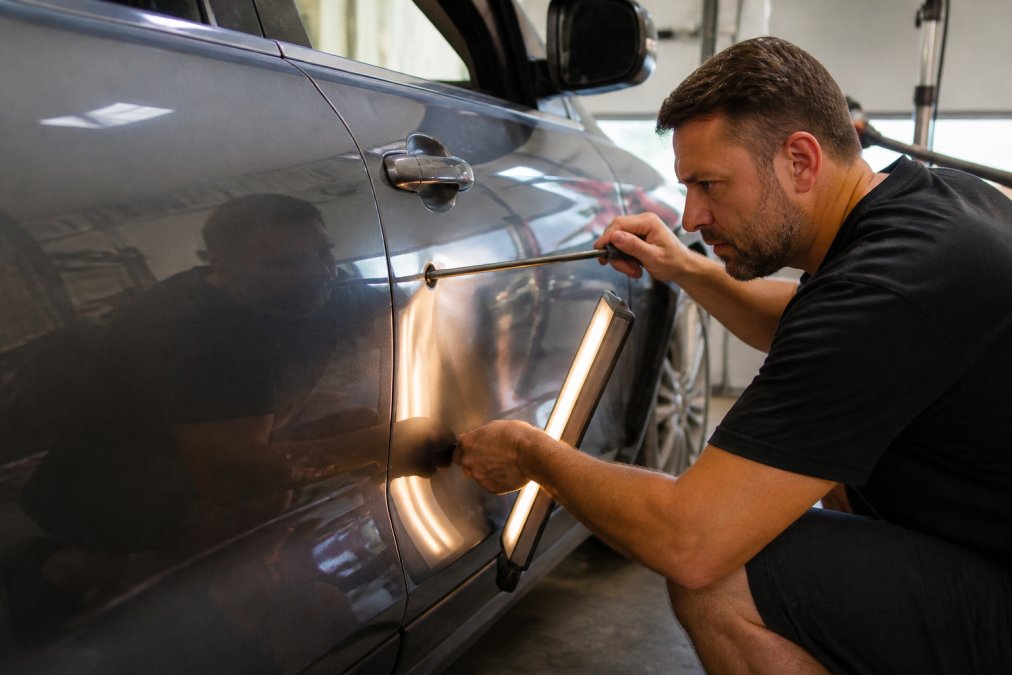
Insurers often recommend PDR for qualifying door dings. PDR works best on shallow dings without creased metal or paint damage and typically completes in one day, getting your vehicle back faster and settling claims sooner.
Traditional body shop repairs involve sanding, filling, priming, and repainting, a longer, costlier process that affects resale value. Insurance adjusters often approve PDR claims more readily because of these advantages.
Many PDR specialists, including 888 PDR, offer vehicle pickup and delivery, so you can keep using your car during repairs. This convenience means less downtime and faster claim resolution.
Deductible vs. Repair Cost: The Financial Decision
The real decision is whether filing a claim makes financial sense. Your deductible is the amount you pay out of pocket before insurance covers the rest. If your deductible exceeds the repair cost, you'll pay the full amount yourself, making a claim pointless.
The Basic Math
Start with this formula:
Repair Cost − Deductible = Insurance Payout
If a door ding repair costs $400 and your deductible is $500, you're out of pocket either way. Filing the claim won't help you, and it may increase your premiums. The smarter move is to pay out of pocket and avoid the claim entirely.
If the repair cost significantly exceeds your deductible, filing a claim may be viable. A $1,200 repair with a $500 deductible means insurance covers $700. However, factor in potential premium increases and lost no-claim discounts, which can offset that savings. Mitigating these long-term financial impacts often requires a broader strategy for auto insurance savings that accounts for your total household coverage.
The Hidden Cost: No-Claim Bonuses
Most drivers miss a critical hidden cost: no-claim bonuses and loyalty discounts. Many insurers offer 5-25% discounts for multiple years without claims. Filing one minor claim can disqualify you for 3-5 years. Example: A $1,200 annual premium with a 10% no-claim discount ($120/year) means losing $360 over three years, plus any rate increase. A $600 repair could cost $500+ in lost discounts and deductible combined.
Before filing a claim, ask your insurer:
- Do I have a no-claim discount or loyalty discount?
- How much would I lose if I file a claim?
- How long would it take to earn that discount back?
- What is the total cost of the claim including lost discounts and rate increases?
The Three-Year Premium Impact
Insurers use claim history to predict future risk. Even a minor door ding claim goes on your record and may trigger 5-15% rate increases at renewal.
Calculate the total cost over three years:
| Scenario | Repair Cost | Deductible | Insurance Pays | Your Out-of-Pocket | Premium Increase (3 years) | Lost Discounts (3 years) | Total Cost |
|---|---|---|---|---|---|---|---|
| Minor ding, file claim | $400 | $500 | $0 | $400 | $180 | $360 | $940 |
| Minor ding, pay out-of-pocket | $400 | $500 | N/A | $400 | $0 | $0 | $400 |
| Moderate damage, file claim | $1,200 | $500 | $700 | $500 | $180 | $360 | $1,040 |
| Moderate damage, pay out-of-pocket | $1,200 | $500 | N/A | $1,200 | $0 | $0 | $1,200 |
The Decision Framework
File a claim only if the insurance payout (repair cost minus deductible) exceeds the combined cost of premium increases and lost discounts over 3-5 years. Use this checklist:
- Get a professional repair estimate (PDR or body shop)
- Calculate: Repair Cost − Your Deductible = Insurance Payout
- Contact your insurer and ask: "If I file a claim, how much will my premium increase and for how long? Do I have any no-claim discounts I would lose?"
- Calculate total three-year cost: Insurance Payout vs. (Premium Increases + Lost Discounts)
- If Insurance Payout > Total Three-Year Cost, file the claim. Otherwise, pay out of pocket.
Many vehicle owners don't realize they have options. When you contact 888 PDR for a free inspection, we provide the exact repair cost needed to make this calculation and help you think through the financial trade-offs.
Average Cost of Door Ding Repair and Claim Viability
Door ding repair costs depend on damage severity, vehicle material, and repair method. Paintless dent repair typically costs less than traditional body shop work because it skips sanding, filling, and repainting. For a single door ding, PDR may cost a few hundred dollars; full body shop repairs cost significantly more.
The critical question: does the repair cost exceed your deductible enough to justify filing a claim? Vehicle type, location, and damage severity affect pricing. Getting a professional estimate is the only way to make an informed decision.
When you contact 888 PDR for a free inspection, you receive a detailed estimate that breaks down labor, materials, and timeline. This gives you the exact number needed to decide whether filing an insurance claim is financially smart for your situation.
Does Filing a Claim for a Dent Raise Insurance Rates?
Yes, filing a claim for a door ding can increase your insurance premium, even if you were not at fault. The impact varies based on claim type, your insurer's practices, and protective endorsements.
How Insurers Classify Door Ding Claims
Insurers categorize claims differently: Collision claims (impact with another vehicle) typically trigger 5-15% rate increases. Comprehensive claims (vandalism, weather, theft, hit-and-run) often have lower or no rate impact.
Typical Rate Increase Amounts
Claim Forgiveness and Accident Forgiveness Endorsements
- Accident Forgiveness prevents rate increases after your first at-fault accident (typically collision claims). Claim Forgiveness prevents rate increases after your first claim of any kind. Disappearing Deductible reduces your deductible by $100 yearly without claims. Check your policy to confirm which you have.
How to Find Out Your Specific Rate Impact
- "If I file a claim for a door ding, how much will my premium increase?"
- "For how long will the increase apply?"
- "Do I have accident forgiveness or claim forgiveness coverage?"
- "If I don't file a claim, will I lose any discounts?"
The No-Claim Discount Factor
When a Rate Increase Doesn't Matter
- The repair cost is very high ($2,000+) and your deductible is low ($500 or less), so the insurance payout is substantial.
- You have accident forgiveness or claim forgiveness, so there is no rate increase.
- The damage is comprehensive (vandalism, weather), which typically has minimal or no rate impact.
- You're switching insurers soon anyway, so the rate increase won't follow you (though the claim will appear on your claims history for 3-5 years).
Handling a Parking Lot Hit-and-Run or Vandalism Claim
If the other driver fled a parking lot hit-and-run, you may file under collision (if you have uninsured motorist property damage) or comprehensive. File a police report immediately, insurers require it to verify the incident. Include photos of damage, location, and witness information.
When to File a Claim vs. Pay Out-of-Pocket
The decision comes down to three factors: repair cost, deductible, and potential premium increase.
| Scenario | Repair Cost | Deductible | File Claim? | Reason |
|---|---|---|---|---|
| Minor ding | $300 | $500 | No | Out-of-pocket cost is lower |
| Moderate damage | $1,200 | $500 | Yes | Insurance covers $700+ after deductible |
| Hail damage (multiple panels) | $3,500 | $1,000 | Yes | Significant insurance coverage justifies claim |
| Small dent, high deductible | $400 | $1,000 | No | Deductible exceeds repair cost |
Frequently Asked Questions
Are door dings covered under comprehensive or collision insurance?
Door dings from parking lot incidents or other vehicles are typically covered under collision insurance. However, if the ding results from vandalism or a hit-and-run where the other driver is unidentified, comprehensive coverage may apply instead. The distinction matters because your deductible and premium impact differ between the two. Review your specific policy language or contact your insurer to confirm which coverage applies to your situation.
Is it financially worth filing an insurance claim for a minor door ding?
Filing a claim for a minor door ding is often not worth it financially. If your deductible is $500 or $1,000 and the repair costs less, you'll pay the full amount out-of-pocket anyway. Additionally, filing a claim can increase your premiums for three to five years, making the long-term cost much higher than the repair itself. Compare your deductible against the actual repair estimate before deciding to file.
What is paintless dent repair and how does insurance coverage work with it?
Paintless dent repair removes dents without fillers or repainting, preserving your vehicle's factory finish and resale value. Most insurance policies cover paintless dent repair under collision or comprehensive coverage, depending on the cause of the damage. Because paintless dent repair typically costs less than traditional body shop repairs, it may fall below your deductible, making an out-of-pocket repair more economical than filing a claim.
Will filing a claim for a dent increase my insurance premiums?
Yes, filing a claim for a dent can increase your insurance premiums. Most insurers apply a surcharge or premium increase for at-fault claims, lasting three to five years. Even if you're not at fault, some policies may still reflect the claim on your record. Before filing, calculate whether the repair cost plus the expected premium increase over several years exceeds paying for the repair yourself. Many drivers find that paying out-of-pocket for minor dents saves money in the long run.