
Table of Contents
- What Is Paintless Dent Repair?
- Why Auto Dent Removal Service Matters for Your Vehicle
- Types of Dents We Repair: Door Ding and Crease Removal
- Auto Hail Damage Repair: Protecting Your Investment
- Paintless Dent Repair Cost 2026: What to Expect
- Mobile vs. Shop-Based Dent Removal: Which Works Best
- Insurance Claims and Professional Repair: Your Complete Guide
- Step 1: Document Damage Immediately (First 24-48 Hours)
- Step 2: File Your Claim Promptly
- Step 3: Prepare for the Adjuster Inspection
- Step 4: Coordinate with Your PDR Provider
- Step 5: Understand Your Deductible and Coverage
- Step 6: Manage Payment and Repair Authorization
- Common Claim Mistakes to Avoid
- Why Professional Coordination Matters
- Why Professional Auto Dent Removal Beats DIY
- Frequently Asked Questions
Last Updated: September 26, 2026
What Is Paintless Dent Repair?
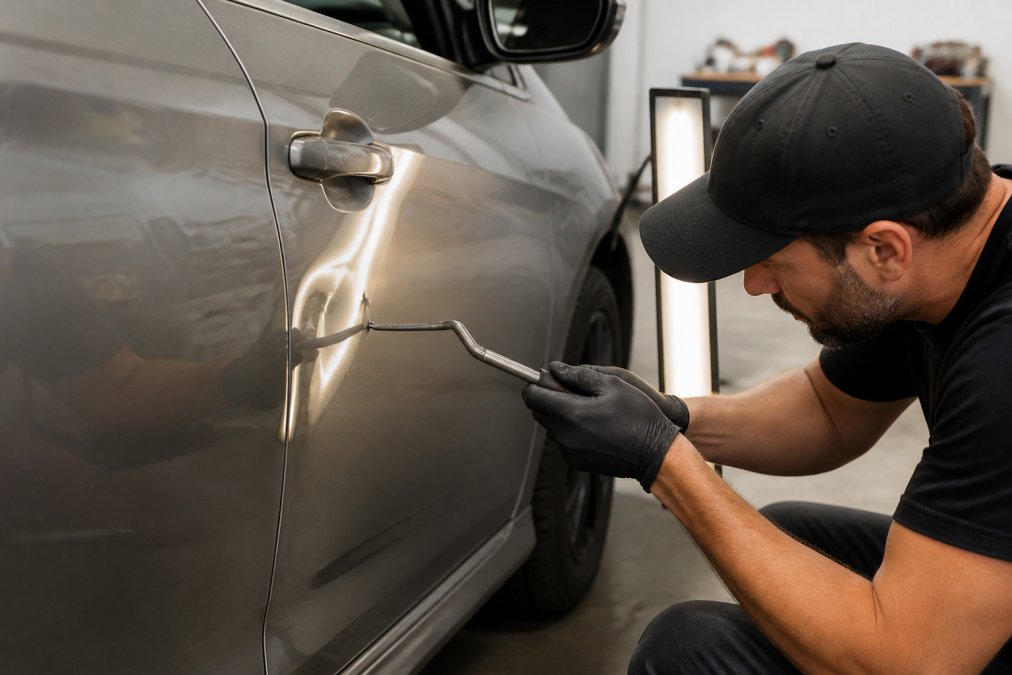
Paintless dent repair (PDR) uses precision tools to massage metal back to its original shape, preserving factory paint and resale value.
PDR handles door dings, hail damage, creases, and minor collisions while preserving the original factory finish and its superior rust and UV protection.
888 PDR specializes in this exact service, removing hail dents, door dings, and creases while preserving your vehicle's factory finish and resale value. The family-owned company operates a 25,000 sq ft facility and serves the Dallas-Fort Worth area and western Nebraska.
Why Auto Dent Removal Service Matters for Your Vehicle
Dents reduce resale value and signal poor maintenance. An auto dent removal service restores appearance while preserving the factory protective coating.
Dents expose bare metal, accelerating rust and water infiltration that can damage electrical systems and interiors. Professional auto dent removal service prevents these costly complications.
Insurance companies cover PDR for hail damage because it's cost-effective and faster than traditional body shop work.
Types of Dents We Repair: Door Ding and Crease Removal
Door dings from adjacent vehicles or shopping carts are among the easiest dents to repair because the impact is localized.
Auto Hail Damage Repair: Protecting Your Investment
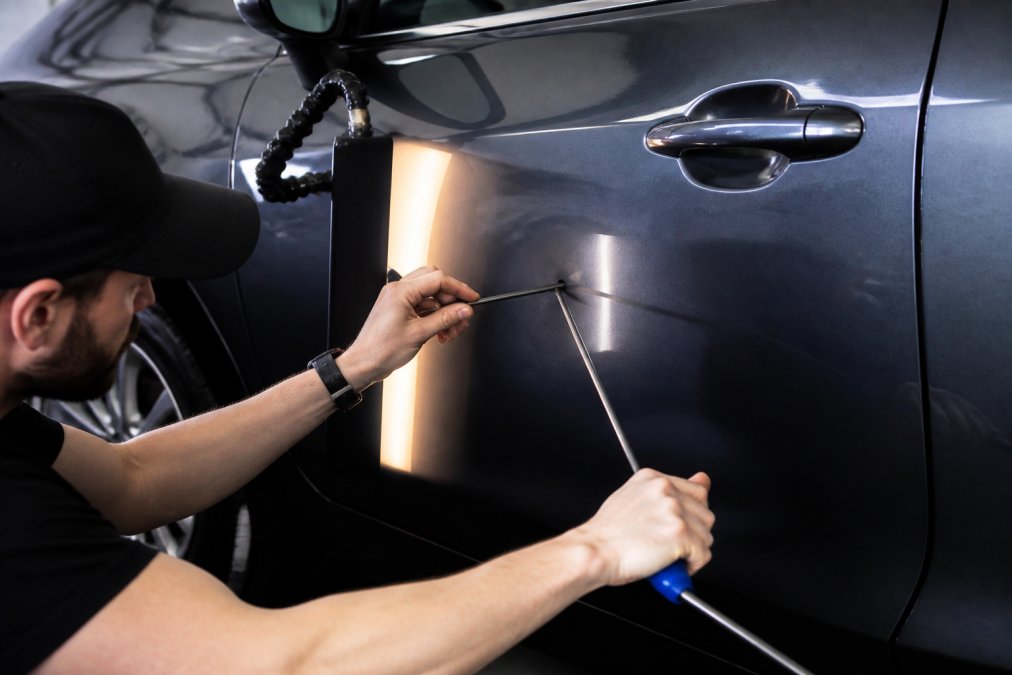
Hail storms create dozens or hundreds of dents where auto hail damage repair through PDR becomes economically superior to conventional approaches.
Paintless Dent Repair Cost 2026: What to Expect
Pricing depends on the number, size, depth, and location of dents. Request a free estimate for transparent pricing based on your vehicle's damage.
Mobile vs. Shop-Based Dent Removal: Which Works Best
Shop-based repair offers controlled lighting and climate for complex damage. The 25,000 sq ft 888 PDR facility handles single-door dings to fleet reconditioning.
Insurance Claims and Professional Repair: Your Complete Guide
Professional auto dent removal service providers like 888 PDR handle insurance claim complexity, but proper documentation ensures quick approval.
Step 1: Document Damage Immediately (First 24-48 Hours)
Document damage within 48 hours of the hail event, before weather exposure or additional impacts.
What to photograph:
- Wide shots of the entire vehicle from all four angles, showing the overall damage pattern
- Close-up shots of each damaged panel, taken at a 45-degree angle to show depth and dimension (straight-on photos flatten dents and make them appear less severe)
- Detailed close-ups of the most severe dents, showing paint stress or cracking if present
- Photos of the vehicle's location during the hail event (driveway, parking lot, open area) to establish exposure
- Timestamp photos if your phone captures metadata; this proves the date and time of documentation
What to document in writing:
- Date and time of the hail event
- Duration of the storm (if known)
- Hail stone size (estimate: pea-sized, marble-sized, golf ball-sized, etc.)
- Vehicle location during the event
- Any other vehicles or property damaged in the same area (corroborates the hail event)
- Weather service reports or news coverage of the storm (screenshot these for your file)
Step 2: File Your Claim Promptly
File your claim within 24-48 hours using your insurer's online app or website.
Step 3: Prepare for the Adjuster Inspection
An adjuster will inspect your vehicle within 3-7 business days. Be present; your input during inspection matters.
Before the adjuster arrives:
- Clean the vehicle's exterior so dents are clearly visible (dirt and grime obscure damage)
- Park in a well-lit location, ideally outdoors in natural light
- Have your documentation photos and written notes ready to show the adjuster
- Prepare a list of all damaged panels and areas (roof, hood, doors, fenders, rear quarter panels, etc.)
- Do not attempt any repairs before the inspection; the adjuster needs to see original damage
During the adjuster inspection:
- Point out all damaged areas; adjusters sometimes miss dents if they're not directed to them
- Explain the hail event details (size of stones, duration, weather conditions)
- Show your documentation photos and explain the timeline
- Ask the adjuster to explain their damage assessment and estimate
- Request a copy of the adjuster's report and estimate before they leave
Step 4: Coordinate with Your PDR Provider
Provide 888 PDR with a copy of the adjuster's estimate; they can identify if it's incomplete.
Step 5: Understand Your Deductible and Coverage
Your deductible is your responsibility. Check your policy for comprehensive coverage limits and any deductible waivers for hail damage.
Step 6: Manage Payment and Repair Authorization
Once your claim is approved, your insurance company issues payment in one of two ways:
-
Check to you and the repair shop (joint check): You and the PDR provider must both endorse the check before it can be deposited. This protects the insurer by ensuring the repair is actually completed.
-
Direct payment to the repair shop: The insurer pays 888 PDR directly, and you pay your deductible to the shop at the time of repair.
Common Claim Mistakes to Avoid
- Delaying documentation: Waiting more than a week to photograph damage weakens your claim because weather exposure and additional impacts create ambiguity about what damage was caused by the hail event.
- Attempting repairs before adjuster inspection: If you repair damage before the adjuster sees it, they may deny the claim or reduce the payout, arguing they can't verify the original damage.
- Accepting the first estimate without question: If the adjuster's estimate seems low, ask for clarification. Supplements are normal and expected in hail damage claims.
- Not providing complete documentation: Adjusters work from photos and written descriptions. The more detail you provide, the stronger your claim.
- Ignoring policy details: Understand your deductible, coverage limits, and any exclusions before filing. This prevents surprises during the claim process.
Why Professional Coordination Matters
Insurance claim management is where full-service providers differentiate themselves. 888 PDR works directly with all insurance carriers, manages the claim from first notice of loss through final payment, and handles supplements if additional damage is discovered. This eliminates the frustration of back-and-forth communication and ensures you're not left with unexpected out-of-pocket costs.
Why Professional Auto Dent Removal Beats DIY
DIY dent removal kits sold online promise results but deliver disappointment and risk. These kits, suction cups, glue-pulling systems, and heat guns, work only on specific dent types and often fail on creases, hail damage, and complex shapes that professional technicians handle routinely.
When DIY Might Be Safe (Rare Cases)
A small, shallow dent (less than half an inch deep) on a flat panel with no crease, located away from body lines, and with no paint stress cracks can sometimes be addressed with a suction cup tool. The dent must be recent, within 24-48 hours, because fresh metal retains flexibility. Even then, success rates are inconsistent, and one mistake voids resale value protection.
When Professional Repair Is Non-Negotiable
Crease dents, hail damage, dents on curved panels, damage near body lines, and dents deeper than half an inch require professional tools and training. Improper technique can permanently warp panel integrity, spreading damage across the entire door or fender. Once metal is over-worked, professional correction cannot fully restore it.
The Hidden Cost of Failed DIY Attempts
A failed DIY repair often costs more to correct professionally than the original damage. When a suction cup or heat gun pushes a dent deeper, spreads it across a larger area, or cracks the paint, the technician must correct both the original and secondary damage. Some panels become unrepairable through PDR and require traditional body shop work costing $800 to $2,000+ per panel.
Professional Advantage: Precision, Warranty, and Peace of Mind
Professional technicians bring years of training and specialized equipment. They understand metal memory, know how to work panels without over-correcting, and have tools that access damage from impossible angles. A professional can feel the metal's resistance and adjust technique in real time, something consumer tools cannot do.
Frequently Asked Questions
How much does auto dent removal service typically cost?
Paintless dent repair pricing depends on dent size, location, severity, and whether hail damage is involved. Smaller door dings cost less than extensive hail damage affecting multiple panels. Contact 888 PDR for a free inspection and accurate quote based on your vehicle's specific damage. Many insurance policies cover PDR, which can significantly reduce your out-of-pocket expense.
What's the difference between paintless dent repair and traditional body shop repair?
Paintless dent repair removes dents without fillers or repainting, preserving your vehicle's original factory finish. Traditional body shops sand, fill, and repaint damaged areas, which can affect resale value and color matching. PDR maintains the structural integrity and factory coating, making it ideal for protecting your vehicle's long-term value and appearance.
How long does paintless dent repair typically take?
Most door dings and minor creases take 1-3 hours. Extensive hail damage may require multiple days depending on the number of dents and panel accessibility. 888 PDR offers fast turnaround times. Vehicle pickup and delivery service is available to minimize your inconvenience.
Will insurance cover my auto dent removal service?
Most comprehensive insurance policies cover hail damage and collision-related dents after you pay your deductible. 888 PDR works directly with all major insurance carriers and handles the entire claim process from first notice of loss through final payment. Our team manages paperwork, supplements, and negotiations so you don't have to.
Does paintless dent repair affect my vehicle's resale value?
No. PDR preserves your original factory paint and finish, which protects resale value. Buyers and appraisers prefer vehicles with intact factory finishes. Traditional body shop repairs that involve repainting can reduce resale value by signaling prior damage. Choosing professional paintless dent repair keeps your vehicle's value intact.