Table of Contents
- Why Luxury Cars Need Specialized Hail Damage Repair
- Paintless Dent Repair for Luxury Cars: How It Works
- The Hail Damage Insurance Claim Process Explained
- Average Cost of PDR for Luxury Vehicles
- Mobile vs. In-Shop Hail Damage Repair for Luxury Cars
- Post-Repair Inspection Checklist for Luxury Vehicles
- Does PDR Affect Your Luxury Car's Warranty?
- Conclusion
Last Updated: August 19, 2026
Why Luxury Cars Need Specialized Hail Damage Repair
Hail damage repair for luxury cars is fundamentally different from fixing a dent on a standard vehicle. The stakes are higher, the materials more complex, and the margin for error essentially zero. At 888 PDR, we've worked on hundreds of high-end vehicles after hail events, and the pattern is consistent: owners who take their luxury car to a general auto body shop often end up with a repair that costs more in resale value than the original damage.
A factory finish on a BMW, Mercedes-Benz, or Porsche represents a precision manufacturing process that no repaint can fully replicate. Once that original finish is compromised, any serious buyer or appraiser will spot it. This is where specialized hail damage repair becomes essential, not optional.
Aluminum vs. Steel Body Panels: Why the Difference Matters
Most modern luxury vehicles use aluminum body panels rather than traditional steel, and that distinction changes everything about how dent repair works. According to the Aluminum Association's automotive resources, aluminum use in vehicle bodies has increased significantly over the past decade as manufacturers chase weight reduction and fuel efficiency targets.
Aluminum behaves differently under pressure than steel. It is stiffer in some ways and more prone to cracking under improper manipulation. A technician trained primarily on steel panels can cause irreversible damage when attempting the same approach on aluminum.
Qualified PDR technicians who specialize in luxury vehicles train specifically on aluminum repair. They understand the grain structure, the temper of the alloy, and the precise amount of force each panel can tolerate. If your luxury vehicle has aluminum panels, and most do, ask your repair provider directly about their aluminum-specific experience before committing.
How Hail Damage Affects Resale Value
A hail-damaged luxury car that has been repainted, even expertly, will show up on a paint thickness gauge during any professional vehicle appraisal. Buyers at the premium end of the used car market know to check, and dealers know to discount. The hit to resale value from a conventional body shop repair can exceed the cost of the original damage.
Paintless dent repair, done correctly, leaves the factory paint intact. There is no added paint thickness, no mismatched clear coat, and nothing for an appraisal tool to flag.
Paintless Dent Repair for Luxury Cars: How It Works
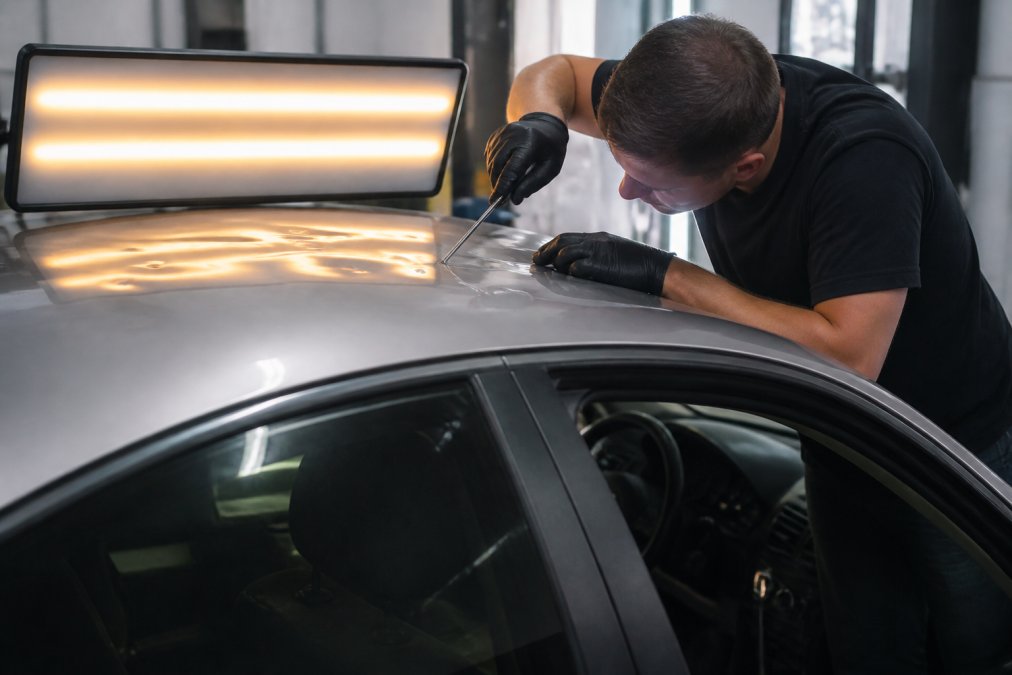
Paintless dent repair (PDR) is a non-invasive technique for removing minor dents and dings from vehicle body panels without disturbing the factory paint, clear coat, or any surface coating. Technicians use precision metal tools to apply controlled pressure from behind the panel, gradually massaging the metal back to its original shape.
At the luxury vehicle level, this requires a level of patience and precision that separates skilled specialists from general practitioners. Each dent is unique, depth, diameter, and location all affect the approach.
The process for a typical hail damage repair on a luxury vehicle follows this sequence:
- Initial assessment: The technician examines every panel under specialized lighting to map all dents, including ones invisible in normal light.
- Access point identification: Tools are inserted through existing openings, behind trim pieces, or through small access holes to reach the back of the panel.
- Progressive pressure application: The technician works the metal in small increments, checking the surface reflection constantly.
- Final leveling: Any remaining high spots are carefully lowered using a tapping technique on the paint surface.
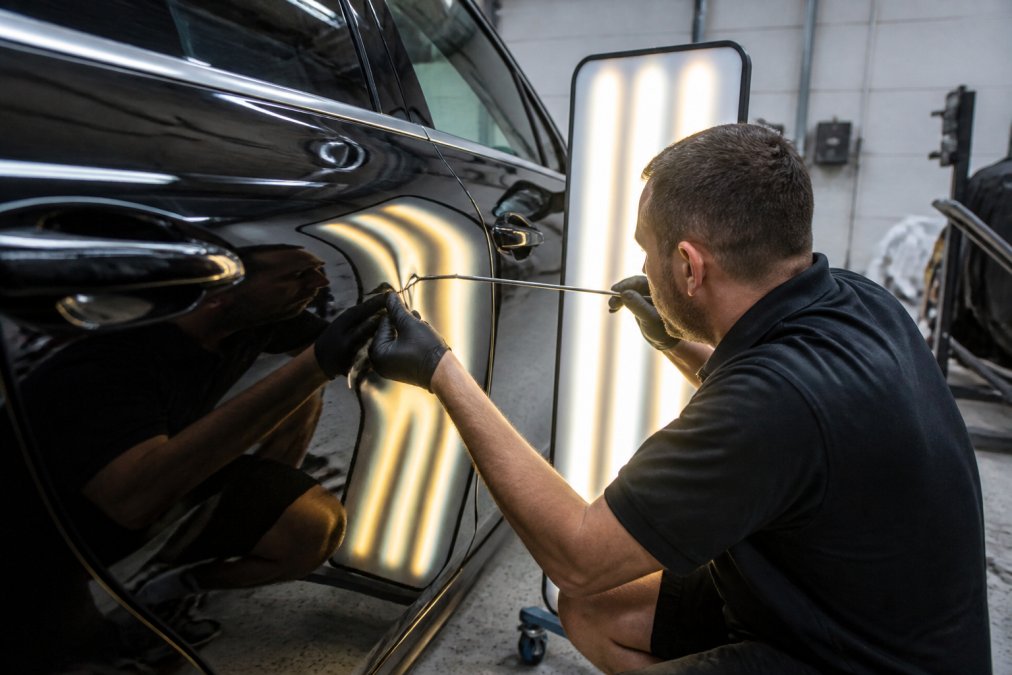
- Surface inspection: The repaired area is checked under LED lighting from multiple angles to confirm the panel is fully restored.
The Role of Specialized Lighting and Precision Tools
The most important tool in PDR is the LED reflection board. Dents that are completely invisible under standard shop lighting become clearly defined under a flat LED board positioned to reflect across the panel surface. Without this lighting, a technician is essentially working blind.
Precision PDR tools themselves are highly specialized. Different rod lengths and tip profiles are required for different panel geometries. On luxury vehicles with complex body lines and tight tolerances, experienced technicians maintain extensive custom tool collections built up over years of specialty work.
This is the artistry component that distinguishes PDR from a purely mechanical process. The technician reads the reflection, adjusts pressure, reads again, and repeats until the panel is indistinguishable from factory condition.
Preserving Factory Paint, Clear Coat, and Ceramic Coatings
The factory paint and finish on a luxury vehicle is a multi-layer system: primer, base coat, clear coat, and often a ceramic coating or paint protection film. PDR leaves every layer intact, unlike conventional body shop repairs that sand through these layers, apply filler, respray, and re-clear.
For vehicles with ceramic coatings, experienced luxury PDR technicians work within the coating's flex tolerance and avoid techniques that would stress the surface. In most cases, a professionally completed PDR repair causes no damage to an existing ceramic coating.
The Hail Damage Insurance Claim Process Explained
Filing an insurance claim for hail damage on a luxury vehicle is where many owners run into trouble. After a hail event, you file a comprehensive claim with your insurer. An adjuster inspects the vehicle and produces a damage estimate. The insurer issues payment based on that estimate, minus your deductible. You then take the vehicle to a repair facility.
The supplementation step is where inexperienced shops leave money on the table. Hail damage on a luxury vehicle often involves dozens or hundreds of individual impacts across multiple panels. Adjusters working quickly in the field routinely miss impacts in complex areas. A specialist who knows how to document and negotiate a supplement can recover substantially more from the insurer.
According to the Insurance Information Institute's guidance on auto claims, policyholders have the right to choose their own repair facility and to dispute an insurer's initial estimate. That right is worth exercising on a high-value vehicle.
Deductible Assistance and What to Expect
Some repair facilities offer arrangements that effectively reduce the out-of-pocket cost to the vehicle owner, but these arrangements vary in legality and structure depending on the state. Ask directly and verify that any arrangement complies with your state's insurance laws.
What you should always expect from a reputable hail damage repair specialist:
- A complete, itemized damage assessment before any work begins
- Direct communication with your insurer on your behalf
- Full documentation of all damage, including supplemental items
- A written repair authorization before work starts
- Clear explanation of what your policy covers and what it does not
888 PDR manages the insurance claim process from start to finish, handling documentation, adjuster communication, and supplement negotiation so owners do not have to navigate that process alone.
Average Cost of PDR for Luxury Vehicles
Pricing for PDR on luxury vehicles depends on several variables: the number of dents, the panels affected, the severity of each impact, the vehicle's body panel material, and the complexity of access. Because 888 PDR does not publish fixed pricing, the only accurate way to get a number is through a direct assessment.
For insurance-covered repairs, the out-of-pocket cost to the vehicle owner is often limited to the deductible, with the insurer covering the remainder based on the negotiated repair estimate.
:::warning Be cautious of any PDR provider quoting a flat price for hail damage without physically inspecting the vehicle first. Accurate pricing requires a hands-on assessment under proper lighting. A quote given from photos alone is almost always incomplete.
Get a free quote from 888 PDR by bringing your vehicle in for a no-obligation assessment.
Mobile vs. In-Shop Hail Damage Repair for Luxury Cars
Mobile PDR and in-shop repair each have a legitimate place, but for luxury vehicles with significant hail damage, the choice matters.
| Factor | Mobile PDR | In-Shop PDR |
|---|---|---|
| Best for | Minor dings, single panels | Extensive hail damage, multiple panels |
| Lighting control | Limited by environment | Controlled LED setup |
| Tool access | Portable kit only | Full specialty tool inventory |
| Weather dependency | High | None |
| Convenience | High | Requires vehicle drop-off or pickup |
| Quality ceiling | Good for simple repairs | Higher for complex repairs |
Mobile repair is useful for isolated dents and minor parking lot damage. For luxury vehicles with hail damage across multiple panels, in-shop repair is the better choice. The controlled environment, full lighting setup, and complete tool inventory allow the technician to address every impact without compromise. 888 PDR offers vehicle pickup and delivery, which removes the main inconvenience of in-shop repair for busy owners.
Post-Repair Inspection Checklist for Luxury Vehicles
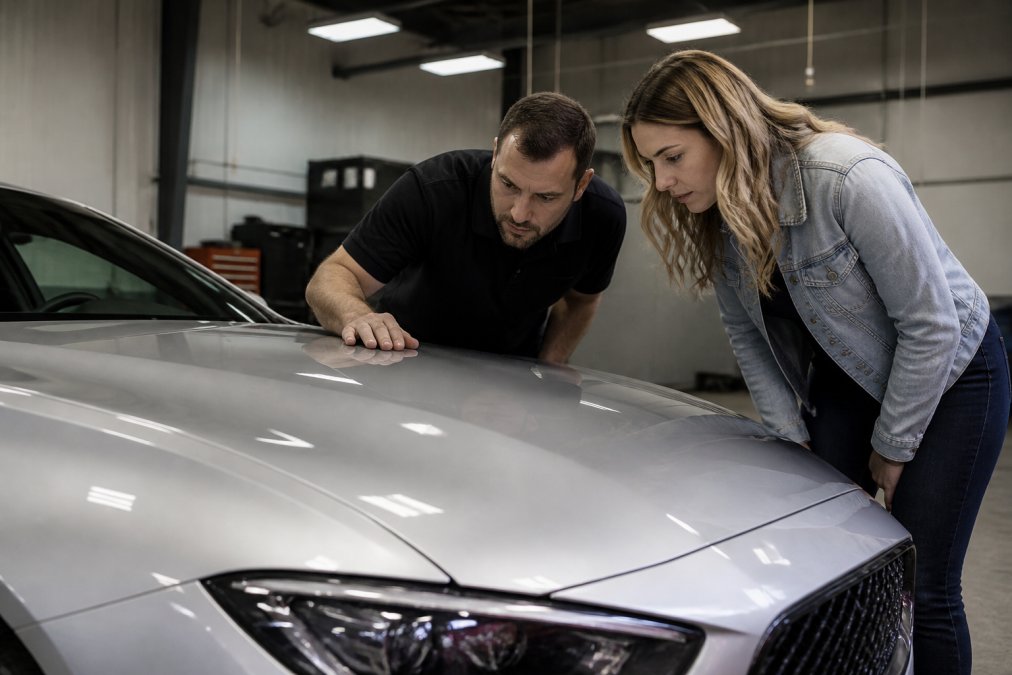
Most owners accept their vehicle back from a repair facility without a systematic inspection. A thorough post-repair check takes fifteen minutes and protects you from discovering problems weeks later.
Work through this checklist before you accept your vehicle:
- Inspect every repaired panel under direct sunlight or a portable LED light at a low angle
- Check panel edges and body lines for any distortion or waviness
- Run your hand across repaired surfaces to feel for any remaining high or low spots
- Verify that trim pieces, moldings, and clips removed for access have been fully reinstalled
- Check that door seals and weather stripping are properly seated
- Confirm that paint thickness readings on repaired panels are consistent with factory spec
- Review the repair documentation and confirm it matches the work completed
- Ask for written confirmation of the warranty terms and what they cover
According to the National Institute for Automotive Service Excellence's consumer resources, vehicle owners should always request a written warranty on any repair and review it before accepting the vehicle. 888 PDR backs every repair with a lifetime warranty, so any issue identified during this inspection, or years from now, is covered.
Does PDR Affect Your Luxury Car's Warranty?
PDR is a non-invasive process that does not alter the vehicle's mechanical systems, structural components, or factory-applied coatings in a way that would void a manufacturer warranty.
The Magnuson-Moss Warranty Act governs manufacturer warranties in the United States and establishes that manufacturers cannot void a warranty simply because a vehicle owner chose an independent repair facility for cosmetic work. The repair must cause actual damage to a covered component for a warranty claim to be denied on those grounds.
PDR, by definition, does not introduce fillers, solvents, or structural alterations. It moves metal that was already part of the vehicle back to its original position. There is no logical basis for a manufacturer to void a mechanical warranty because a dent was removed from a door panel.
The one area worth confirming with your dealer is any dealer-applied ceramic coating or paint protection film warranty. Some coating warranties specify approved service providers for any work on the coated surface. Check your coating documentation before your PDR appointment and notify your technician if any coating warranty terms apply.
Frequently Asked Questions
Is it worth repairing hail damage on a luxury car?
Yes, especially when paintless dent repair is an option. Unrepaired hail damage shows up on vehicle history reports and vehicle appraisals, reducing resale value significantly on high-end models. PDR restores panel integrity without repainting, keeping the factory finish intact. For luxury vehicles where resale value and automotive aesthetics matter most, repairing hail damage is almost always the financially sound decision, and most repairs are covered by comprehensive auto insurance.
Does paintless dent repair affect the factory finish of a luxury car?
No. Paintless dent repair is a non-invasive technique that works entirely from behind the panel, never touching the clear coat or factory paint. Unlike traditional collision repair methods that use fillers and repainting, PDR leaves the original finish completely undisturbed. For luxury cars with ceramic coatings or paint protection film, a certified PDR technician will account for those layers during the repair process to avoid any surface disruption.
How does the hail damage insurance claim process work?
After a hail storm, you file a claim with your insurer under your comprehensive coverage. An adjuster inspects the vehicle and issues an estimate. A reputable PDR shop can manage this entire process on your behalf, communicating directly with your insurer, reviewing the adjuster's estimate for accuracy, and supplementing the claim if additional damage is found during repair. You typically pay only your deductible, though some shops offer deductible assistance programs. Always confirm coverage details with your insurer before repair begins.
How long does hail damage repair take for a luxury vehicle?
Repair time depends on the number of dents, the size of the affected panels, and whether the vehicle has aluminum or steel body panels. Minor hail damage on a single panel can be completed in a day. Extensive hail storm damage covering the roof, hood, and trunk may take several days. Shops that offer vehicle pickup, delivery, and rental vehicle assistance can make the wait far less disruptive, particularly for professionals who rely on their car daily.
Hail damage on a luxury vehicle is not a problem you want to hand to a general body shop. The factory finish, the aluminum panels, the resale value, and the warranty implications all require a specialist who understands exactly what is at stake. 888 PDR brings family-owned accountability, full insurance claim management, and a lifetime warranty to every repair, so you are not navigating any of this alone. Reach out today and get a free quote from a team that treats your vehicle the way you do.
This article was written using GrandRanker