
Table of Contents
- What Affects the Cost of Paintless Dent Removal
- How Long Does Paintless Dent Repair Take
- PDR vs Traditional Body Shop Repair: Cost and Quality Comparison
- Is Hail Damage Covered by Insurance
- Small vs Large Dents: Pricing Breakdown
- Is Paintless Dent Removal Worth the Investment
- Frequently Asked Questions
Last Updated: September 18, 2026
What Affects the Cost of Paintless Dent Removal
The cost for paintless dent removal depends on dent size, vehicle material, panel location, and technician expertise. Understanding these factors helps you anticipate costs and make informed decisions.
Dent Size, Depth, and Shape Classification
Technicians classify dents into two broad categories that directly affect labor time and cost: soft dents and sharp dents.
Soft dents are shallow, rounded depressions under one inch across (shopping cart dings, minor door bumps). They take 30 minutes to one hour to repair and represent the lowest-cost scenario.
Sharp dents feature defined creases from direct impact (baseballs, rocks, corner edges). They require multiple approaches and careful metal manipulation, taking two to four hours to resolve.
Larger dents require more tool access points and broader metal manipulation, increasing cost. Sharp dents demand precision work to avoid paint cracking.
Hail damage creates dozens of small soft dents across large areas. Addressing thirty to fifty dents extends total repair time to four to eight hours, reflected in insurance claims.
Vehicle Type, Panel Material, and Paint Composition
Modern vehicles use different materials that respond differently to dent removal techniques and affect labor costs significantly.
Steel panels accept pressure well and reshape predictably, representing baseline labor cost.
Aluminum panels require gentler handling to avoid cracking and different tool angles. Labor time runs 20-30% longer than steel dents, directly increasing cost.
High-strength steel in structural areas (door frames, roof rails, pillar sections) complicates removal and often cannot be fully repaired through PDR alone.
Luxury vehicles with multi-layer panels and ceramic-enhanced paint cost more because materials demand slower technique and certified technicians.
Some high-end vehicles use multi-coat or ceramic-infused finishes requiring extra care during PDR, commanding higher labor rates.
Panel Location and Access Complexity
Dent location dramatically affects removal difficulty and cost for paintless dent removal. Flat door panels are far more accessible than areas near windows, trim, or structural edges.
Restricted access requires careful maneuvering around obstacles. Curved sections and areas near trim demand different tool angles and extra care.
Some locations cannot be reached with standard PDR equipment and may require partial panel removal or traditional body shop work.
Technician Skill Level and Equipment Investment
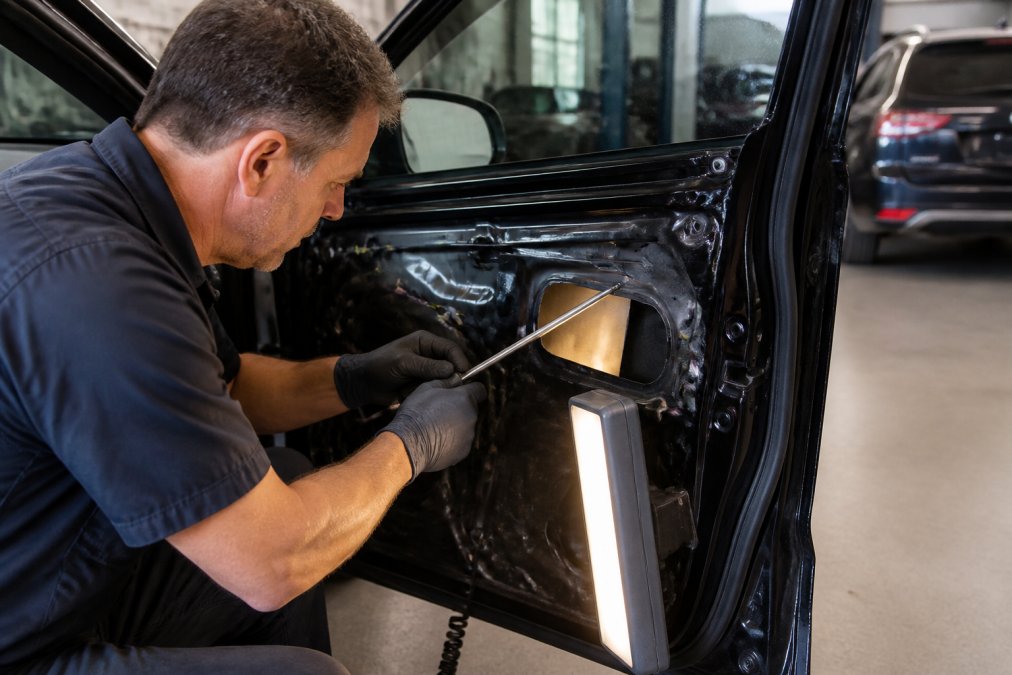
Experienced technicians complete dents faster and own specialized equipment (reflective lights, precision rods, specialized hammers) that accelerates the process.
Professional-grade PDR toolkits cost $2,000 to $5,000. Certified technicians with extensive track records command higher hourly rates but deliver faster turnaround and superior outcomes.
How Long Does Paintless Dent Repair Take
Paintless dent repair timelines vary widely based on dent complexity, quantity, and vehicle access. Understanding what drives duration helps you plan your schedule and set realistic expectations.
Single Dent Repair Timeline
A single small, soft dent (shopping cart ding, minor door bump) takes 30 minutes to one hour from arrival to completion.
A single medium dent (two to four inches across) takes one to two hours.
A single large or sharp dent (four inches or larger) takes two to four hours and demands patience to avoid visible lines or shadows.
Multiple Dent and Hail Damage Timeline
A vehicle with 10-15 hail dents requires three to five hours; 30-50 dents require six to ten hours, often extending into a second business day.
Timeline is not linear; technicians develop efficiency through repetition. Sharp creases mixed with soft dents extend the timeline.
Factors That Extend Repair Time
Material type affects speed significantly. Aluminum dents add 20-30% to the timeline due to cracking risk.
Panel access creates delays. Poor access can double repair time.
Paint condition matters. Existing stress cracks or thin spots add time and may make the dent unrepairable through PDR.
Dent shape complexity extends timelines. Dents with multiple creases require addressing each component separately.
Technician experience affects speed, but reputable shops prioritize correct repair over fast turnaround.
Same-Day vs. Multi-Day Repair
Most single dents and small hail damage (under 15 dents) complete within one business day. The customer drops off the vehicle in the morning and picks it up by evening.
Moderate hail damage (15-30 dents) may require a full business day or extend into a second day depending on dent severity and vehicle access. Shops typically communicate this timeline during the initial inspection.
Severe hail damage (30+ dents) or damage involving sharp creases often requires two to three business days. The technician cannot rush the work without risking incomplete repairs or paint damage. Quality shops schedule hail damage repairs in sequence, managing multiple vehicles through the repair process. When the underlying metal has been stretched or the finish compromised beyond the scope of these specialized techniques, owners must instead navigate the complexities of auto body paint jobs to restore the vehicle's original appearance.
Timeline Considerations for Your Schedule
If you need your vehicle back urgently, communicate this during the inspection. Technicians can sometimes prioritize your repair, but this may mean scheduling around other customers' work. Some shops offer evening or weekend appointments for customers with tight schedules.
Pickup and delivery service eliminates the need to wait at the shop. You can drop off your vehicle and return to your daily routine. The shop handles the repair and delivers the vehicle back to you, saving you time even if the repair itself takes several hours.
PDR vs Traditional Body Shop Repair: Cost and Quality Comparison
Paintless dent removal and conventional body shop repair represent two fundamentally different approaches with distinct cost and quality implications.
PDR removes dents without sanding, filling, or repainting. Traditional body shops sand, fill, prime, paint, and blend, taking days and costing significantly more.
Why PDR Preserves Resale Value
Factory paint has specific thickness and composition. Repainting introduces variables in batch, spray technique, and environmental conditions that affect color match and durability.
Buyers and appraisers use electronic gauges to measure paint thickness. Repainted sections show higher readings, signaling previous damage and reducing resale value.
PDR preserves factory paint integrity, retaining resale value and appealing to buyers seeking proof of careful ownership.
When Traditional Repair Is Necessary
Large creases, dents with paint cracks or chips, and structural damage require traditional body shop work.
Paint cracks require separate addressing. Severe structural damage and frame repairs demand full-service body shop resources.
Is Hail Damage Covered by Insurance
Most comprehensive auto insurance policies cover hail damage, protecting against weather events and falling objects.
Collision coverage does not cover hail damage; hail falls under comprehensive coverage.
How Deductibles Work with Hail Claims
Your deductible is the amount you pay out of pocket before insurance covers the rest. Common deductibles are $500 or $1,000.
File a claim with your insurance company. The insurer approves a repair estimate. You pay your deductible to the repair shop; insurance pays the balance.
888 PDR manages the entire insurance claim process.
What Your Insurance Covers
Comprehensive coverage pays for hail damage repair. The insurance adjuster estimates repair costs, which becomes the basis for claim approval.
Insurance covers the cost for paintless dent removal when PDR is appropriate, or traditional body shop work if needed.
Your deductible applies per claim, not per dent. Fifty dents on one claim equals one deductible.
Small vs Large Dents: Pricing Breakdown
Small dents (under one inch, shallow depth) represent the simplest repair scenario and require basic PDR technique.
Large dents spanning multiple inches demand extended technician time. The cost for paintless dent removal increases proportionally with dent size and complexity.
Hail damage creates numerous dents across large areas. Total cost reflects cumulative time to address each dent individually.
Dent size and cost depend on location, material, and technician assessment. 888 PDR provides free inspections with accurate pricing before work begins.
Is Paintless Dent Removal Worth the Investment
The cost for paintless dent removal is substantially lower than traditional body shop repair, which involves sanding, filling, priming, painting, and blending.
Factory paint intact commands higher resale prices and attracts more serious buyers. Value retention often exceeds repair cost.
PDR offers speed and convenience, your vehicle returns within hours or a day. 888 PDR's pickup and delivery service saves travel time. Lifetime warranty covers any repair issues at no additional cost.
For minor dents and hail damage, PDR is the obvious choice. Most hail dents respond well to paintless removal; the few that cannot are handled through traditional methods.
Frequently Asked Questions
What dents cannot be removed by paintless dent repair?
PDR works best on shallow dents without creases or paint damage. Dents with sharp creases, paint cracks, or dents on edges where panel access is impossible cannot be repaired using paintless dent removal. Severely damaged areas requiring filler or panel replacement also fall outside PDR capability. A technician can assess whether your specific dent is repairable during a free inspection.
Is paintless dent repair covered by car insurance?
Most comprehensive auto insurance policies cover hail damage and door dings through comprehensive coverage. However, your deductible applies, you'll typically pay that amount out of pocket. Contact your insurance agent to confirm your specific coverage and whether paintless dent repair qualifies.
How does PDR pricing compare to traditional body shop repairs?
Paintless dent repair is generally more affordable than conventional repair because it eliminates labor-intensive sanding, body filler application, and paint matching. Traditional body shop repairs require multiple steps and materials, increasing costs. PDR also preserves your vehicle's factory finish and resale value. For hail damage with multiple dents, the cost difference becomes more significant, making PDR the economical choice for most vehicle owners.
Why does paintless dent removal cost vary so much?
Cost depends on dent size, depth, location on the vehicle, panel material (aluminum vs steel), and technician access. Multiple dents from hail damage increase total cost. Vehicle-specific factors matter too, luxury vehicles or those with complex panel designs may cost more. Labor rates also vary by location and technician experience. Getting a free estimate from a professional shop gives you an accurate quote based on your specific damage.
Hail damage and parking lot dents are stressful, but they don't have to derail your day. 888 PDR removes dents without fillers or repainting, preserving your factory finish and resale value. We handle insurance claims from start to finish, manage vehicle pickup and delivery, and back every repair with a lifetime warranty. Get a free quote today and see how paintless dent removal can restore your vehicle while protecting what matters most.