
Table of Contents
- What Is On-Site Dent Removal and Why It Matters
- Step 1: Damage Assessment and Inspection
- Step 2: Gaining Access to the Damaged Panel
- PDR Tools and Techniques Used in Dent Removal
- Step 3: Massaging and Reshaping the Metal
- Step 4: Refining and Finishing the Repair
- How Long Does Paintless Dent Repair Take
- Types of Dents Suitable for PDR
- Frequently Asked Questions
Last Updated: September 23, 2026
What Is On-Site Dent Removal and Why It Matters
On-site dent removal, also known as paintless dent repair (PDR), is a non-invasive technique that removes dents and dings from vehicle panels without using fillers, sanding, or repainting. The process preserves your car's original factory finish and resale value, which matters significantly if you plan to sell or trade in your vehicle down the road.
Unlike traditional bodywork that requires sanding, primer, paint, and weeks of downtime, on-site dent removal works by carefully massaging and reshaping the metal from behind the panel. A technician gains access to the back of the damaged area, applies pressure at specific points, and uses specialized tools to coax the metal back into its original shape. The entire process happens on your property or at a repair facility, often in just a few hours.
At 888 PDR, we remove hail damage, door dings, and creases for customers across the region. The reason this matters is simple: your vehicle's factory finish is irreplaceable. Once it's repainted, that original coating is gone forever. Paintless dent repair keeps your car looking and feeling original, which buyers and appraisers notice.
Step 1: Damage Assessment and Inspection
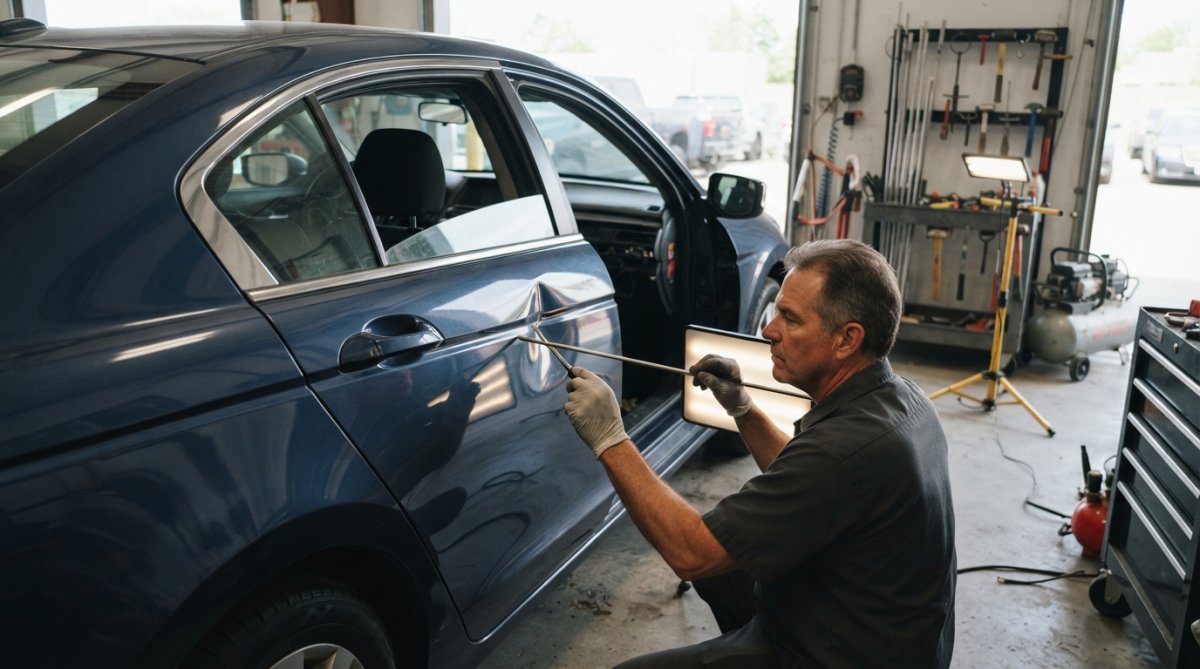
The first step in any dent removal process is a thorough inspection. The technician examines the damaged panel under specialized lighting to understand the dent's depth, size, location, and shape. This assessment determines whether the damage is a candidate for paintless dent repair or requires traditional bodywork.
During inspection, the technician looks for:
- Dent size and depth, smaller, shallower dents are ideal for PDR
- Paint integrity, any cracks, creases, or paint separation disqualifies the panel
- Location on the panel, dents near edges or body lines are harder to access
- Metal type, aluminum panels behave differently than steel and may require adjusted techniques
- Structural damage, bent frames or crumpled metal cannot be repaired with PDR alone
The technician will also ask about the damage history. How did the dent happen? Was it a hail strike, a door ding, or a shopping cart hit? Understanding the impact helps predict how the metal will respond to reshaping.
The National Institute for Automotive Service Excellence provides certification standards for auto technicians, and PDR specialists often pursue advanced training to handle complex damage patterns.
Step 2: Gaining Access to the Damaged Panel
Once the technician confirms the damage is suitable for PDR, the next step is gaining access to the back of the panel. This is where the work becomes technical. Most vehicle panels have interior trim, insulation, wiring, or structural components blocking direct access to the back surface.
The technician carefully removes interior trim pieces to expose the panel's rear side. For door dings, this means removing door cards and any padding. For roof or hood damage, it may require removing headliners or insulation. The goal is to create a clear work path without damaging anything else on the vehicle.
Common access points include:
- Door cards, removable interior panels that come off with clips or fasteners
- Roof liners, headliners that can be folded back or partially removed
- Trunk liners, carpet or plastic panels that pull away from the structure
- Fender wells, accessible from inside the wheel area for side panel work
This step requires patience and mechanical knowledge. A technician who rushes risks breaking clips, cracking trim, or damaging wiring. Most shops take 15-30 minutes just to gain proper access, depending on the vehicle's design.
PDR Tools and Techniques Used in Dent Removal
Paintless dent repair relies on a specialized toolkit that's very different from traditional auto body equipment. These tools allow the technician to apply precise pressure and use without damaging the paint or the underlying metal structure.
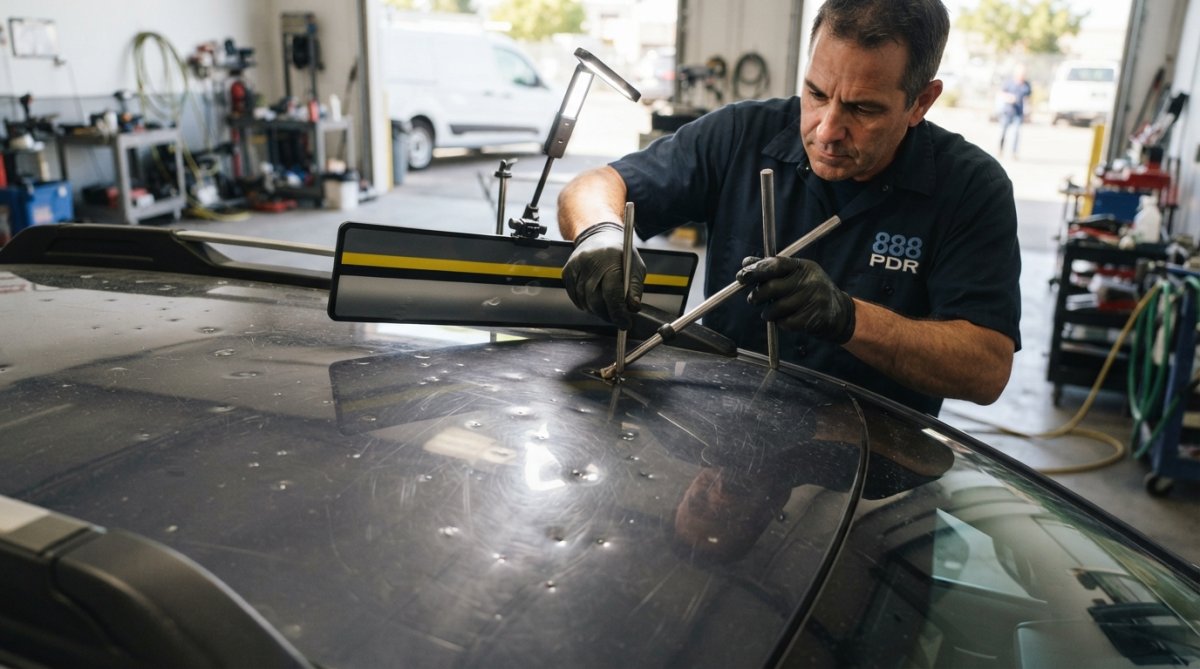
Core PDR tools include:
- Rod tools, long metal rods with various tip shapes that fit behind the panel and apply pressure to specific points
- Reflection boards, large, smooth reflective surfaces that help the technician see the panel's contours and track progress in real time
- Specialized lighting, LED lights that highlight high spots and low spots on the metal surface
- Slide hammers, tools that pull dents outward using use and controlled force
- Glue pulling systems, adhesive tabs that stick to the panel and allow pulling from the front when rear access isn't possible
The technique itself is called metal massage or pressure point therapy.
Step 3: Massaging and Reshaping the Metal
With access gained and tools ready, the actual reshaping begins. This is where the skill separates experienced technicians from amateurs. The goal is to apply pressure at the right points with the right amount of force to gradually return the panel to its original contour.
Key principles during reshaping:
- Work from the edges inward
- Apply steady, controlled pressure (not sudden force)
- Check progress frequently with the reflection board
- Adjust technique based on how the metal responds
- Avoid over-correcting, which creates new high spots
Step 4: Refining and Finishing the Repair
Once the major reshaping is complete, the technician shifts to fine-tuning. This step removes any remaining imperfections and ensures the panel matches the surrounding body lines perfectly.
The finishing phase also includes:
- Checking body line alignment, ensuring the repaired panel flows smoothly with adjacent panels
- Verifying paint integrity, running hands over the surface to confirm no paint damage occurred
- Testing panel fit, opening and closing doors or checking hood/trunk alignment if those panels were repaired
- Final reflection board check, one last visual inspection under specialized lighting
How Long Does Paintless Dent Repair Take
The timeline for on-site dent removal depends on the damage extent, panel accessibility, and the number of dents. A single small door ding might take 1-2 hours total, including access and reassembly. Extensive hail damage across multiple panels can take a full day or more.
Typical timelines by damage type:
- Single small ding, 1-2 hours
- Multiple door dings, 2-4 hours
- Hail damage on roof or hood, 4-8 hours
- Extensive hail damage (multiple panels), 8+ hours or multiple days
Most dent removal jobs finish within a single business day. Complex hail damage may require a second day, but even then, the turnaround is far faster than traditional bodywork.
Types of Dents Suitable for PDR
Not every dent is a candidate for paintless dent repair. Understanding which damage types work with PDR and which require traditional repair helps you set realistic expectations.
Dents that work well with PDR:
- Door dings, small, shallow impacts from other car doors
- Hail damage, small round dents across multiple panels (ideal for PDR)
- Shopping cart hits, minor creases and dents on bumpers and lower panels
- Crease dents, linear creases along body lines (if paint is intact)
- Shallow dents, damage with no paint cracking or separation
Dents that do NOT work with PDR:
- Cracked or peeling paint, any paint damage disqualifies the panel
- Bent or twisted metal, severe damage that has permanently altered the panel's structure
- Dents on edges or corners, areas where rear access is impossible
- Large creases, deep, sharp creases that have stressed the metal beyond recovery
- Damage near welds, areas where the panel is welded to the frame are difficult to reshape
| Damage Type | PDR Suitable | Reason |
|---|---|---|
| Door ding | Yes | Shallow, paint intact, accessible |
| Hail strike | Yes | Small dent, paint usually intact, multiple panels |
| Shopping cart hit | Yes | Minor crease, lower panel, accessible |
| Cracked paint | No | Paint failure during reshaping |
| Deep crease | No | Metal permanently stressed, difficult access |
| Bent frame | No | Structural damage, requires frame work |
| Rust or corrosion | No | Metal integrity compromised |
Frequently Asked Questions
What are the main steps involved in the on-site dent removal process?
On-site dent removal follows a structured process: first, a technician inspects the damage to assess severity and location. Next, they gain access to the panel by removing trim or door cards. Then, using specialized PDR tools like rods and leverage techniques, they massage the metal from behind the dent, working from the outer edges inward. Finally, they refine the surface using reflection boards and specialized lighting to ensure the repair matches the surrounding body lines perfectly. The entire process preserves your factory finish without filler or repainting.
How long does paintless dent repair typically take?
Repair time depends on damage severity and location. Minor door dings or single hail dents may take 30 minutes to 2 hours. Moderate hail damage affecting multiple panels typically requires 4-8 hours, sometimes spread across multiple days. Extensive hail damage may take several days.
What types of dents are suitable for PDR?
PDR works best on small to medium dents without paint damage, creases, and hail damage on body panels. Door dings, crease dents, and hail-damaged roofs and doors are ideal candidates. Dents near edges, sharp creases with paint breaks, or damage on plastic trim are typically not suitable. A professional assessment determines feasibility, some dents that appear severe may still be repairable, while others require traditional bodywork.
Will paintless dent repair preserve my vehicle's factory finish and resale value?
Yes. PDR removes dents without filler, primer, or repainting, keeping your original factory finish intact. This preservation is a major advantage for resale value because buyers prefer vehicles with untouched original paint. When you sell, there's no repair history to disclose, and the vehicle maintains its manufacturer's paint integrity. Insurance companies and dealerships recognize PDR as non-invasive, making it preferred for fleet vehicles and luxury cars where maintaining original specifications is critical.