
Table of Contents
- PDR vs Traditional Body Shop: Which Method Saves Money
- Paintless Dent Repair Cost 2026: What to Budget
- Professional Mobile Dent Repair Services
- DIY Car Dent Removal Risks and Reality Check
- Insurance Coverage and Deductible Strategy
- How to Assess Your Dent and Pick the Right Solution
- Conclusion: Balancing Cost, Quality, and Vehicle Value
- Frequently Asked Questions
Last Updated: September 25, 2026
PDR vs Traditional Body Shop: Which Method Saves Money
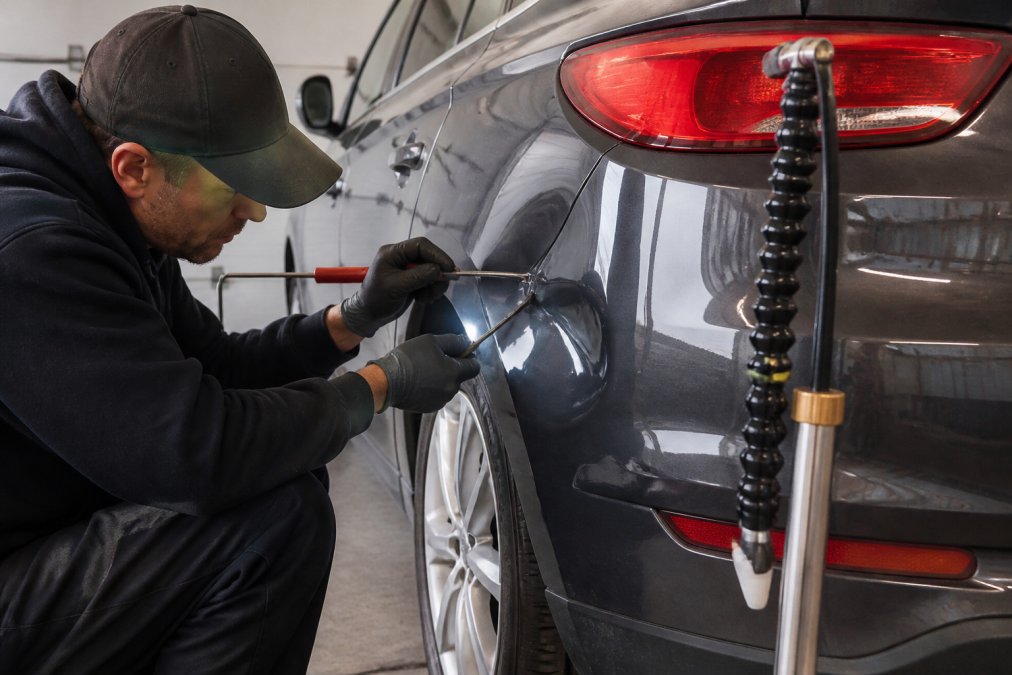
Paintless dent repair (PDR) and traditional body shop methods differ fundamentally: PDR manipulates metal back to shape without touching paint, while traditional shops sand, fill, and repaint. For owners concerned about preserving factory finish and avoiding unnecessary expenses, understanding alternatives to expensive auto body shop dent repair is critical.
Traditional body work involves sanding, filling, priming, and repainting, each step adding labor and material costs. PDR uses specialized tools to access dents from behind the panel and push metal back into place, preserving the factory finish entirely, which matters for resale value and long-term durability.
A door ding taking a PDR technician 30 minutes might require a traditional shop a full day of sanding, filling, and repainting. Traditional body work also risks paint matching issues that can affect future repairs or resale value.
888 PDR offers a lifetime warranty on paintless dent repair work, protecting your investment long-term.
Paintless Dent Repair Cost 2026: What to Budget
Paintless dent repair pricing varies by dent size, depth, location, creasing, and complexity. Minor door dings cost less than hail damage across multiple panels; deep creases require more expertise than shallow dings.
Smaller, shallower dents cost less than larger, deeper ones. Many PDR providers, including 888 PDR, offer free inspections so you understand costs before committing.
Insurance policies often cover PDR services for hail or collision damage, sometimes with little or no out-of-pocket expense depending on your deductible.
Professional Mobile Dent Repair Services
Mobile dent repair brings work to your location, eliminating drop-off and transportation hassles. A technician assesses and completes repairs on-site while you continue your day.
DIY Car Dent Removal Risks and Reality Check
DIY dent removal kits range from suction-cup pullers to bridge pullers and slide hammers. They appeal to budget-conscious owners, but involve significant risks. Understanding which dents are safe for DIY versus which will cause permanent damage is key to responsible decisions.
When DIY Dent Removal Is Reasonably Safe
Shallow, round dings on flat, accessible panels like doors or fenders respond better to DIY tools. DIY kits carry manageable risk only if your dent meets all these criteria:
- Dent depth under 1 inch: Shallow depressions are easier for amateur tools to manipulate without over-pulling.
- Round or smooth shape: Dings without sharp creases or stress lines are more forgiving. Run your hand over the area; if it feels like a smooth bowl rather than a sharp valley, it's a better candidate.
- Paint is completely intact: No cracks, chips, or paint loss visible around or within the damaged area. If paint is broken, stop, DIY work will worsen the problem.
- Location on flat panel: Doors, fenders, and flat hood sections are accessible from behind. Avoid curved surfaces like the roof, bumper covers, or quarter panels where access is limited.
- Single isolated dent: Multiple dents across different panels suggest hail damage or collision complexity that requires professional assessment.
- Non-critical visibility: The dent is on a panel you rarely see while driving or from a distance. Imperfect results are acceptable to you.
When DIY Dent Removal Will Likely Cause Damage
Certain damage characteristics make DIY repair dangerous and likely to create secondary problems worse than the original dent:
- Creased or sharp dents: If the dent has a visible crease line or sharp valley, the metal has been stressed and creased. Pulling creases requires precise angle control and knowledge of metal memory that amateurs lack. Incorrect pulling creates a high spot (bulge) adjacent to the dent, requiring professional re-work.
- Deep dents (over 1 inch): Deeper dents require more force to manipulate. Excessive force causes over-pulling, creating a bulge or high spot that is harder to fix than the original dent.
- Paint damage or rust: If paint is already cracked or chipped, DIY pulling will expand the damaged area. If rust has begun, the metal structure is compromised and pulling may cause further tearing.
- Dents on curved surfaces: Hoods, roofs, bumper covers, and quarter panels have complex curves. Access from behind is limited or impossible, and pulling angles are difficult to control. Incorrect angles cause uneven metal stress and permanent deformation.
- Dents near panel edges or corners: Edges and corners have less metal depth and structural support. Pulling near these areas risks creating a crease or permanent high spot.
- Multiple dents or hail damage: Widespread damage indicates metal stress across the panel. Attempting to pull multiple dents without professional assessment of metal memory and stress patterns often results in new creases or bulges.
- Dents on vehicles with aluminum or composite panels: Newer vehicles increasingly use aluminum hoods and doors, and composite (plastic) fenders. These materials respond differently to pulling than steel. Aluminum can crack under pulling force; composite can break or permanently deform. Unless you know your vehicle's material composition and the tool is rated for it, avoid DIY attempts.
The Hidden Cost of Over-Pulling
The most common DIY failure is over-pulling, applying too much force and creating a bulge. Amateurs cannot feel when to stop, and over-pulled panels cost more to fix professionally than the original repair would have.
The Decision Framework
Before attempting DIY repair, ask: "If this goes wrong, am I willing to pay a professional to fix both the original dent and damage I cause?" If no, explore alternatives to expensive auto body shop dent repair like professional PDR services. If yes and your dent meets all six criteria, proceed cautiously with a suction-cup puller.
Insurance Coverage and Deductible Strategy
Your insurance coverage and deductible structure directly impact out-of-pocket repair costs. Most comprehensive and collision policies cover hail and collision dents, but the deductible significantly affects your financial responsibility.
How to Assess Your Dent and Pick the Right Solution
Assess your dent's size, depth, location, shape, and paint condition before scheduling professional inspection. Self-assessment helps you communicate clearly with technicians and determine if damage suits PDR or requires traditional body work.
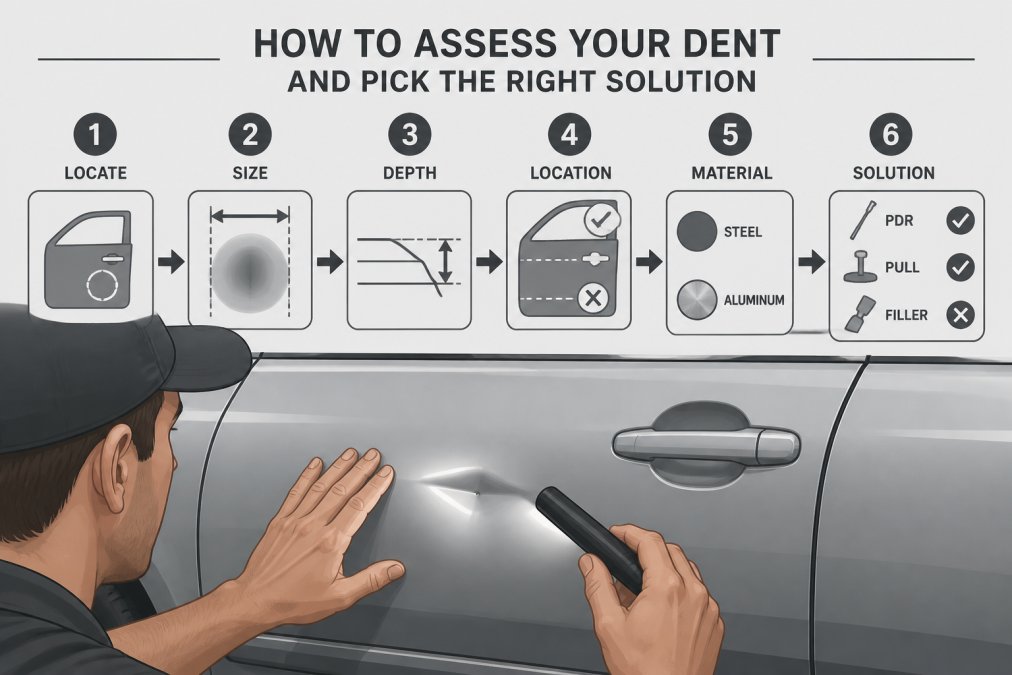
Visual and Tactile Inspection: The Dent Shape Test
Inspect in natural daylight to avoid shadow distortion. Photograph the damaged area from multiple angles, then run your hand over it to feel the dent's shape and edges.
Size and Depth Assessment
Estimate dimensions: Width (under 2" = minor, 2-6" = moderate, over 6" = large); Depth (shallow = barely noticeable, moderate = obvious but not distorted, deep = noticeably deformed, over 1" = complex repair); Surface area (single area or multiple inches = widespread hail/impacts).
Location and Accessibility
Flat panels (doors, fenders, trunk lids) are ideal for PDR, faster and less expensive. Curved surfaces (roof, bumper covers, quarter panels) present challenges with limited access and control, increasing cost. Panel edges and corners are most difficult with less metal support; pulling risks creases. Proximity to other damage complicates repairs.
Paint Integrity Check
Intact paint: PDR is viable if paint is completely unbroken. Paint cracks or chips: PDR cannot be used; traditional body work is required. Stress marks: Indicate creased metal; even with intact paint, creased dents are harder to repair via PDR.
Damage Pattern Recognition
Single isolated dent: Localized impact; typically straightforward via PDR if shallow and round. Multiple dents on one panel: Assess if similar (hail) or varied (collision debris). Dents across multiple panels: Indicates hail damage, classic PDR application with insurance coverage. Dents with paint loss or creasing: Suggests severe impact requiring traditional body work.
The Assessment Checklist
Before contacting a repair shop, complete this checklist:
| Assessment Factor | Your Finding | Implication |
|---|---|---|
| Dent shape | Round/smooth or creased? | Creased = likely traditional repair needed |
| Paint condition | Intact or damaged? | Damaged = traditional repair required |
| Dent depth | Shallow (<0.5"), moderate (0.5-1"), deep (>1") | Deeper = more complex, higher cost |
| Dent width | <2", 2-6", >6" | Larger = higher cost |
| Location | Flat panel, curved, or edge? | Edges/curves = more complex |
| Number of dents | Single or multiple? | Multiple = hail damage pattern |
| Damage pattern | Isolated, clustered, or widespread? | Widespread = hail; isolated = impact |
When to Schedule Professional Assessment
Free professional inspections eliminate guesswork. Technicians assess damage and recommend the most cost-effective solution, PDR, mobile service, or traditional body work, while clarifying insurance coverage and deductible implications.
Conclusion: Balancing Cost, Quality, and Vehicle Value
Choosing between paintless dent repair and traditional body shop work ultimately comes down to protecting your vehicle's value while managing repair costs responsibly. Paintless dent repair preserves your factory finish, costs significantly less than traditional body work, and qualifies as insurance-preferred for many damage types. When your damage suits PDR, shallow to moderate dents without paint compromise, it's the superior choice financially and for long-term vehicle condition.
Frequently Asked Questions
Is paintless dent repair cheaper than a traditional body shop?
Paintless dent repair typically costs less than traditional body shop work because it eliminates labor-intensive sanding, body filler application, and repainting. PDR preserves your factory finish and avoids the overhead of a full collision shop. However, cost depends on dent size, location, and damage severity. For minor door dings and hail damage, PDR is usually the more affordable option. Complex structural damage may require traditional repair methods regardless of cost.
Can DIY dent repair kits actually damage my car's paint?
Yes, DIY kits carry significant risk. Improper use of bridge pullers or slide hammers can create new high spots, crack paint, or damage the underlying metal. Even glue-tab systems require precise technique to avoid paint adhesion problems. The risk increases with deeper dents or creased panels. Unless you have experience, professional assessment is worth the cost to avoid compounding the damage and reducing your vehicle's resale value.
What is the $3,000 rule for car repairs, and how does dent repair fit in?
The $3,000 rule suggests that repairs exceeding this threshold may warrant considering vehicle replacement or totaling the car for insurance purposes. Dent repair alone rarely reaches this cost unless combined with structural or paint damage. Minor hail damage and door dings typically fall well below this threshold, making them good candidates for repair. If your insurer suggests totaling the vehicle, get a second opinion from an independent appraiser.
How does preserving factory finish impact my car's resale value?
Factory finish is a major resale value indicator. Vehicles with original paint command higher prices and sell faster than those with repaints. Paintless dent repair maintains factory finish, protecting your investment. Traditional body shop repairs using fillers and repaints can reduce resale value by 5-15% depending on the repair quality and visibility. If you plan to sell or trade in your vehicle, PDR is a smart choice for minor damage.