Table of Contents
- Why Dent Repair Before Lease Return Matters
- Understanding Excessive Wear and Tear Lease Guidelines
- Paintless Dent Repair Cost vs Lease Penalty: The Real Math
- Top Dent Repair Options for Your Lease Turn-In
- DIY vs. Professional Repair: Know the Threshold
- How to Use a Lease Return Inspection Checklist
- Final Steps for a Smooth Lease Turn-In
- Frequently Asked Questions
Last Updated: September 5, 2026
Why Dent Repair Before Lease Return Matters
A lease return is the one moment where minor damage becomes a direct financial penalty. A small door ding can cost hundreds at the dealership inspection. The best dent repair for lease return removes the damage before that inspection, preserving your security deposit and avoiding penalty fees.
Most lease agreements include an excess wear and tear clause holding you responsible for damage beyond normal use (the FTC). A single dent larger than the stated threshold can trigger charges far exceeding professional repair costs.
Most of this damage is preventable. Paintless dent repair (PDR) removes dings, dents, and creases without fillers or repainting, preserving your vehicle's original factory paint and resale value.
Understanding Excessive Wear and Tear Lease Guidelines
Lease-end damage isn't judged by a universal standard; it's governed by the specific 'excess wear and tear' addendum attached to your contract.
Decoding the 'Excess Wear and Tear' Addendum
Your lease contract's addendum is the single most important document for your turn-in strategy. It typically defines 'normal wear' and 'excessive wear' with specific, measurable criteria. Look for these key sections:
- The Damage Schedule: A table assigning a dollar amount to each damage type (e.g., 'dent over 1.5 inches'). If your damage isn't on the schedule, it's likely normal wear.
- The 'Normal Wear' Exclusion: Defines what is not chargeable, like 'minor paint chips (less than 1/4 inch)' or 'light scuffs on the bumper.' This is your first defense against unfair charges.
- The 'Prior Approval' Clause: Some addendums require written approval from the leasing company before repairs. Failing to do this may void repair acceptance or incur an administrative fee.
The 'Quarter' vs. 'Dollar Bill' vs. 'Inch' Standard
While the 'quarter-sized' dent is common industry shorthand, your contract specifies a precise measurement. Common standards include:
- The 1.5-Inch Rule: The most frequent standard in modern leases. Any single dent with a diameter larger than 1.5 inches (about the size of a golf ball) is considered excessive, regardless of paint damage.
- The 2-Inch Rule: Some contracts, particularly for trucks or SUVs, use a more lenient 2-inch threshold.
- The 'Quarter' Rule: Often a misnomer. A quarter is about 0.955 inches in diameter, making this stricter than the 1.5-inch rule (usmint.gov). However, many contracts use the 'quarter' as a visual reference for paint chips, not dents.
The critical mechanism is the 'crease' clause. Most addendums classify a dent with a sharp crease or paint crack as automatically excessive, regardless of size, because it compromises the panel's structural integrity and cannot be fixed with simple PDR.
How to Read Your Contract for the 'Chargeable' Definition
To avoid a surprise bill, perform this 15-minute audit:
- Locate the Addendum: Usually the last pages of your lease packet, titled 'Excess Wear and Tear Schedule' or 'Vehicle Return Conditions.'
- Find the 'Damage' Definition: Note the exact measurement (e.g., 'greater than 1.5 inches').
- Check the 'Repair Quality' Clause: Repairs must be 'completed to a professional standard' and 'match the original factory finish.' A cheap DIY repair leaving a paint mismatch can still result in a penalty.
- Note the 'Dispute' Process: The addendum outlines how to appeal a damage assessment, usually via third-party arbitration. Knowing this gives you leverage if you disagree with the dealership's walk-around.
Paintless Dent Repair Cost vs Lease Penalty: The Real Math
The decision to repair a dent before a lease return is a pure cost-benefit analysis: if the repair cost is less than the penalty, you repair. But the real numbers are more nuanced, and most guides fail to account for the hidden costs of an insurance claim.
The Itemized Penalty Structure
Lease-end penalties are an itemized list of charges that stack up quickly. A typical assessment for a single dent includes:
- Damage Charge: $150 - $400 per panel, depending on size and location. Door edge dents or creases along body lines are at the higher end.
- Administrative/Processing Fee: $50 - $150, often non-negotiable.
- Diminished Value (if you buy out): The vehicle's history may reflect a prior repair, lowering resale value by 5-10%.
For a single 2-inch dent with a crease, the total penalty could reach $400-$500. Three such dents can exceed $1,200.
The Real Cost of Professional PDR
Professional PDR pricing is based on size, location, and accessibility. Industry-standard pricing for a single, accessible dent is:
- Small Ding (< 1 inch): $75 - $125
- Medium Dent (1-3 inches): $125 - $200
- Large Dent (3-5 inches) or Crease: $200 - $350
- Hail Damage (per panel): $200 - $500
A 'lease return package' with a full inspection and flat rate for all qualifying dents (e.g., up to 5 dents for $400-$600) is often less than the penalty for just two dents.
The Insurance Claim Trap: Why 'Free' Isn't Free
Filing an insurance claim for a lease-end dent is almost always a net negative financial move:
- Deductible: Your deductible is typically $500 or $1,000. A $300 repair is paid fully out of pocket anyway.
- Premium Increase: A single comprehensive claim can raise your annual premium by 10-20% for 3-5 years (iii.org). On a $1,500 premium, that's $450-$1,500 over the claim's life, a hidden cost dwarfing the repair.
- Claim History: Even a small claim can mark you as higher-risk, affecting rates for other vehicles or coverage availability.
The 'Leave It' Scenario: When the Math Says Don't Repair
If your contract specifies a 1.5-inch threshold and you have a 1.4-inch dent with no paint damage, the repair cost ($125) is wasted because the dent falls under the 'normal wear' exclusion. Document it with a dated photo and leave it. The 'leave it' strategy is only valid for damage clearly within the contract's 'normal wear' definition.
The Financial Decision Matrix
Here is the refined decision framework based on the actual numbers:
| Damage Type | Typical Lease Penalty | PDR Cost | Insurance Claim Outcome | Recommended Action |
|---|---|---|---|---|
| Dent under 1 inch, no paint damage | Often waived (under threshold) | $75 - $125 | Deductible makes it pointless | Leave it, document it |
| Dent 1-3 inches, no paint damage | $150 - $300 + admin fee | $125 - $200 | Net negative (premium hike) | Professional PDR (out of pocket) |
| Dent with crease or sharp edge | $300 - $500 + admin fee | $200 - $350 | Net negative (premium hike) | Professional PDR (out of pocket) |
| Dent with cracked paint | $400 - $700 (repaint needed) | N/A (PDR can't fix) | Net negative (premium hike) | Traditional body shop (out of pocket) |
| Multiple dings on one panel | $150 - $300 per ding | $200 - $400 flat rate | Net negative (premium hike) | Professional PDR package deal |
For the vast majority of lease-return dents, paying a professional PDR technician out of pocket is the most cost-effective strategy. It avoids the penalty, the insurance premium hike, and preserves the vehicle's factory finish.
Top Dent Repair Options for Your Lease Turn-In
You have three realistic paths for addressing dents before a lease return: a dedicated PDR shop, a mobile technician, or the dealership's body shop. Each has tradeoffs in cost, convenience, and outcome quality.
Option 1: Professional PDR Service
A dedicated paintless dent repair service is the strongest option for most lease returns. These specialists remove dents without affecting the factory finish, which matters for passing inspection and maintaining resale value if you buy out the lease.
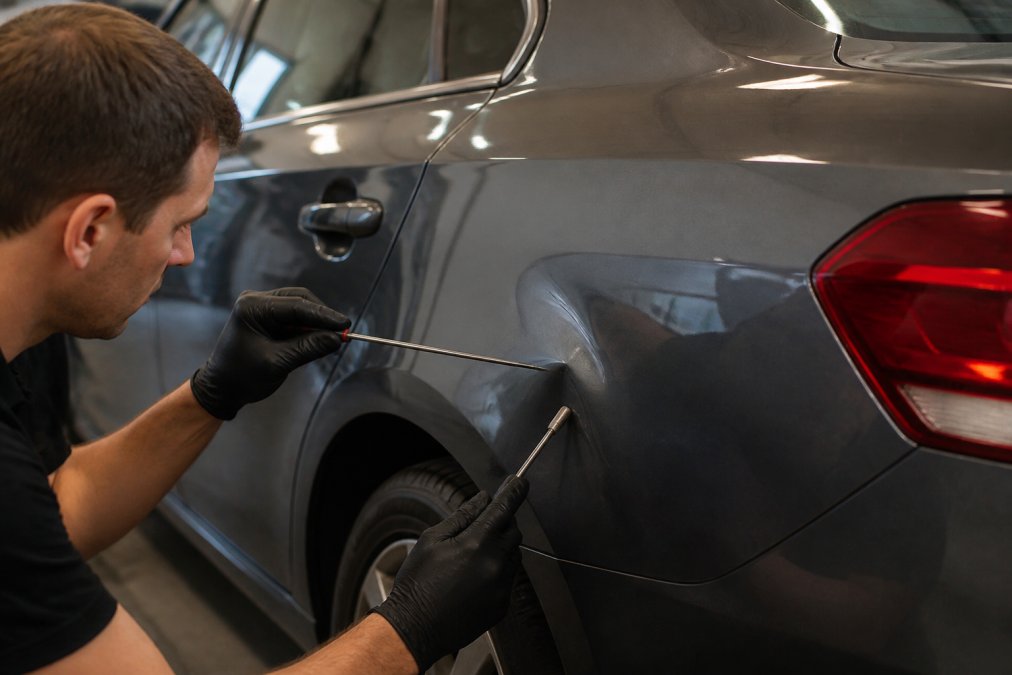
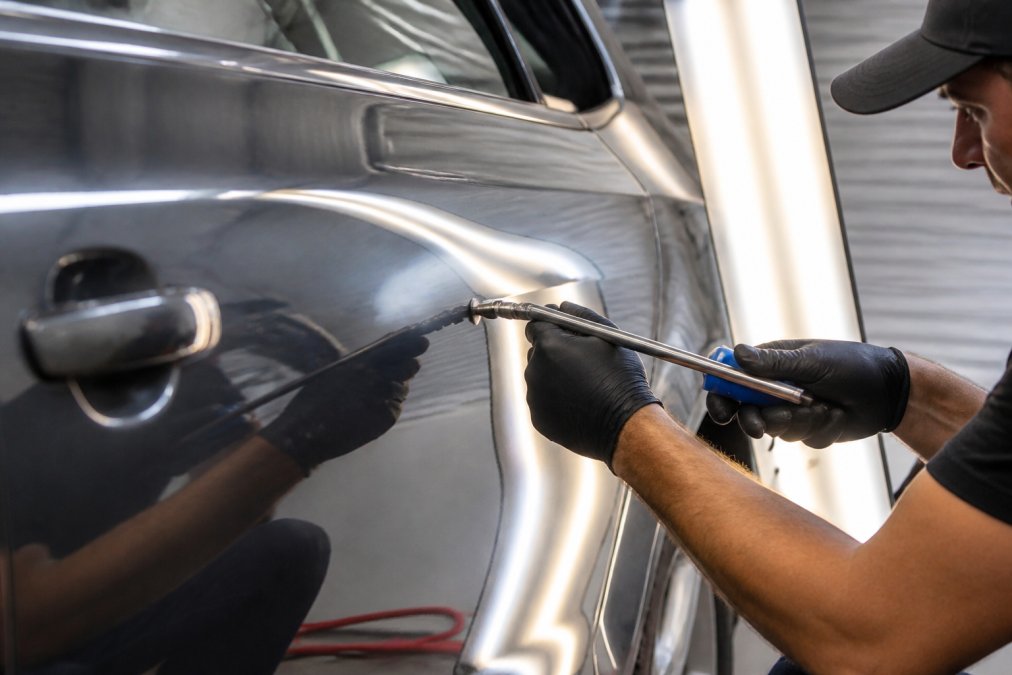
Professional PDR technicians use specialized tools to massage the metal back to its original shape from behind the panel. This preserves the original factory paint, avoids color matching risks, and delivers faster turnaround than traditional body work.
Our top pick is 888 PDR. As a family-owned paintless dent repair company, we remove hail dents, door dings, and creases without fillers or repainting, preserving the factory finish and resale value. We handle the full insurance claim process when applicable, offer vehicle pickup and delivery, and back every repair with a lifetime warranty. For lease returns, our free inspection helps you understand what needs fixing before you pay.
Option 2: Mobile PDR Technicians
Mobile PDR technicians bring the repair to you, a major convenience if your schedule is tight. They operate from equipped vehicles and can often complete repairs in your driveway or workplace parking lot.
The tradeoff is variability. Quality ranges from highly skilled craftspeople to part-time operators. For a lease return with a strict inspection standard, ask about their experience with lease inspections before booking.
Mobile service works best for minor dings easily accessed by a skilled technician. Complex damage, such as creases along body lines or dents in difficult-to-reach panels, may require a shop environment with better lighting and equipment.
Option 3: Dealership Body Shop
The dealership's body shop is usually the most expensive option, but it offers one advantage: the repair is guaranteed to meet that dealership's inspection standards, eliminating the risk of a rejected repair.
The downsides are significant. Dealership body shops typically use traditional methods, sanding, filler, and repainting, which removes the original factory paint and can reduce resale value if you buy it out. Labor rates run higher than independent shops, and scheduling can stretch your timeline.
DIY vs. Professional Repair: Know the Threshold
The DIY threshold for dent repair is lower than most drivers expect. Attempting to remove a dent yourself without proper training and specialized tools often makes the damage worse, turning a minor ding into a crease requiring professional intervention.
DIY kits use suction cups, glue pullers, or body filler for very shallow, accessible dents, but improper technique can stretch the metal, crack the paint, or leave the panel worse. You've then converted a small PDR job into a larger, more expensive repair.
The practical threshold: if the paint is intact and the dent is accessible from behind the panel, a professional can typically remove it with PDR. If the paint is cracked, the dent has a sharp crease, or the panel is structurally damaged, you need a body shop. Most lease-return damage falls into the first category, making PDR the right call.
How to Use a Lease Return Inspection Checklist
A lease return inspection checklist helps you identify damage before the dealership does, giving you time to repair it at your own cost rather than paying inflated penalties. The inspection covers exterior panels, wheels, glass, interior condition, and mechanical function.
Start with a full walk-around in good lighting. Look for dents, dings, scratches, and scuffs on every panel, including the roof and door edges. Check bumpers for scuffs and cracks, wheels for curb rash, and tires for damage or excessive wear. Inside, check for stains, tears, and burns on upholstery, plus damage to the dashboard or trim.
Documentation Strategy: Photos and the Condition Report
Your documentation strategy can save you thousands at lease turn-in. Before any repair work begins, photograph every existing imperfection with a date-stamped image. These photos create a baseline protecting you if the dealership tries to charge you for pre-existing damage.
When you return the vehicle, walk through the dealership's condition report with the representative and photograph the vehicle again on the day of return. Your dated photos provide evidence of the vehicle's condition at turn-in if a dispute arises.
Final Steps for a Smooth Lease Turn-In
A smooth lease turn-in comes down to preparation. Schedule a pre-inspection with your leasing company or dealership a few weeks before your return date. This official assessment tells you exactly what damage they consider chargeable, so you can decide what to repair and what to leave.
Once you know the damage, book repairs with enough lead time for parts, scheduling, and follow-up work. For most minor dents and dings, paintless dent repair is the best option because it's cost-effective, preserves the factory finish, and meets inspection standards. Clean the vehicle thoroughly, remove all personal items, and bring maintenance records to show proper care.
The lease return process punishes unprepared drivers with penalty fees that are almost always avoidable. Professional paintless dent repair addresses the most common causes of excess wear and tear charges while preserving your vehicle's factory finish and resale value. At 888 PDR, we combine specialized PDR techniques with full insurance claim management, a lifetime warranty on all repairs, and vehicle pickup and delivery to make the process painless. Get a free quote today and return your lease with confidence, not costly surprises.
Frequently Asked Questions
Can you return a leased car with a dent?
Yes, but the leasing company will likely charge you a penalty fee. Most lease contracts consider dents larger than a quarter or 1.5 inches as excessive wear and tear. You will receive a vehicle condition report at the final dealership inspection. Fixing qualifying dents with paintless dent repair before the turn-in is usually far more cost-effective than paying the penalty fees.
What is the 1.5-inch rule when leasing a car?
The 1.5-inch rule is a common industry guideline used by leasing companies to assess damage. It typically states that any dent larger than 1.5 inches in diameter is considered excessive wear and tear, which can lead to a penalty fee on your lease return. Dents smaller than this threshold are often overlooked. Always check your specific lease contract for the exact language and measurements.
How much can I save by fixing dents before a lease return?
You can save hundreds of dollars. Dealership penalty fees for a single dent can often be higher than the cost of a professional paintless dent repair service. For example, a typical door ding might cost less to repair than the penalty charged by the dealership. A pre-inspection with a PDR specialist can give you a clear cost comparison before you decide.
Are paintless dent repair services accepted by leasing companies?
Yes, leasing companies accept paintless dent repair because it restores the vehicle to its original condition without affecting the original factory paint. PDR preserves the metal integrity and factory finish, which is what the leasing company expects. As long as the repair is done well and the damage is gone, you will pass the inspection.
This article was written using GrandRanker