Table of Contents
- What Is Paintless Dent Repair and How Does It Work?
- Is Paintless Dent Repair Permanent?
- Paintless Dent Repair Cost 2026
- How Long Does Paintless Dent Repair Take?
- PDR vs Traditional Body Shop Repair
- Types of Damage Suitable for PDR and Material Limitations
- Factors Affecting PDR Repair Longevity
- PDR Myths vs. Facts
- Frequently Asked Questions
Last Updated: September 3, 2026
What Is Paintless Dent Repair and How Does It Work?
Paintless dent repair (PDR) is a technique that removes dents, creases, and dings from vehicle panels without using body filler, repainting, or sanding. The process preserves the factory finish and original paint, which is why many vehicle owners prioritize it for maintaining resale value and structural integrity.
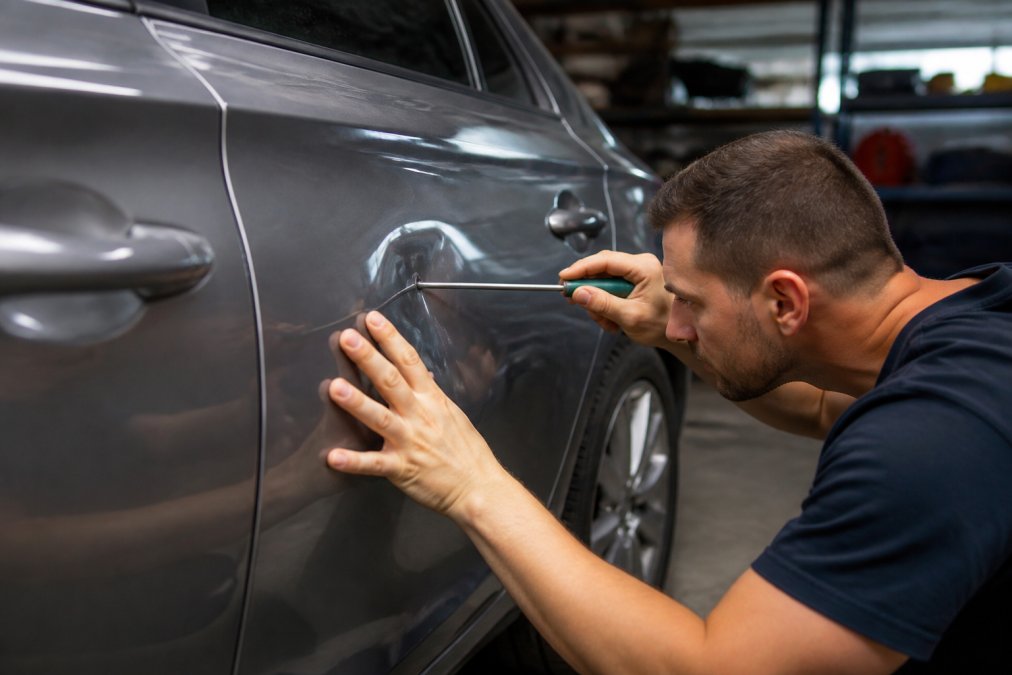
The method works by accessing the backside of damaged panels, typically through door jambs, trim openings, or interior access points, and using specialized rod tools and pressure application techniques to gradually reshape the metal. Certified technicians use use points and controlled force to work the deformed metal back to its original contour. The metal itself does the work; the technician guides it.
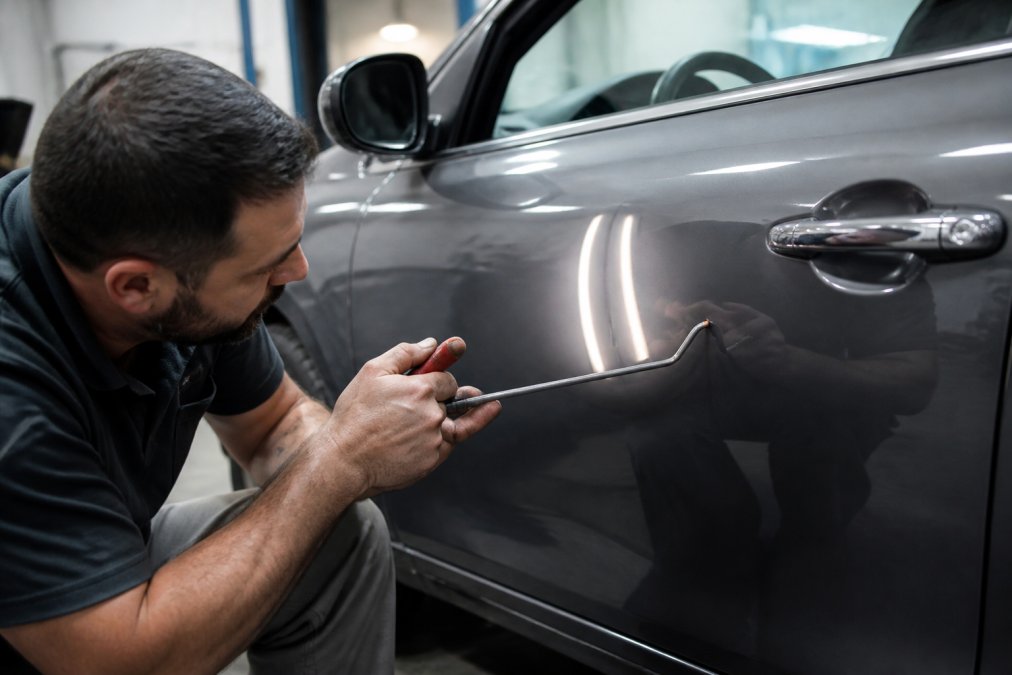
Unlike traditional body shop repair, PDR doesn't interrupt the paint layer. No primer, no body filler, no clear coat application. This distinction matters because it means the vehicle retains its factory finish, the exact paint formulation and thickness applied at the manufacturing plant. For newer vehicles, that factory finish is often a significant factor in resale value.
The technique works best on metal panels with minor to moderate damage. Hail damage, door dings, parking lot creases, and shopping cart hits are ideal candidates. The damage must not have cracked the paint or created sharp creases that have already compromised the metal's ability to move back into shape.
At 888 PDR, we handle everything from single-door dings to extensive hail damage using these specialized techniques. The process typically involves a thorough inspection to determine which dents are suitable for PDR and which might require supplemental work.
Is Paintless Dent Repair Permanent?
Paintless dent repair is permanent when performed correctly on suitable damage. The metal returns to its original shape through the reshaping process, and once the deformation is corrected, the panel maintains that correction indefinitely. The repair doesn't degrade, weaken, or revert over time under normal driving conditions.
The permanence depends on three factors: the damage type, the metal's condition, and the technician's skill. PDR works because it leverages metal memory, the inherent property of automotive sheet metal to return to its original shape when properly manipulated. Once that shape is restored, the metal stays restored.
The Role of Metal Memory and Elasticity
Metal memory is the automotive sheet metal's natural tendency to return to its original form after deformation (peer-reviewed research). This property exists because the metal retains the molecular structure and tensile strength it had when it left the factory. When a dent occurs, the metal is displaced but not destroyed; the atomic structure remains intact beneath the surface.
Elasticity is the related property that allows the metal to flex without permanent damage. Automotive steel and aluminum are designed to withstand minor impacts and deformations. When a PDR technician applies controlled pressure to reshape the panel, they're working within the metal's elastic range, the zone where deformation is reversible.
This is why PDR works at all: the metal "wants" to return to its original shape. The technician simply guides it back. Once the panel is fully reshaped, the metal locks into that corrected position because the atomic structure has realigned.
The permanence fails only if the damage exceeds the metal's elastic limit, if the impact was severe enough to cause cracking, tearing, or permanent molecular deformation. In those cases, the metal has moved beyond recovery, and PDR alone cannot fix it.
Why Dents Don't Pop Back Out
A common misconception is that dents repaired with PDR might spontaneously pop back out or gradually revert. This doesn't happen because the repair isn't a temporary reshaping; it's a permanent restoration of the panel's original geometry.
Once the metal is reshaped and the pressure is released, the panel holds its corrected form. The metal doesn't have a "memory" of being dented; it has returned to its factory state. The surface tension and structural integrity of the panel are restored to their original condition.
Dents don't reappear because the repair doesn't rely on adhesives, fillers, or external supports that could fail over time. The metal itself is the repair. As long as the vehicle isn't subjected to another impact in the same location, the corrected panel remains corrected.
This is fundamentally different from temporary cosmetic fixes or paint-based repairs that might degrade. PDR is a structural restoration, not a cosmetic patch.
Paintless Dent Repair Cost 2026
The cost of paintless dent repair varies based on the extent of damage, the vehicle's accessibility, and the number of panels affected. Minor single dents typically cost less than extensive hail damage affecting multiple panels. Pricing depends on damage severity, vehicle type, and repair complexity.
For insurance claims, many deductibles are waivable or negotiable depending on the policy and the damage circumstances. At 888 PDR, we work directly with all insurance carriers to manage claims from first notice of loss through supplement and final payment, so you understand your out-of-pocket responsibility upfront.
We recommend requesting a free inspection to get an accurate quote for your specific damage. This allows our technicians to assess which dents are suitable for PDR and provide a detailed estimate.
How Long Does Paintless Dent Repair Take?
The timeline for paintless dent repair depends on the damage extent and panel accessibility. A single door ding might take 1-2 hours, while extensive hail damage affecting multiple panels could take several days.
Most vehicles are completed within 2-5 business days from the start of repair work. Accessibility affects duration significantly; some panels are easier to reach than others, which influences how quickly the technician can apply pressure and reshape the metal.
At 888 PDR, we offer vehicle pickup and delivery service, so you don't need to manage transportation while your car is being repaired. For customers who need a rental vehicle, we can arrange that as well, minimizing disruption to your daily routine.
PDR vs Traditional Body Shop Repair
The core difference is preservation. PDR removes dents without interrupting the factory finish. Traditional body shop repair uses body filler, primer, and repainting, which replaces the original paint layer with new material applied on-site.
Paint Integrity and Factory Finish Preservation
The factory finish applied at the manufacturing plant has specific properties: precise thickness, formulation, and hardness that are difficult to replicate in a shop environment (sae.org). Factory paint is baked on under controlled conditions during production, creating a durable, uniform coating.
When a traditional body shop repairs a dent, they sand away the damaged area, apply body filler, prime it, sand again, and then repaint. Each step introduces variability. The new paint may not match the original exactly in color, texture, or durability. Over time, the repaired section can show a visible difference, a "repair line", especially in direct sunlight.
PDR preserves the factory finish entirely. No sanding, no filler, no repainting. The original paint remains intact, which means the vehicle retains its authentic factory appearance and the durability of the original coating.
This distinction matters for vehicles you plan to keep long-term or eventually resell. The factory finish is part of the vehicle's authenticity and condition assessment.
Resale Value Impact
Vehicles with PDR repairs typically retain higher resale value than those with traditional body shop repairs. Potential buyers recognize that PDR preserves the factory finish, which signals that the vehicle's structural and cosmetic integrity has been maintained.
A vehicle with visible body filler repairs or paint that doesn't match the original finish raises questions about the extent of prior damage and repair quality. Even if the repair is mechanically sound, the cosmetic history affects buyer perception and valuation.
Insurance companies and used-car dealers often view PDR repairs more favorably because they preserve the original paint and demonstrate that damage was addressed with a non-invasive technique. This can influence insurance premiums and trade-in offers.
For vehicles with hail damage, choosing PDR over traditional repair can preserve resale value, depending on the extent of damage and the vehicle's market segment.
Types of Damage Suitable for PDR and Material Limitations
PDR works effectively on minor to moderate dents, creases, door dings, hail damage, and parking lot damage. The damage must not have cracked the paint or severely compromised the metal's structural integrity.
Suitable damage types:
- Hail dents (small to moderate)
- Door dings and creases
- Parking lot impacts
- Shopping cart damage
- Minor crease repairs
Unsuitable damage:
- Cracked or chipped paint
- Deep creases with severe metal deformation
- Damage combined with rust or corrosion
- Panels with existing body filler or previous repairs
- Damage on composite or plastic panels
Material limitations matter. PDR works on steel and aluminum panels but not on composite materials, plastic trim, or fiberglass components. Modern vehicles increasingly use mixed materials, so some damage may require hybrid repair approaches combining PDR with other techniques.
Older vehicles with thinner, more brittle metal may have limitations; the metal's elasticity decreases with age and exposure. Newer vehicles with modern automotive sheet metal are typically ideal candidates for PDR.
At 888 PDR, our certified technicians assess each vehicle during the free inspection to determine which panels are suitable for PDR and whether any damage requires supplemental repair methods.
Factors Affecting PDR Repair Longevity
Several factors influence how long a PDR repair remains effective. The primary factor is the quality of the initial repair; a properly executed PDR correction is permanent. Secondary factors relate to how the vehicle is used after repair.
Impact resistance: Once a panel is repaired, it has the same impact resistance as any other panel on the vehicle. PDR doesn't weaken the metal or create structural vulnerability. However, if the same spot receives another impact, new damage can occur.
Environmental exposure: PDR repairs don't degrade from sun exposure, temperature fluctuations, or humidity. The restored metal panel behaves identically to the rest of the vehicle's body. Thermal expansion and contraction affect the entire vehicle uniformly.
Paint integrity: Since PDR preserves the factory finish, the paint remains as durable as it was before the damage occurred. No new paint layers mean no additional surfaces to crack, fade, or chip.
Technician skill: The quality of the initial repair determines longevity. A certified technician using proper technique and specialized tools produces a repair that lasts indefinitely. Poor technique or incomplete reshaping can result in a repair that doesn't fully restore the panel's original geometry, potentially allowing minor movement or imperfections to become apparent over time.
Damage severity: Minor dents reshape cleanly and permanently. Severe damage that approaches the metal's elastic limit may result in a repair that's excellent but not absolutely perfect; the panel may retain a very slight irregularity that doesn't affect function but might be noticeable under certain lighting.
At 888 PDR, every repair comes with a lifetime warranty, which reflects our confidence in the permanence of properly executed PDR work.
PDR Myths vs. Facts
Myth: PDR is only temporary, and dents will pop back out. Fact: PDR is permanent. Once the metal is reshaped, it stays reshaped. The repair relies on the metal's inherent properties, not adhesives or fillers that could fail.
Myth: PDR damages the paint. Fact: PDR preserves the paint entirely. The technician accesses the backside of the panel, so the paint surface is never touched, sanded, or compromised.
Myth: PDR doesn't work on hail damage. Fact: PDR is specifically designed for hail damage. Hail creates numerous small dents that are ideal candidates for the technique. Extensive hail damage may take several days to repair, but PDR is the preferred method.
Myth: PDR leaves the vehicle looking worse than traditional repair. Fact: PDR restores the panel to its original factory appearance. Because it preserves the factory finish, the vehicle looks exactly as it did before the damage, no paint mismatches, no repair lines.
Myth: You need to repaint the vehicle after PDR. Fact: No repainting is required or recommended after PDR. The factory finish is intact, and repainting would actually diminish the repair's value by replacing the original paint.
Myth: PDR is only for minor dents. Fact: While PDR works best on minor to moderate damage, it can address extensive hail damage affecting multiple panels. The technique's limitations relate to damage severity, not the number of affected areas.
Myth: Insurance won't cover PDR. Fact: Insurance companies typically cover PDR for hail damage and collision damage. Many policies don't distinguish between repair methods; they cover the cost of restoring the vehicle to pre-damage condition. At 888 PDR, we handle the entire claims process with your insurance carrier.
Choosing paintless dent repair preserves your vehicle's factory finish and resale value in ways traditional body shop repair cannot match. If you're dealing with hail damage, door dings, or other suitable damage, a free inspection from 888 PDR can clarify which repairs are best handled with PDR and what your insurance coverage includes. We manage the entire claims process, offer lifetime warranty protection on all repairs, and provide vehicle pickup and delivery to make the experience as seamless as possible. Contact 888 PDR for a free inspection or call (469) 284-0336 to get started.
Frequently Asked Questions
Q: Can dents come back after paintless dent repair?
A: No. Once a dent is properly repaired through PDR, it does not return. The metal memory of automotive sheet metal allows technicians to reshape the panel back to its original form. The metal retains this new shape permanently because the material's elasticity has been restored to its factory state. However, the vehicle can sustain new dents from future impacts, PDR does not prevent new damage from occurring.
Q: How is paintless dent repair different from traditional body shop repair?
A: PDR removes dents without using body filler or repainting, preserving your factory finish and paint integrity. Traditional body shops sand, fill, and repaint panels, which can affect resale value and the vehicle's original protective clear coat. PDR is non-invasive and maintains structural integrity. This makes PDR a preferred method for preserving the original finish and value.
Q: What factors affect how long a paintless dent repair lasts?
A: PDR permanence depends on several factors: the skill of the certified technician, the size and location of the dent, the vehicle's metal composition, and how the repair was executed. Smaller dents and door dings typically last indefinitely when performed correctly. Larger hail damage or creases may be more susceptible to metal fatigue if the technician applies insufficient pressure or uses improper leverage points. Weather exposure, thermal expansion, and subsequent impacts can also influence repair longevity.
Q: Does paintless dent repair affect my factory paint warranty?
A: PDR does not damage the factory finish or clear coat, so it should not void your manufacturer's warranty. Because the process is non-invasive and preserves paint integrity, most manufacturers and insurance carriers recognize PDR as a legitimate repair method. However, warranty terms vary by vehicle manufacturer. It's advisable to check your specific warranty documentation or ask your dealership if you have concerns about coverage following PDR work.
This article was written using GrandRanker