Table of Contents
- DFW Hail Repair vs Local Specialists: Quick Comparison
- Paintless Dent Repair vs Body Shop: Key Differences
- The Hail Damage Insurance Claim Process Explained
- How Long Does Hail Repair Take? Timelines Compared
- Why Local Specialists Often Beat National Chains
- How to Verify Quality and Avoid Common Pitfalls
- The Bottom Line: Choosing Your DFW Hail Repair Shop
- Frequently Asked Questions
Last Updated: September 13, 2026
DFW Hail Repair vs Local Specialists: Quick Comparison
When hail hits the Dallas-Fort Worth metroplex, the real question isn't whether to repair your car, it's who repairs it, and whether the shop owns your insurance claim start to finish. This guide from 888 PDR compares hail repair with a local specialist versus the national chains that sweep into town after every major storm.
The short answer: local specialists usually win on claim management, timeline, and finish preservation. National chains win on brand recognition alone.
| Factor | Local Specialist | National Chain |
|---|---|---|
| Insurance claim handling | Managed start to finish | Often outsourced or delayed |
| Repair method | PDR-first, factory finish kept | PDR or panel replacement |
| Turnaround | Days, not weeks | Longer queue during storm season |
| Warranty | Lifetime, in writing | Varies by franchise |
| Rental assistance | Usually included | Often an upsell |
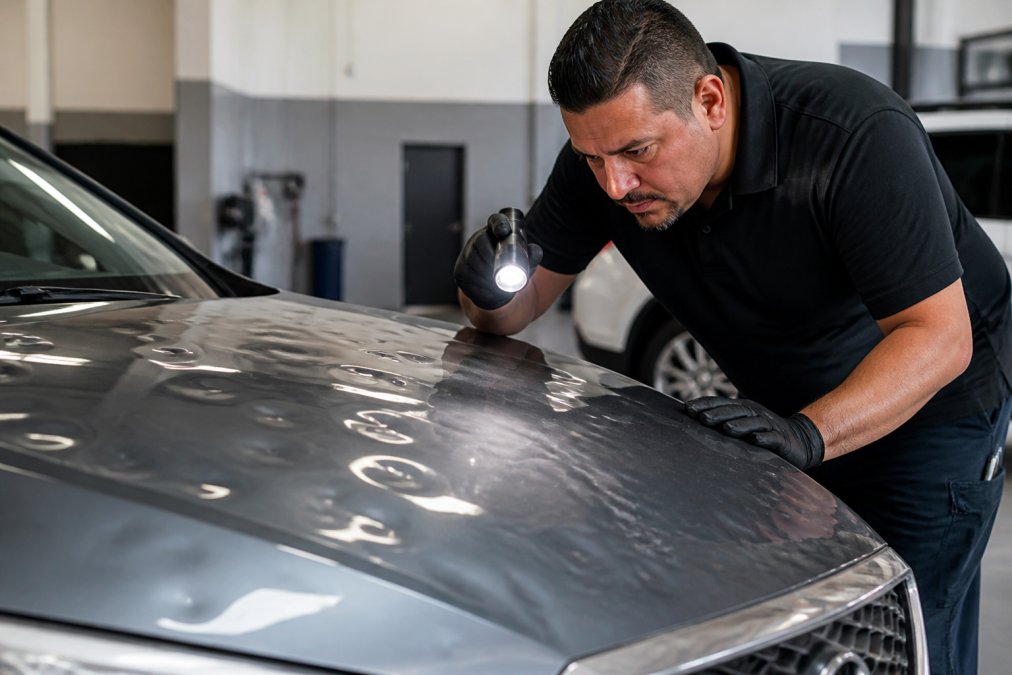
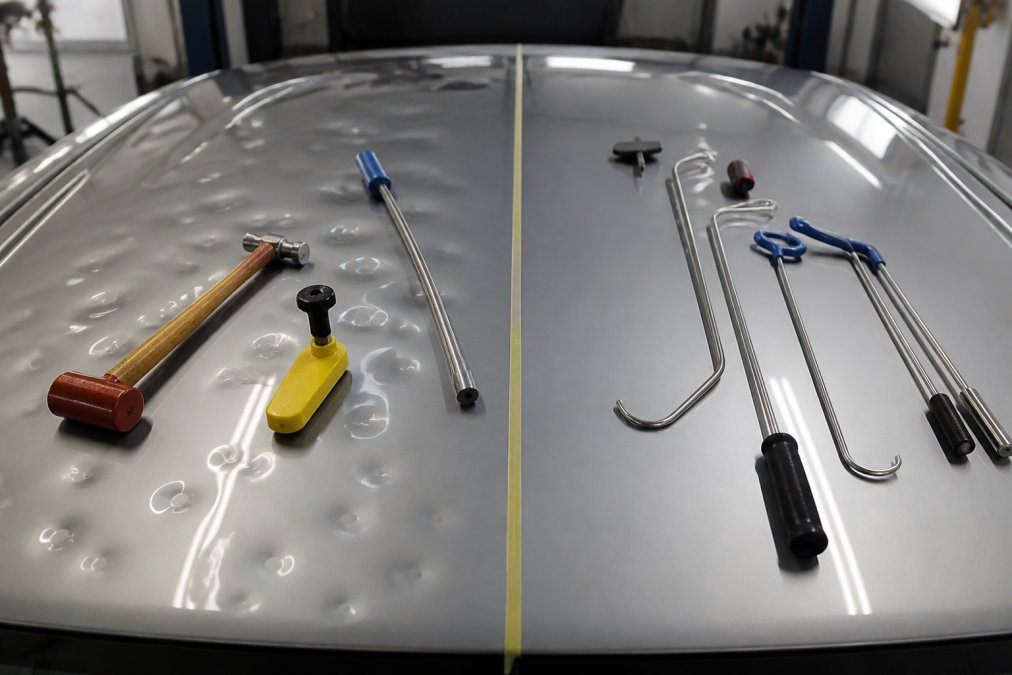
Paintless dent repair (PDR) is a technique that removes dents and dings by massaging the metal back into shape from behind the panel, without fillers, sanding, or repainting.
Paintless Dent Repair vs Body Shop: Key Differences
Paintless dent repair and traditional body shop work solve the same problem in opposite ways: PDR keeps your original paint, body shop repair removes it.
A collision center grinds the damaged area, pulls or replaces the panel, applies body filler, then repaints and blends surrounding panels. That works when metal is torn or creased past reshaping, but for hail damage it is almost always overkill.
How PDR Preserves Your Factory Finish
Your car left the factory with a paint job no shop can fully replicate, robotic application, controlled oven curing, and consistent film thickness (sae.org). Every repaint is thicker, less uniform, and detectable with a paint depth gauge.
That matters at resale: an appraisal flagging repainted panels raises questions about hail, collision, or improper repair. PDR avoids the question entirely, no filler, no blend lines, no mismatched texture.
When Traditional Body Shop Repair Makes Sense
PDR has limits. If hail punched through the paint, the metal is stretched beyond what a technician can work back, or a panel is creased at a structural edge, a body shop is the honest answer, and a quality shop will say so during inspection rather than force a PDR result that fails in a year.
The Hail Damage Insurance Claim Process Explained
Most comprehensive auto policies cover hail damage, minus your deductible (iii.org). On paper the claim is simple: file a first notice of loss, get an inspection, receive an estimate, approve repairs, collect the vehicle. In practice, paperwork is where claims stall.
Here is the sequence that actually matters:
- File the claim and get a claim number
- Schedule an adjuster inspection or use a shop's photo documentation
- Receive the initial estimate
- Approve repairs and confirm the deductible
- Complete repairs and submit a supplemental claim if hidden damage appears
- Final payment and vehicle release
The supplemental claim step is where national chains and inexperienced shops lose people. Once panels come apart, technicians often find damage the adjuster could not see. A shop that documents that properly gets the insurer to cover it. A shop that doesn't leaves the customer holding the difference.
Working With Your Adjuster and Understanding Deductibles
Your deductible is a contract term, not a negotiation: if your policy says $1,000, you pay $1,000. Some shops advertise "deductible assistance" or "$0 out of pocket," usually by absorbing part of the cost through their own pricing, worth asking about directly, since terms vary and some arrangements raise questions with insurers.
How Long Does Hail Repair Take? Timelines Compared
Repair time is the second-most-asked question after cost, and the honest answer depends on four variables: dent count, dent severity, panel access, and how fast the claim clears.
PDR Timelines by Damage Level
Most PDR technicians work in "dent units," a rough measure of labor per dent. A small, shallow dent on an accessible panel might be one unit; a deep dent on a curved roof edge with a brace behind it might be five or more. That is why two cars with the "same" number of dents can have wildly different repair times.
- Light damage (roughly 1-20 dents, all accessible): Often a same-day or next-day job. Many shops can complete these while you wait if the vehicle is dropped off in the morning.
- Moderate damage (roughly 20-75 dents, mixed panels): Typically two to four working days, assuming parts are not needed and the claim is already approved.
- Heavy damage (75+ dents, or dents on roof rails, hood edges, and body lines): One to two weeks is common. Roof work alone can double the labor because headliners and interior trim have to come down for access.
- Severe damage with stretched metal or broken paint: PDR may not be viable on every panel. Those panels go to a body shop, which adds paint and cure time, often another three to seven days per panel depending on the shop's booth schedule.
The Insurance Clock Is Usually the Real Delay
A common pattern: the repair takes three days but the vehicle sits two weeks waiting on paperwork. The stages that eat time:
- First notice of loss to adjuster assignment: One to five business days in normal conditions. After a metro-wide storm, this can stretch to two weeks or more because every carrier's adjuster pool is overwhelmed.
- Adjuster inspection to written estimate: Usually 24-72 hours once the inspection happens.
- Estimate to customer approval: This is on you. Shops cannot start until you authorize the work.
- Supplement discovery and approval: If hidden damage is found mid-repair, a supplement has to be filed and approved. A shop that documents supplements well can often get same-day or next-day approval. A shop that does not can stall for a week.
- Final payment and release: Usually one to two business days after the insurer issues payment.
Why Storm-Season Queues Compound
After a major hail event, every shop in the area fills up within days. Two things separate shops that stay on schedule:
- Permanent capacity vs. surge capacity. A shop with a permanent facility and trained technicians can absorb volume without rebuilding its workflow. A storm-response crew that deploys into the market has to hire, train, and house temporary labor, and that ramp-up shows up as delay on your vehicle.
- Parts dependency. PDR rarely needs parts, which is one reason it moves faster than body work. If your repair requires a replacement panel, glass, or trim clips, you are now waiting on a supply chain strained by the same storm.
What to Ask Before You Hand Over the Keys
Get a written completion estimate, not a verbal one. Ask specifically:
- How many vehicles are ahead of mine in the queue right now?
- Is my estimate based on the adjuster's initial write-up, or did you do your own inspection?
- If a supplement is needed, who files it and how long does your shop typically wait for approval?
- Will you call me if the timeline slips, or do I need to call you?
Rental Assistance and the Timeline Overlap
If your policy includes rental reimbursement, the clock usually starts when the vehicle is dropped for repair, not when the claim is filed, so a slow claim can eat into your rental days before the repair begins (naic.org). Confirm with your adjuster when coverage activates, and with the shop whether they provide a loaner or coordinate with the rental agency.
Why Local Specialists Often Beat National Chains
A local specialist lives on reputation in the same market where you live, and that changes behavior: when your next customer might be your neighbor, you handle the claim properly, answer the phone, and stand behind the work.
National chains operating through a franchise or storm-response model have a different incentive structure. The crew that repairs your car may be gone in six weeks. Follow-up warranty work becomes a phone tree across state lines. That is not a knock on every chain, but it is the structural reality.
888 PDR is family-owned and operates a 25,000 sq ft facility in Dallas, with a second location serving western Nebraska from Scottsbluff. We work directly with all insurance carriers and manage the claim from first notice of loss through supplement and final payment. Customers get a free inspection, a lifetime warranty on repairs, vehicle pickup and delivery, and rental assistance. Storm response crews deploy to hail-affected markets after major events, which means capacity scales when the metroplex needs it.
That combination, permanent local infrastructure plus storm-season surge capacity, is what most national chains cannot offer.
How to Verify Quality and Avoid Common Pitfalls
Most guides tell you to ask about warranties; fewer tell you what to look for on the car itself after the repair. Here is a concrete inspection routine you can run in the shop's lot before you drive away. Verifying the quality of bodywork requires the same level of scrutiny one should apply when evaluating professional assistance, a principle detailed further in our service comparison guide.
What Bad PDR Work Actually Looks Like
Paintless dent repair leaves no paint evidence, which is exactly why subpar work is hard to spot. The tells:
- Orange peel texture. Factory paint has a fine, uniform texture. A repainted or over-heated panel can develop a bumpy, citrus-skin surface. Run your fingertips across the repaired area in good light and compare it to an untouched panel on the same car.
- Micro-cracking in the clear coat. Aggressive PDR on stretched metal can fracture the clear coat without breaking the color layer. Look at the repaired area under direct sunlight or a bright LED at a low angle. Hairline cracks that catch the light are a failure, not a finish.
- Wavy reflections. Stand so a straight line, a building edge, a light pole, a parking stripe, reflects across the repaired panel. The reflection should stay straight. If it ripples, the metal is not fully leveled.
- Panel misalignment. If trim, headliners, or interior panels were removed for access, they should go back flush. Gaps that are uneven, clips that rattle, or a headliner that sags are installation problems, not cosmetic ones.
- Paint depth anomalies. A body shop repaint shows up on a paint depth gauge as a thicker reading than the surrounding factory panels. If a shop told you the repair was PDR-only but a gauge tells a different story, ask why.
- Dents that return. Some dents look fixed in cool morning air and reappear in afternoon heat. Metal has memory. A properly worked dent stays flat across temperature swings; a poorly worked one does not.
A Pre-Repair Assessment You Can Do Yourself
Before you take the car to any shop, spend ten minutes documenting what you have. It protects you if a shop later claims damage was pre-existing and gives you a baseline to compare against after the repair.
- Park the car in direct sunlight or under a bright, angled light source.
- Walk the entire vehicle, hood, roof, trunk, all four doors, fenders, and the rear quarter panels.
- Photograph each panel straight-on and at a low angle, where dents cast shadows.
- Note the approximate count per panel (a range is fine, "10-15 on the hood" is more useful than a guess).
- Check for any pre-existing scratches, chips, or prior repair work and photograph those separately.
- Check the windshield and glass for chips that may have been caused by the same storm.
- Save the photos with a date stamp before you visit any shop.
This is not a substitute for a professional inspection. It is a record. Shops that do honest work will welcome it; shops that do not will often try to talk you out of it.
Questions That Separate Real Shops From Storm Chasers
- Is the warranty in writing, and does it name the specific repair performed?
- Will the technician document pre-existing damage with photos before starting?
- Does the shop file supplements directly with the insurer, or will you be the messenger?
- Can you see the facility and meet the technicians working on your car?
- Is rental assistance included, or is it an added cost?
- What happens if a dent reappears or the repair fails in two years, who pays, and where do you take the car?
- Is the shop's address a permanent facility, or a temporary location tied to this storm?
A shop that hesitates on the warranty question is telling you something. So is a shop that will not let you see the work area.
The Post-Repair Walkaround
Do this before you sign the release and before you return any rental:
- Re-run the same sunlight inspection you did before the repair.
- Compare your before photos to the current condition, panel by panel.
- Check every panel the shop touched for the tells above, orange peel, wavy reflections, misaligned trim.
- Open and close every door, the hood, and the trunk. Listen for rattles.
- Confirm the written warranty document is in your hand, not promised by email later.
The Bottom Line: Choosing Your DFW Hail Repair Shop
The gap between a good hail repair experience and a bad one rarely comes down to the dents. It comes down to who manages the insurance claim, who communicates, and who is still there when you need them. Local specialists win that comparison more often than not, because their business depends on it.
At 888 PDR, we handle the entire claim from first notice of loss through supplement and final payment, preserve your factory finish with paintless dent repair, and back every repair with a lifetime warranty. We also provide vehicle pickup and delivery and rental assistance so you are not stranded while your car is in the shop.
Get a free quote from 888 PDR and let our team manage the claim, the repair, and the timeline from start to finish.
Frequently Asked Questions
What is the average cost to repair hail damage?
Repair costs vary widely based on the number of dents, their size, and your vehicle's make and model. Most insurance claims cover the repair minus your deductible. For a free evaluation and a clear estimate, contact a local specialist like 888 PDR. They can assess the damage and explain your options without any obligation.
Is it worth getting hail damage repair?
Yes, repairing hail damage is usually worth it. Unrepaired dents can lead to rust, reduce resale value, and may worsen over time. Paintless dent repair (PDR) preserves your factory finish, which helps maintain your car's value. Many insurance policies cover hail damage, so your out-of-pocket cost may be just your deductible.
Do car insurance rates go up after hail damage?
In most cases, filing a hail damage claim does not increase your premium because it's considered a comprehensive claim, not a collision. However, policies vary. Check with your insurance agent to understand your specific coverage. A local specialist can help you navigate the claims process and communicate with your insurer.
How does paintless dent repair compare to traditional body shop methods?
Paintless dent repair (PDR) removes dents without fillers or repainting, preserving your vehicle's original factory finish. Traditional body shops often use body filler and repaint, which can diminish resale value and take longer. PDR is faster, less invasive, and typically preferred for hail damage when the paint is not cracked.
How can I verify the reputation of a local hail repair specialist?
Check online reviews, ask for references, and verify certifications like PDR technician training. A reputable shop will offer a lifetime warranty, provide a detailed estimate, and communicate clearly. Local specialists with a physical location, like 888 PDR, are often more accountable than storm-chasing crews that leave town after the work is done.