
Table of Contents
- The Transparency Problem in PDR Pricing
- Factors Affecting PDR Pricing and Cost Variation
- How to Get an Accurate Dent Repair Quote
- PDR vs Traditional Body Shop Cost: What's the Real Difference?
- Red Flags in Dent Repair Quotes
- Why Your Insurance Deductible Matters More Than You Think
- Frequently Asked Questions
Last Updated: September 19, 2026
The Transparency Problem in PDR Pricing
When you call a paintless dent repair shop with a photo of your hail-damaged car, you're hoping for a straightforward answer: "That'll cost you $X." What you usually get instead is: "We'll need to see it in person." This isn't evasion. It's the reality of how PDR pricing transparent assessment works.
The challenge with understanding paintless dent repair pricing transparency stems from one fundamental truth: no two dents are identical. A door ding that looks minor from the parking lot might involve complex panel access. A hail damage claim affecting 40 dents requires assessment of overlapping damage patterns. The variables stack up fast, and that's why is professional dent removal pricing transparent remains such a common question among vehicle owners.
At 888 PDR, we've worked with thousands of insurance claims and individual customers, and we understand the frustration about price variation. One technician quotes $400. Another quotes $650 for what appears to be the same damage. The difference isn't always about quality or dishonesty, it's about how each shop factors in the variables that actually drive cost. Understanding those variables is the first step toward evaluating whether a quote is fair.
Factors Affecting PDR Pricing and Cost Variation
PDR pricing transparency is complicated because the cost depends on multiple overlapping factors, each of which can shift the final number significantly. A shop that charges $200 for one door ding might charge $350 for another that looks similar to the untrained eye. Here's what's actually driving those differences.
Dent Size, Depth, and Complexity
The most obvious variable is the dent itself. A shallow crease running along a body line is fundamentally different from a sharp, deep dent in the center of a panel. Deep dents with sharp creases can require multiple sessions and specialized techniques that demand more technician time.
Hail damage introduces additional complexity. A single hail strike creates one dent. A hail event creates dozens or hundreds, often overlapping in ways that force technicians to work around previously repaired areas. The cumulative effect of multiple dents on the same panel changes the repair strategy entirely, what works for isolated damage fails when dents interact with each other.
Size matters too, but not always in the way you'd expect. A large, shallow dent across a wide area might be faster to repair than a small, deep dent in a tight spot. The depth and sharpness of the crease determine how much metal manipulation is required. A dent that's an inch deep but spread across a large surface area is often easier than a quarter-inch dent with razor-sharp edges.
Panel Access and Technician Skill Level
This is where is professional dent removal pricing transparent becomes genuinely difficult. Some panels are accessible from behind. Others require removal of interior trim, speakers, or wiring harnesses. A dent on a door panel might need the door removed from its hinges. A dent near the fuel door might require fuel system access.
Panel removal adds time and complexity. A technician needs to disconnect electrical components, document their positions, remove fasteners, work around wiring, and reinstall everything perfectly. A shop that factors panel removal into their quote might charge significantly more than one that doesn't, not because one is dishonest, but because one is accounting for a real cost that the other is either absorbing or not disclosing.
Technician skill level also affects pricing. An experienced PDR technician can work faster and handle more complex damage. A newer technician might need more time on the same dent. Some shops price by technician level; others charge a flat rate regardless. This variation alone can explain a 30-40% difference in quotes for identical damage.
Mobile Service vs. Shop-Based Repair
Mobile PDR technicians come to your location. Shop-based repair requires you to bring the vehicle in. This distinction affects pricing in ways that aren't always obvious.
Mobile service eliminates your travel time and hassle, but it limits the technician's access to tools and workspace. A mobile technician working in a parking lot has different constraints than one working in a climate-controlled shop with a full tool arsenal. Some damage that's straightforward in a shop becomes complicated in a mobile setting.
Shop-based repair allows for more complex work but requires you to arrange transportation. Some shops factor this into their pricing by offering lower rates for in-shop work. Others charge the same regardless. The transparency question here is whether the shop discloses these differences and explains why one approach costs more or less.
How to Get an Accurate Dent Repair Quote
Getting an accurate quote requires asking the right questions and understanding what the shop is actually committing to repair. A free inspection is the industry standard, but what happens during that inspection matters enormously.
The Free Inspection Advantage
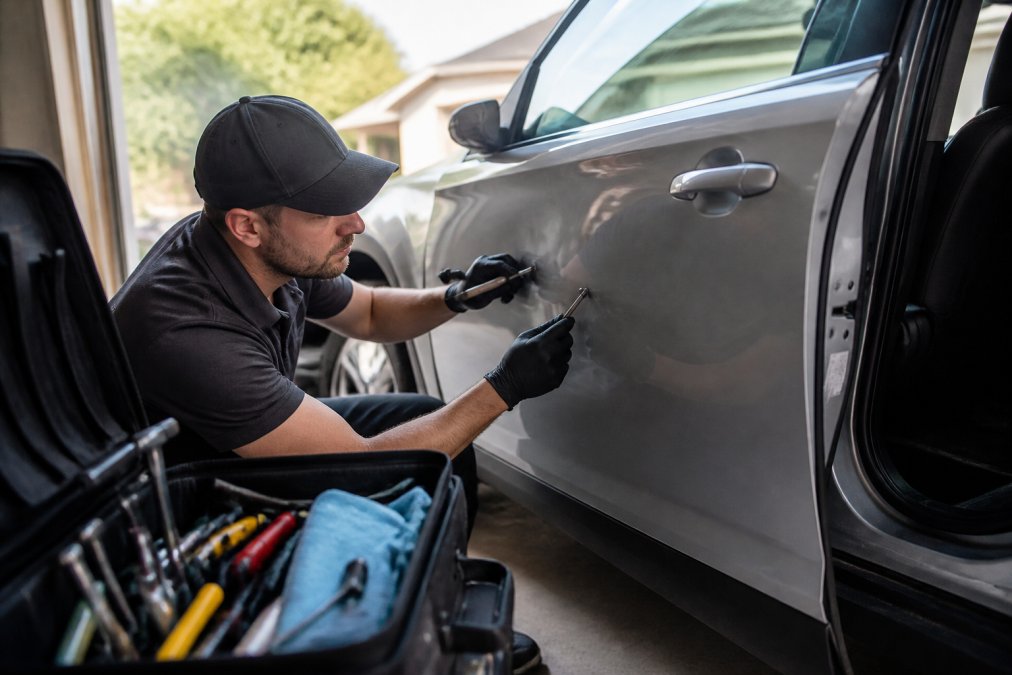
Most reputable PDR shops offer free inspections because they need to see the damage in person to provide an accurate estimate. This is the correct approach. A quote based solely on photos is inherently unreliable because the technician can't assess depth, panel access, or overlapping damage patterns.
During an inspection, a qualified technician should:
- Examine the dent from multiple angles
- Test the metal's flexibility and assess crease sharpness
- Determine whether panel removal is necessary
- Identify any paint damage that might affect repairability
- Check for underlying damage (frame, structural components)
- Provide a written estimate with PDR pricing transparent details that break down labor time and any material costs
The free inspection also gives you a chance to evaluate the technician's communication. Do they explain what they're looking at? Do they answer your questions about why certain damage costs more or less? A shop that communicates clearly during the inspection is more likely to deliver transparent pricing throughout the repair.
What to Ask Before Committing
Before accepting a quote, ask these specific questions:
On scope and access: "Does this estimate include any panel removal, or is it based on exterior access only?" A clear answer tells you whether hidden costs might emerge later.
On timeline: "How long will this repair take, and do you charge by the hour or by the job?" Hourly rates introduce uncertainty. Fixed-price quotes are more transparent, but only if the shop has accurately assessed the damage.
On warranty: "What's covered under your warranty, and for how long?" Some shops offer lifetime warranties on repairs. Others offer one year. The terms matter enormously for your peace of mind.
On insurance claims: "Do you work directly with my insurance company, or do I handle the claim myself?" This is critical if you're filing a claim. A shop that manages the claim process reduces your stress and ensures proper documentation.
On additional costs: "Are there any costs beyond the estimate, materials, fees, or charges if additional damage is found?" This prevents surprises at the end.
A shop that answers these questions clearly and in writing is demonstrating pricing transparency. A shop that deflects or provides vague answers is signaling that surprises might emerge.
PDR vs Traditional Body Shop Cost: What's the Real Difference?
The cost comparison between paintless dent repair and traditional body shop repair is where pricing transparency becomes genuinely important. PDR typically costs less than traditional repair because it eliminates several expensive steps.
Traditional body shops use filler, sanding, priming, and repainting. Each step adds labor and material costs. A traditional repair for hail damage might involve filling dozens of small dents, sanding smooth, applying primer, and repainting entire panels. This process takes significantly longer than PDR.
PDR removes dents without filler or paint, which reduces labor time and eliminates material costs.
Red Flags in Dent Repair Quotes
Certain patterns in quotes signal that a shop may not be operating with full pricing transparency.
Why Your Insurance Deductible Matters More Than You Think
If you're filing an insurance claim for hail damage, your deductible is one of the most important factors in your actual out-of-pocket cost. This is where PDR pricing transparency intersects with insurance coverage.
Frequently Asked Questions
What factors influence the final cost of paintless dent repair?
PDR pricing depends on dent size, depth, location on the vehicle, panel access requirements, and technician skill level. Hail damage with multiple dents costs more than a single door ding. Sharp creases are harder to remove than shallow dents. Mobile services may charge travel fees, while shop-based repair avoids that overhead. The condition of the paint and proximity to vehicle body lines also affect labor time and final pricing.
Why do PDR quotes vary significantly between shops?
Different technicians assess damage severity differently based on experience. Some shops include mobile service fees, inspection costs, or warranty coverage in their quotes while others charge separately. Labor rates vary by location and shop overhead. A technician with specialized tools and expertise may charge more but deliver faster results. Always get multiple estimates to understand the pricing landscape.
Is paintless dent removal covered by car insurance?
Most comprehensive and collision policies cover PDR, especially for hail damage. You'll typically pay your deductible, and the insurer covers the rest. Some insurers offer waived or reduced deductibles for hail claims. Your coverage depends on your specific policy terms. If you're unsure, contact your insurance agent before scheduling repair. Many PDR shops handle insurance claims directly, which simplifies the process and reduces your out-of-pocket stress.
How can I tell if a dent repair quote is fair?
Get quotes from at least two reputable shops to compare pricing and approach. A fair quote includes a detailed breakdown of labor, materials, and any additional fees. Beware of quotes that seem unusually low, they may indicate rushed work or hidden costs later. Ask about warranty coverage, inspection fees, and whether the quote is binding. Choose a shop that offers a free inspection and explains their assessment clearly. Professional shops provide transparent estimates that justify their pricing based on specific damage factors.