Table of Contents
- What Are Mobile Paintless Dent Repair Services?
- Quick Comparison: Mobile PDR Providers
- Paintless Dent Repair Cost 2026: What to Expect
- How Long Does Paintless Dent Repair Take?
- Mobile Auto Hail Damage Repair: What to Know
- Why Mobile Service Beats a Traditional Body Shop
- Insurance Claims and DIY Risks: What to Avoid
- Frequently Asked Questions
Last Updated: September 14, 2026
What Are Mobile Paintless Dent Repair Services?
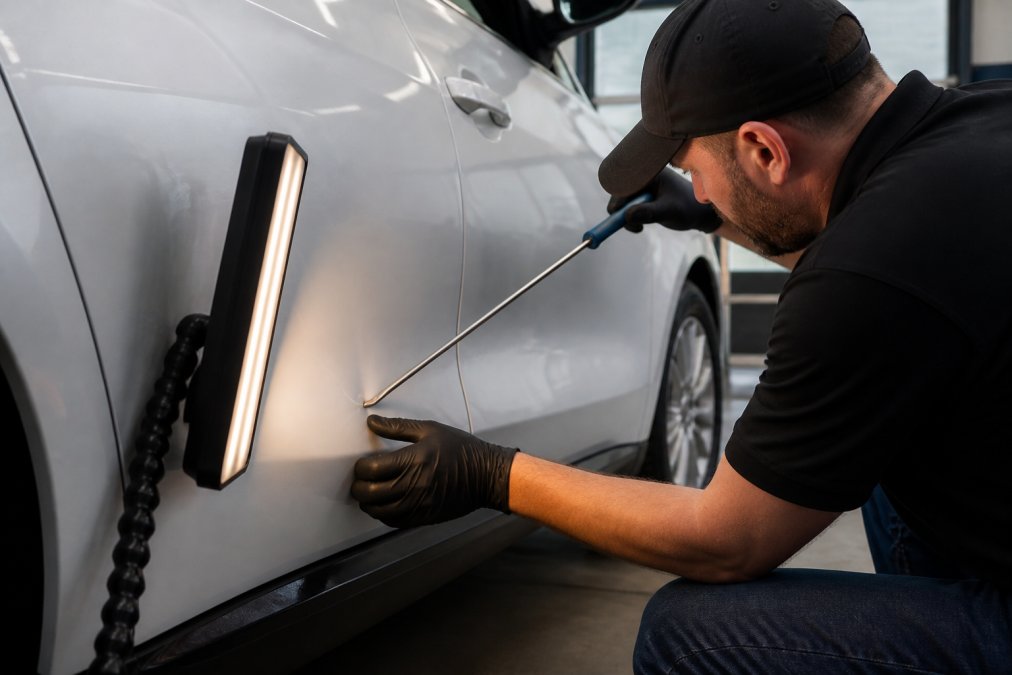
Mobile paintless dent repair services bring the repair shop to your driveway. A trained technician uses specialized rods, levers, and glue-pulling tools to massage a dent out from behind the panel, keeping your original paint intact. This guide from 888 PDR breaks down what that means for your car, your timeline, and your wallet.
The process relies on what technicians call metal memory. Steel and aluminum panels naturally want to return to their original shape, and a skilled hand can guide them back without sanding, filler, or a spray booth. That is the core difference between paintless dent repair and everything a traditional body shop does.
How PDR Preserves Your Factory Finish
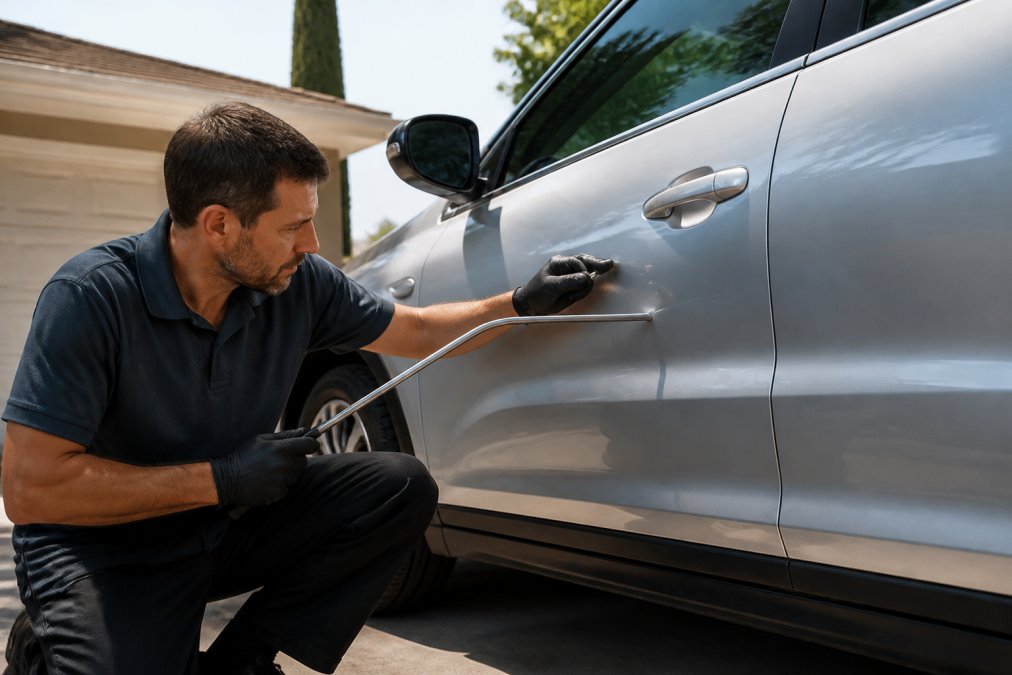
Paintless dent repair is a non-invasive repair method that reshapes the metal from behind the panel, so the factory paint coat is never touched. That matters more than most owners realize.
Factory paint is applied in a controlled oven environment and bonded to the metal in a way no body shop can replicate. Once a panel is sanded and repainted, it is a repair, not a restoration. PDR avoids that entirely.
A common mistake is assuming any dent can be repaired this way. If the paint is cracked or the metal is stretched past a certain point, PDR may not be an option. A technician has to assess it in person.
Quick Comparison: Mobile PDR Providers
The best mobile provider for you depends on your location, your damage type, and whether you want the company to handle your insurance claim. Here is how the major mobile PDR options stack up.
| Provider | Service Area | Insurance Help | Standout Feature |
|---|---|---|---|
| 888 PDR | Dallas-Fort Worth, Scottsbluff NE | Full claim management | Lifetime warranty, pickup and delivery |
| Mobile Dent Experts | Orange County | Not stated | On-site convenience |
| Mobile Dent Medic | Los Angeles | Not stated | Non-paint damage focus |
| Dent Sharks | Regional | Not stated | Advanced PDR equipment |
| Colors on Parade | National franchise | Varies by location | Established brand network |
888 PDR stands out because it manages the entire claim from first notice of loss through supplement and final payment, and it backs every repair with a lifetime warranty.
Paintless Dent Repair Cost 2026: What to Expect
There is no single price for paintless dent repair, but the way shops actually build a quote is predictable. Understanding the pricing model lets you sanity-check any number you are given before you commit.
Most mobile PDR providers quote per panel or per dent rather than per hour, because the technician's time is only one input. The real drivers are access difficulty, dent severity, and total dent count. A shop that quotes by the hour on a hail job is usually signaling that it does not do much hail work.
How Shops Actually Build a Quote
A typical estimate is assembled from four inputs:
- Panel count. Each panel is priced separately, because each one has to be accessed, worked, and inspected independently.
- Dent severity tier. Shops commonly bucket dents into size classes, dime-sized, quarter-sized, and larger, and price each tier differently. A quarter-sized dent on a door is not the same job as a quarter-sized dent on a roof.
- Access difficulty. A door or fender gives a technician room to reach behind the panel. A roof, hood, or rear quarter panel often requires removing interior trim, headliners, or taillights, and that labor is built into the quote.
- Paint and metal condition. Cracked paint or stretched metal can push a job out of PDR entirely, which changes the quote from a PDR number to a body shop number.
Because of this, the same dent can be quoted differently by two shops and both quotes can be legitimate. What should not vary is the requirement that someone inspects the car, in person or through clear photos, before a firm number is given.
What Drives the Number Up or Down
- Dent count: A single ding costs far less than a full panel of hail strikes. Hail pricing is usually quoted per panel with a per-dent multiplier, not as a flat rate.
- Dent size and depth: Larger, deeper dents take more time and skill, and deep creases that cross a body line are the hardest category.
- Panel location: Roofs, hoods, and rear quarter panels are harder to access than doors, and the labor to reach them is real.
- Paint condition: Cracked or chipped paint may rule out PDR entirely and force a refinish.
- Metal type: Aluminum panels behave differently from steel and can be trickier to work, which some shops price at a premium.
How to Compare Quotes Without Getting Burned
When you collect estimates, ask each shop the same three questions: Is this quote per panel or per dent? Does it include paintless repair only, or does it assume refinishing? And is the number firm after inspection, or an estimate subject to supplement?
The answers tell you more than the dollar figure. A quote that assumes refinishing on a panel that could have been saved with PDR is not a cheaper repair, it is a different repair with a worse outcome for resale value.
How Long Does Paintless Dent Repair Take?
A single door ding can be finished in under an hour (aaa.com). A full hail damage repair covering multiple panels typically takes one to three days, depending on severity and parts availability.
The honest answer is that time-to-repair varies more than most guides admit. A technician working a small dent in a parking lot can wrap up before you finish a coffee. A car with hundreds of hail strikes across the hood, roof, and trunk is a multi-day project that has to be scheduled and worked panel by panel.
Same-Day Service vs. Multi-Day Repairs
Same-day service suits minor dents: door dings, shopping cart hits, and small creases on accessible panels. These are the jobs mobile providers handle on-site in a single visit.
Multi-day repairs are the norm for hail damage. When dozens or hundreds of dents cover a vehicle, the work has to be staged, and the car may need to stay at the shop. This is where rental assistance matters, and it is one reason to pick a provider that offers it.
Mobile Auto Hail Damage Repair: What to Know
Mobile auto hail damage repair handles the aftermath of a storm without a trip to a body shop. Technicians work panel by panel to lift each dent, and on severe storms, crews are often deployed to affected areas to handle the volume.
Hail is the most common reason owners seek PDR at scale. A single storm can dimple every upward-facing surface of a car, and traditional body shops would require repainting entire panels. PDR avoids that, which is why it has become the default approach for hail repair on vehicles with intact paint.
A practical note: after a major storm, shops get booked fast. Scheduling early, and getting your claim started, keeps you from waiting weeks behind a backlog.
Why Mobile Service Beats a Traditional Body Shop
Mobile service wins on convenience, speed, and paint preservation. You skip the drop-off, the rental counter, and the multi-day body shop queue, and you keep your factory finish in the process.
The traditional alternative means leaving your car, waiting days or weeks, and often accepting filler and repainting on panels that could have been saved. For a newer vehicle, that is a real hit to resale value. Buyers and inspectors can detect repainted panels, and a Carfax-style record of body work raises questions (Check car by VIN & get the vehicle history).
Mobile PDR flips the model. The technician comes to your home or office, works on-site, and returns the car with its original paint intact. For busy professionals, that is the difference between losing a day and losing nothing.
Insurance Claims and DIY Risks: What to Avoid
Two mistakes cost owners the most money: botching a DIY repair and mishandling an insurance claim. Both are avoidable, but avoiding them requires knowing the actual mechanics of each.
The DIY Trap: Why Suction Cups and Boiling Water Fail
PDR looks simple in videos. It is not. The tools that make it work, long rods, glue-pulling tabs, and a properly calibrated light board, exist because the technician needs to see the dent's low point and apply force from the correct angle without stretching the metal past its elastic limit.
Amateur attempts fail in predictable ways:
- Suction cups and boiling water pull the center of a dent but leave the edges stretched, creating a wavy panel that is harder to repair than the original dent.
- Cheap pullers and glue tabs apply force at the wrong angle and routinely crack paint, especially on cold panels or factory finishes that have aged.
- Overworking the metal stretches it past the point where it will return, which turns a repairable dent into a panel that needs filler and refinishing.
Once the paint cracks, PDR is off the table. The repair becomes a body shop job, and the cost difference is not marginal, it is the difference between preserving factory paint and losing it.
The Insurance Trap: How Hail Claims Actually Work
Hail claims follow a defined sequence, and skipping a step is where owners get underpaid.
- First notice of loss. You report the claim to your carrier and get a claim number. Do this before you authorize any repair.
- Documentation. Photograph every damaged panel in daylight, including wide shots that show the whole vehicle and close shots that show individual dents. Adjusters work from these.
- Adjuster inspection. The carrier sends an adjuster to write an initial estimate. This estimate is often conservative because hidden damage is not yet visible.
- Repair and supplement. Once the shop opens up the vehicle, it may find additional dents or access issues. A supplement is a request to the carrier for additional payment. Supplements are common, not exceptional.
- Final payment. The carrier pays the supplement and closes the claim.
Owners who try to manage this alone often end up underpaid because they accept the initial adjuster estimate as final. It is not final. It is a starting point.
What to Ask Before You Choose a Shop
- Does the shop work directly with insurance carriers, or will you be the one calling the adjuster?
- Who handles the supplement if hidden damage is found?
- Is there rental or loaner assistance during multi-day repairs, and does the shop coordinate it with your policy?
- What happens if the carrier's estimate comes in below the shop's quote?
A shop that manages the claim from first notice of loss through supplement and final payment removes the burden of being the middleman between your carrier and your repair. That is the difference between a stressful process and a handled one.
Frequently Asked Questions
Is mobile paintless dent repair as effective as shop-based repair?
Yes, mobile paintless dent repair uses the same specialized tools and techniques as shop-based PDR. A certified technician can remove door dings, creases, and hail damage on-site without fillers or repainting. The main difference is location, not quality. Mobile service is ideal for minor to moderate damage and preserves your vehicle's factory finish just as effectively as a fixed shop.
How much does mobile paintless dent repair cost compared to traditional body shops?
Pricing for paintless dent repair depends on dent size, location, and complexity. Mobile PDR is often more cost-effective than traditional body shops because it avoids paint and materials. For an accurate quote, request a free inspection. Many providers, like 888 PDR, offer free estimates and work directly with insurance carriers to manage your claim.
Can mobile PDR technicians remove hail damage at my home?
Yes, mobile paintless dent repair technicians can remove hail damage at your home or office. They bring specialized tools and lighting to assess and repair dents on-site. This is especially convenient for large hail damage claims. 888 PDR offers vehicle pickup and delivery, and their storm response crews deploy to hail-affected markets after major events.
What types of dents can be fixed with mobile paintless dent repair?
Mobile PDR works best on dents where the paint is not cracked or chipped. Common repairs include door dings, shopping cart hits, creases, and hail damage. Minor collision dents may also qualify. If the paint is damaged or the metal is stretched too far, a traditional body shop may be needed. A technician can assess your vehicle and recommend the best approach.
Does mobile paintless dent repair affect my vehicle's resale value?
Paintless dent repair preserves your vehicle's factory finish, which helps maintain resale value. Unlike traditional repairs that use fillers and repainting, PDR keeps the original paint intact. This is especially important for newer cars. By choosing PDR, you avoid potential paint mismatches and keep your car's history clean for future buyers.
Hail season does not wait, and neither should your repair. If you are dealing with dents, dings, or storm damage, 888 PDR handles the inspection, the insurance claim, and the repair, backed by a lifetime warranty and vehicle pickup and delivery. Get a free quote from 888 PDR and get your car back to its original finish.