Table of Contents
- Quick Comparison: Best Paintless Dent Repair DFW Providers
- 1. 888 PDR: Full-Service Hail Repair and Insurance Management
- 2. Dentwerks: 24 Years of Specialized Hail Damage Expertise
- 3. Dallas PDR Paintless Dent Repair: Mobile Convenience for Minor Dings
- 4. Auto Medic Dent Repair: Versatile Solutions from Dings to Severe Hail
- 5. Transcendent PDR: Community-Trusted Quality
- 6. Speedy Mobile Dent and Bumper Repair: Combined Cosmetic Repairs on the Go
- 7. Grubbs Collision: Full-Service Collision Center with PDR Options
- PDR vs Traditional Body Shop Repair: Which Preserves Value?
- The Paintless Dent Repair Insurance Claim Process
- What Affects Auto Hail Damage Repair Cost
- Frequently Asked Questions
Last Updated: September 10, 2026
Quick Comparison: Best Paintless Dent Repair DFW Providers
Finding the best paintless dent repair DFW has to offer starts with knowing what separates a specialist from a general body shop. Paintless dent repair, or PDR, removes hail damage, door dings, and creases by massaging metal back to shape from behind the panel, without fillers or repainting. At 888 PDR, we have handled thousands of hail claims across the metroplex, and the shops that consistently deliver share three traits: certified technicians, direct insurer relationships, and a written warranty.
| Provider | Best For | Mobile Service | Insurance Claim Help | Warranty |
|---|---|---|---|---|
| 888 PDR | Full hail repair + claim management | Yes | Full management | Lifetime |
| Dentwerks | Long-term hail expertise | No | Limited | Not stated |
| Dallas PDR | Minor dings at your location | Yes | No | Not stated |
| Auto Medic | Dings to severe hail | No | Limited | Not stated |
| Transcendent PDR | Community-verified quality | No | No | Not stated |
| Speedy Mobile | PDR + bumper repair | Yes | No | Not stated |
| Grubbs Collision | Full collision center | No | Yes | Not stated |
How We Evaluated These PDR Shops
We scored each shop on technician certification, insurance claim handling, warranty terms, turnaround time, and whether repairs preserve the factory finish. Specialists that only handle light dings rank below shops equipped for full hail damage repair, because a single storm can leave hundreds of dents across a roof and hood. The Insurance Information Institute guide to auto claims is a useful reference for understanding what your policy actually covers before you choose a shop.
1. 888 PDR: Full-Service Hail Repair and Insurance Management
888 PDR handles the entire claim, from first notice of loss through supplement and final payment, so you are not relaying paperwork between insurer and shop.
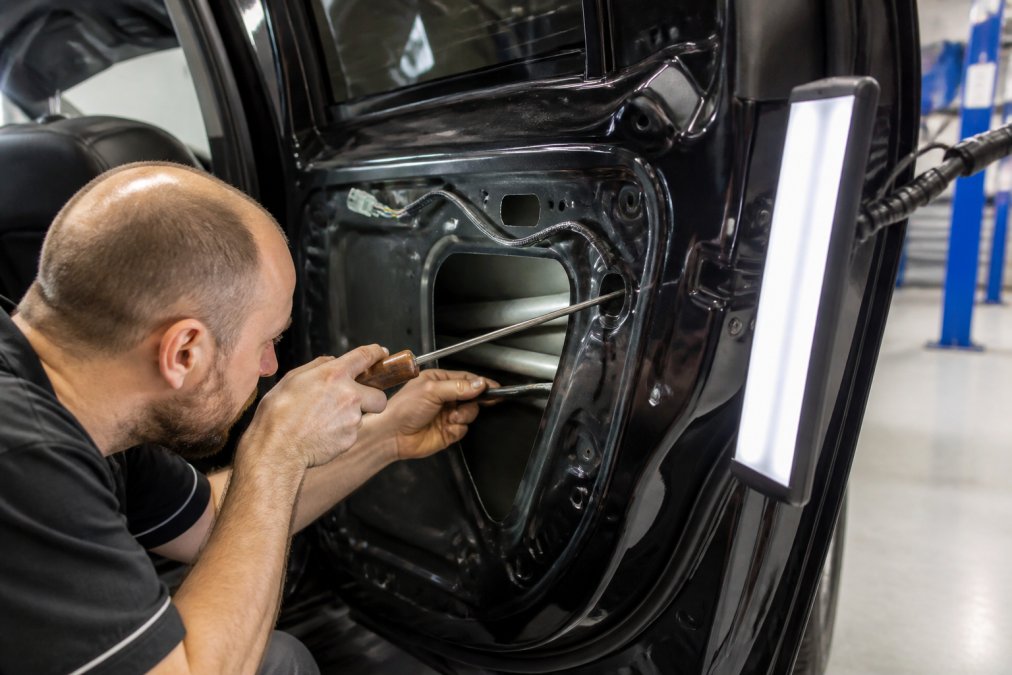
The family-owned company operates a 25,000 sq ft facility at 4707 LBJ Freeway in Dallas, with a second location in Scottsbluff, Nebraska. Technicians remove hail dents, door dings, and creases without fillers or repainting, preserving your factory finish and resale value. Every repair carries a lifetime warranty, plus free inspection, vehicle pickup and delivery, and rental assistance.
Pros:
- Full insurance claim management from start to finish
- Lifetime warranty on all repairs
- Vehicle pickup, delivery, and rental assistance
- Storm response crews deploy after major hail events
Cons:
- Primary shop is in Dallas, so far-flung suburbs rely on pickup and delivery
2. Dentwerks: 24 Years of Specialized Hail Damage Expertise
Dentwerks has focused on hail damage for more than two decades, and that longevity shows in how it handles large, complex claims.
The shop specializes in paintless dent repair and preserves the factory finish rather than resorting to body filler. The tradeoff is convenience: no online instant pricing, so you must call for an estimate.
Pros:
- Long-standing regional reputation
- Dedicated focus on non-invasive repair techniques
Cons:
- No online pricing or booking
- Limited mobile options
3. Dallas PDR Paintless Dent Repair: Mobile Convenience for Minor Dings
If your damage is a handful of parking lot dings rather than a full hail event, mobile service is the fastest fix. Dallas PDR brings the repair to your home or office and has more than 22 years of technician experience behind it. The limitation is scope: mobile setups handle minor dents and dings, not the hundreds of impacts a serious hailstorm leaves.
Pros:
- High convenience with on-site service
- Experienced technicians
Cons:
- Not equipped for severe hail damage
4. Auto Medic Dent Repair: Versatile Solutions from Dings to Severe Hail
Auto Medic covers the widest damage range on this list, from a single door ding to full hail restoration.
The shop uses precision PDR techniques and returns panels to factory condition without filler. Pricing varies with damage severity, so get a written estimate before authorizing work.
Pros:
- Handles minor and major damage
- Factory-standard finish focus
Cons:
- Pricing swings widely with severity
5. Transcendent PDR: Community-Trusted Quality
Transcendent PDR earns its place through customer reviews rather than advertising spend.
Local customers consistently rate the shop highly, and the work focuses on finish preservation. The tradeoff is thin online information: booking details are limited, so plan on a phone call to confirm availability and scope.
Pros:
- Strong local reputation
- Proven customer satisfaction record
Cons:
- Limited online booking information
6. Speedy Mobile Dent and Bumper Repair: Combined Cosmetic Repairs on the Go
Speedy handles two jobs in one visit: paintless dent repair and bumper repair.
That combination suits drivers with a scuffed bumper and a few dents at once. Mobile service is convenient, though weather can delay outdoor work. For a single dent, a dedicated PDR specialist usually finishes faster.
Pros:
- Convenient mobile service
- Broad cosmetic repair range
Cons:
- Weather-dependent scheduling
7. Grubbs Collision: Full-Service Collision Center with PDR Options
Grubbs Collision is a full collision center that offers PDR among its services, suiting drivers whose damage goes beyond dents.
If your vehicle needs structural or panel work alongside dent removal, a full-service facility avoids moving the car between shops. The tradeoff is speed: a busy collision center has longer wait times than a specialized PDR shop, and PDR is one service among many rather than the core focus.
Pros:
- Comprehensive repair capabilities
- Free estimates available
Cons:
- Longer wait times than specialized PDR shops
PDR vs Traditional Body Shop Repair: Which Preserves Value?
Paintless dent repair preserves your vehicle's resale value far better than traditional body shop work, and the reason is mechanical, not marketing. PDR keeps the original factory finish intact. Traditional repair removes it.
Here is what happens to the metal and paint in each method:
- PDR: The technician works the back of the panel with specialized rods and hooks, gradually pushing the metal back to its original contour. The factory paint, primer, and corrosion coating are never touched. No filler, no sanding, no repaint.
- Traditional repair: The panel is sanded to bare metal, body filler rebuilds the contour, the panel is primed, and the area is repainted and blended into adjacent panels. The original finish on that panel is gone permanently.
That difference shows up in three places at resale:
1. Paint thickness and appraiser inspection. Appraisers and trade-in buyers use a paint depth gauge to detect bodywork. A repainted panel reads thicker than factory paint, flagging the vehicle as having had collision or hail repair. A PDR-repaired panel reads factory-original because it is factory-original. On a late-model vehicle, an undetected repair history can impact trade-in value.
2. Color-match risk. Factory paint is applied in a controlled environment with a specific formulation. A body shop mixing paint to match a sun-aged panel may not get a perfect match, especially on metallics, pearls, and tri-coat finishes. A mismatch can be visible in certain light. PDR has no color-match risk because no paint is mixed.
3. Repair history and disclosure. A traditional repair is often reportable and can appear on a vehicle history report depending on how the claim and repair are documented. PDR, because it does not replace or repaint panels, is less likely to generate a record that reduces a trade-in offer.
There is also a corrosion angle. Factory panels are coated for corrosion resistance before paint. Sanding to bare metal and applying filler removes that coating, and a poor repaint can trap moisture and cause rust years later. PDR leaves the factory corrosion protection untouched.
When traditional repair is the right call. PDR is not always an option. If the paint is cracked at the dent, the metal is stretched past reshaping, the dent sits on a panel edge or body line, or the damage includes structural components, conventional repair is correct. A qualified PDR technician will tell you when a dent is not a PDR candidate rather than forcing it and risking cracked paint.
What insurers prefer. Many insurers now prefer PDR for hail claims because it can cost less than conventional repair. That preference is not universal, and your claim is not automatically routed to PDR. Ask your adjuster which method your claim authorizes, and get it in writing.
The Paintless Dent Repair Insurance Claim Process
The paintless dent repair insurance claim process follows five steps, and knowing them prevents most delays.
- File the claim. Contact your insurer and get a claim number the same day.
- Get an inspection. A PDR shop documents every dent and produces a damage map.
- Adjuster estimate. Your insurer sends an adjuster or requests photos.
- Supplement if needed. If the estimate misses dents, the shop files a supplement.
- Repair and payment. Work begins, and the shop bills your insurer directly.
What Affects Auto Hail Damage Repair Cost
Auto hail damage repair cost is not a flat rate. It is built from dent count, dent size, panel access, panel material, and the labor hours each panel requires. Two vehicles with the same number of dents can land hundreds of dollars apart because a dent on a flat steel hood is a 20-minute job while the same dent on a reinforced roof rail or aluminum fender can take an hour or more.
Here is how pricing breaks down:
- Dent count. Most shops price in tiers. A handful of dings is a small job; a full hail event leaving 100 to 300 impacts across the hood, roof, trunk, and both sides is priced per panel, not per dent, because technicians work the whole panel at once.
- Dent size and sharpness. A dime-sized ding with rounded edges is the easiest repair. A quarter-sized crease with a sharp edge has stretched the metal, which takes longer to work back because the technician must shrink it, not just push it.
- Panel access. Hoods, trunks, and doors have open backside access, making them the fastest panels. Roof rails, A-pillars, and rear quarter panels are braced or double-walled, so the technician works through existing holes or removes interior trim to reach the back.
- Panel material. Aluminum panels are softer and less elastic than steel, requiring slower, more controlled pressure and less forgiving of a misjudged push, so labor time runs higher. Many late-model trucks and premium vehicles use aluminum hoods and fenders.
- Paint condition. If the paint is already cracked at the dent, PDR is off the table and the panel needs conventional repair, which can multiply the cost of one panel several times over.
- Vehicle size and roof height. A full-size SUV or truck has more surface area and taller panels, adding labor time versus a compact sedan.
Two other cost levers matter:
- Your deductible. On a comprehensive claim, you pay your deductible and the insurer covers the rest of the approved estimate. If your deductible is $1,000 and the approved repair is $2,400, you pay $1,000. If the approved repair is $900, you are paying out of pocket either way, and filing may not be worth it.
- Storm surge pricing. After a major hail event, demand spikes and shops book out for weeks. Some hold pricing steady and extend timelines; others raise rates or add storm fees. Ask whether the quote changes if you book during a storm backlog.
Because every estimate is vehicle-specific, no honest shop quotes a firm number over the phone. Get a free inspection and a written estimate that lists dent count by panel, and confirm in writing whether your insurer is paying the shop directly or reimbursing you. The Texas Department of Insurance consumer help page explains your rights if a claim is delayed or denied.
Frequently Asked Questions
How much does paintless dent repair cost for hail damage in DFW?
Auto hail damage repair cost in DFW depends on the number of dents, their size and location, and your vehicle's make and model. A free inspection can provide a written estimate before any work begins. Because pricing varies so much, it's best to get a personalized quote. Many providers, including 888 PDR, work directly with insurance companies to cover the repair, so your out-of-pocket expense may be limited to your deductible.
Does insurance cover paintless dent repair for hail damage?
Yes, most comprehensive auto insurance policies cover hail damage repairs, and paintless dent repair is often the preferred method because it preserves your vehicle's factory finish. The paintless dent repair insurance claim process typically starts with filing a claim, getting an inspection, and receiving an estimate. Some DFW shops handle the paperwork and communicate directly with your insurer, making the process smoother for you.
Is paintless dent repair better than traditional body shop repair?
For dents where the paint is not cracked or chipped, PDR vs traditional body shop repair can be a better option because it keeps your original factory finish intact, which helps maintain vehicle resale value. Traditional repair can involve body filler and repainting, which may be detected and could lower your car's value. PDR is also faster and less invasive, though it may not be suitable for every type of damage, such as deep creases or dents near panel edges.
How long does a typical paintless dent repair take?
Turnaround time depends on the extent of the damage. A single door ding can be fixed in under an hour, while extensive hail damage may take several days. Some DFW shops offer rental vehicle assistance to keep you on the road during repairs. When you choose a provider for paintless dent repair in DFW, ask about their estimated timeline and whether they offer pickup and delivery to minimize disruption to your schedule.
What should I look for in a qualified PDR technician?
Look for technician certification, years of experience, and a portfolio of completed repairs. A reputable shop may offer a lifetime warranty on their work, use specialized tools like rod and hook or glue pulling systems, and have clear communication about the process. Check reviews and ask if they handle insurance claims directly. In DFW, some providers also offer mobile service, but confirm they have a physical location for more complex hail damage repairs.