Table of Contents
- Does Paintless Dent Repair Actually Work on Aluminum?
- Aluminum vs. Steel Auto Body Repair: Key Differences
- Aluminum Hail Damage Repair: What PDR Can Handle
- When PDR Is Not Suitable for Aluminum Dents
- PDR Technician Experience with Aluminum Panels
- Realistic Expectations: Timeline, Cost, and Results
- Preserving Factory Finish and Resale Value
- Frequently Asked Questions
Last Updated: October 21, 2026
Does Paintless Dent Repair Actually Work on Aluminum?
Whether is paintless dent repair effective for aluminum bodies is a question with important caveats, the answer is yes, but aluminum behaves differently from steel.
Aluminum responds to reshaping, the core principle behind PDR, but its physical properties make the process trickier. The metal is softer, more prone to springback, and can develop stress fractures if handled incorrectly, so success depends on dent characteristics, technician skill, and existing panel damage.
The key insight most people miss: aluminum doesn't "remember" its original shape the way steel does. Steel has greater metal memory and wants to return to form. Aluminum, being softer, can hold a reshaped position but may also shift back unpredictably if the technique isn't precise.
Aluminum vs. Steel Auto Body Repair: Key Differences
The fundamental difference between aluminum and steel panels shapes everything about repair strategy. Steel is harder, denser, and more elastic. Aluminum is lighter, softer, and more prone to permanent deformation if reshaping isn't executed perfectly.
Why Aluminum Is More Difficult to Repair
Aluminum's softness is both a blessing and a curse. It's easier to reshape initially, requiring less force, but that same softness means it can crease permanently if pressure is applied incorrectly. One wrong angle or too much force can create micro-fractures in the aluminum structure.
Steel forgives mistakes better, gradually returning to shape under steady pressure. Aluminum demands precision: the technician must know exactly how much force to apply and from which angle. Too much pressure creates permanent damage; too little leaves the dent partially reshaped.
Additionally, aluminum oxidizes. If a dent exposes raw aluminum, oxidation begins immediately, weakening the panel's structural integrity and complicating future repairs. Steel rusts, but more slowly and predictably.
How Aluminum Responds to Reshaping
When a technician applies pressure to reshape aluminum, the metal moves more readily than steel. That seems like an advantage, but it means the margin for error is razor-thin.
Aluminum exhibits springback, the tendency to partially return to its original shape after force is removed.
The metal's response also depends on the dent's location and depth. A shallow door ding may respond perfectly to gentle pressure, while a crease along a panel edge, where the metal is already stressed, may resist reshaping or crack.
Temperature affects aluminum differently than steel. Aluminum conducts heat rapidly and can become brittle in cold conditions. A dent repair attempted in freezing weather may fail because the cold aluminum loses flexibility. This is why technician experience with aluminum-specific challenges matters so much.
Aluminum Hail Damage Repair: What PDR Can Handle
Hail damage creates hundreds of small, shallow dents across large panel areas. For aluminum bodies, it's one of the best PDR candidates if the dents meet specific criteria.
Small hail dents (under 1 inch) with no paint cracking respond exceptionally well to paintless repair on aluminum.
Larger hail dents (1-2 inches) become riskier on aluminum. The deeper the dent, the more force required, increasing the chance of stress points or micro-fractures. Some larger hail dents may still be repairable with PDR, but they require exceptional skill and patience.
The real limitation appears when hail damage includes paint cracking or metal creasing. If the impact cracked the paint, the underlying aluminum likely has stress fractures, and reshaping it can cause further cracking. These cases require conventional repair with paint and filler.
Dent Size, Depth, and Location as Repair Factors
Dent size is the first screening factor. Small dents (under 1 inch) are excellent PDR candidates on aluminum. Medium dents (1-2 inches) are possible but require skilled technique. Large dents (over 2 inches) are increasingly difficult and may require conventional repair.
Dent depth matters more than size on aluminum. A 2-inch dent a quarter-inch deep is more repairable than a 1-inch dent half an inch deep. Deeper dents require more force, increasing the risk of permanent damage.
Location significantly affects repairability. Dents on flat panel areas are easier to access and reshape. Dents near panel edges, door creases, or window frames are riskier because that metal is already stressed and curved.
Dents in areas with multiple metal layers, like door panels with interior reinforcement, are also harder. The technician must account for hidden layers and apply pressure carefully to avoid damaging the structure beneath.
Door Dings and Minor Dents on Aluminum Panels
Door dings are among the most common dents on aluminum bodies and usually excellent candidates for paintless repair. A typical door ding is shallow, localized, and doesn't involve paint damage, so it responds well to PDR because the shallow depth requires minimal force.
Shopping cart hits and parking lot bumps create similar shallow dents. If the paint isn't cracked and the dent is under 2 inches, PDR succeeds on aluminum more often than not. Address the dent quickly: the sooner after impact, the easier the reshaping, since the metal hasn't fully settled into its new shape.
Minor creases along panel lines are trickier. A crease along an existing panel edge involves metal that's already bent and stressed, and reshaping it can extend the crease or crack the metal. These dents sometimes require conventional repair even though they're small.
When PDR Is Not Suitable for Aluminum Dents
Not every dent on an aluminum body is a PDR candidate. Knowing the limits prevents wasted time and money.
Sharp Dents and Paint Damage
Sharp dents with defined edges are harder to reshape on aluminum than rounded dents. A sharp crease concentrates stress on a narrow line of metal, and when a technician applies pressure, that stress point becomes a weak spot. Aluminum can crack along sharp creases more easily than steel.
If the dent includes paint cracking or chipping, the aluminum underneath is compromised. The impact breached the protective paint layer and likely created stress fractures, so attempting PDR risks extending the damage. These dents almost always require conventional repair: sanding, priming, and repainting the cracked area.
Dents with visible raw aluminum beneath the paint also indicate stress fractures. The exposed metal oxidizes rapidly, weakening the panel further, so these dents require paint repair to prevent ongoing oxidation.
Springback and Metal Memory Challenges
Aluminum's weak springback is a double-edged sword. The metal won't fight back as hard when reshaped, but the reshaping can be imprecise: if a technician overshoots slightly, the metal won't spring back to correct the mistake.
Some dents exhibit "creep" on aluminum, slowly shifting back toward their original shape over weeks after repair because the metal lacks strong memory. A dent that looks perfect immediately after PDR might show a slight depression again after a month. On steel this is rare; on aluminum it's a known risk.
Dents in high-stress areas are especially prone to springback issues. Metal near welds, reinforcement points, or panel edges is already under structural stress, and reshaping it can cause unpredictable springback.
PDR Technician Experience with Aluminum Panels
Not all PDR technicians are equally skilled with aluminum. The technique requires specific training and experience. A technician proficient with steel panels may struggle with aluminum's different properties.
Specialized Tools and Technique Requirements
Aluminum repair requires different tools than steel. Access points often differ because aluminum panels are typically thinner, and pressure points must be more precise because the softer metal can't tolerate the same force levels.
A qualified aluminum PDR technician uses specialized glue-pulling systems designed for softer metals, applying steady, controlled pressure rather than the aggressive techniques used on steel.
The technique itself differs.
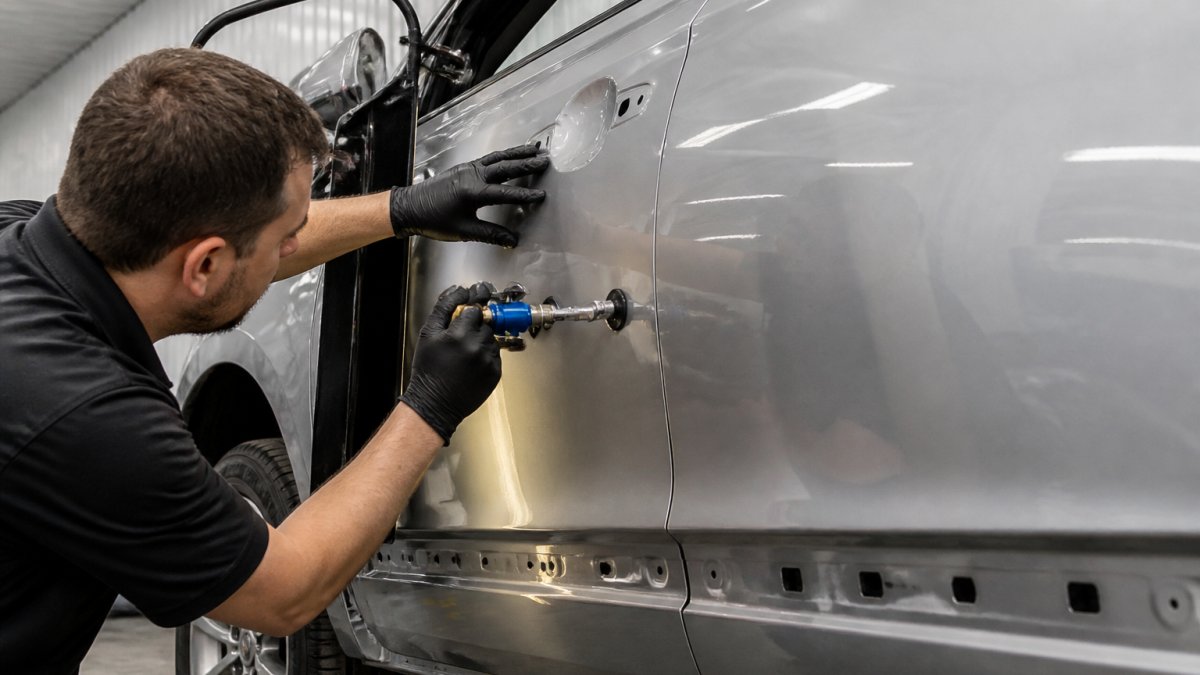
Experience with aluminum-specific challenges is essential. A technician who has worked with hundreds of aluminum panels understands how various alloys respond, including how newer alloys in modern vehicles differ from older versions.
Heat Use During Aluminum Repair
Heat is sometimes necessary during aluminum PDR, but it must be used carefully. Aluminum conducts heat rapidly and can become brittle if overheated; the goal is to warm the metal slightly to increase flexibility, not to heat-treat it.
A qualified technician applies heat gradually with specialized automotive heat guns, carefully controlling temperature, typically between 100-150 degrees Fahrenheit. This modest warming makes the aluminum slightly more pliable without damaging the paint or creating brittleness.
Heat is most useful for stubborn dents that resist reshaping at room temperature, helping the metal conform to the technician's efforts.
Never allow aggressive heating methods on aluminum panels. If a technician suggests torch-heating or other extreme heat methods, find a different shop: these approaches risk warping the panel, damaging surrounding components, and creating structural weaknesses.
Realistic Expectations: Timeline, Cost, and Results
Timeline varies with dent complexity. Simple door dings typically take 1-2 hours; moderate hail damage across multiple panels might require 4-8 hours; complex dents with multiple creases or large affected areas could take a full day or more.
Results on aluminum are often excellent for ideal candidates: shallow dents with no paint damage disappear completely, and the factory finish remains untouched. For more challenging dents, results may be partial, improving significantly but not vanishing entirely.
Cost depends on the number and complexity of dents. A single door ding costs far less than hail damage covering multiple panels. PDR pricing is typically lower than conventional repair because no paint, filler, or repainting is required.
Insurance coverage varies. Many policies cover PDR for hail damage, sometimes with a deductible. Some insurers prefer PDR because it's faster and cheaper than conventional repair; others may push conventional repair regardless of suitability.
Preserving Factory Finish and Resale Value
The primary advantage of paintless dent repair is preservation of the factory finish. Your vehicle leaves the manufacturer with a specific paint formulation, thickness, and finish quality.
When conventional repair involves repainting, the new paint never quite matches the original.
PDR avoids this entirely. The factory finish remains untouched, so when you eventually sell, the paint is original.
Panel structural integrity also matters for resale.
For aluminum bodies specifically, preserving the factory finish is even more important. Aluminum oxidizes, and the factory finish includes protective coatings that prevent it.
Paintless dent repair is genuinely effective for many aluminum body dents, but success depends on dent characteristics, technician expertise, and realistic expectations.
At 888 PDR, we specialize in aluminum body repair and understand the nuances of working with this material.
Frequently Asked Questions
Is paintless dent repair good for hail damage on aluminum vehicles?
Paintless dent repair can be effective for aluminum hail damage, particularly for small to medium dents without paint crease or sharp edges. Aluminum responds differently than steel due to its material properties and springback tendency, so success depends on dent characteristics, panel location, and technician expertise with aluminum-specific techniques. Many hail-damaged aluminum vehicles are good candidates for PDR when dents meet specific criteria.
What makes aluminum hail damage repair more challenging than steel?
Aluminum exhibits springback, the tendency to partially return to its original shape after force is removed, and its response can be less predictable than steel. Aluminum also conducts heat differently, requiring specialized heating techniques to avoid damage. Additionally, aluminum panels are often thinner and more prone to creasing, and the material's softer nature means sharp dents can cause permanent paint damage more easily than on steel.
When is PDR not suitable for aluminum dents?
PDR is not recommended for aluminum dents with sharp creases, significant paint damage, or dents on edges and panel seams where access is limited. Hail damage involving multiple deep overlapping dents or dents requiring heat treatment beyond safe aluminum tolerances also require conventional repair. A qualified technician should assess each dent individually to determine repairability.
How do I find a PDR technician experienced with aluminum panels?
Look for technicians certified in aluminum-specific PDR techniques. Ask directly about their specialized tools for aluminum work and whether they use heat during repairs. Verify they understand aluminum springback and metal memory challenges. A reputable shop should provide a free inspection and honest assessment of what PDR can achieve on your specific damage.
Will paintless dent repair preserve my car's factory finish and resale value?
Yes. PDR removes dents without fillers, repainting, or grinding, preserving the original factory finish and clear coat. This maintains your vehicle's resale value better than conventional repair, which involves repainting and can affect color matching and long-term durability. For aluminum vehicles especially, keeping the factory finish intact is valuable because it demonstrates no major body work occurred, a key factor buyers consider when evaluating used cars.