Table of Contents
- Paintless Dent Repair vs Body Shop Fillers: Key Differences
- What Is Paintless Dent Repair?
- How Traditional Body Shop Fillers Work
- Benefits of Paintless Dent Repair
- How Long Does Paintless Dent Repair Take?
- Paintless Dent Repair Cost 2026: What to Expect
- When to Choose PDR vs Body Shop Repairs
- Insurance Claims and Long-Term Durability
Last Updated: August 23, 2026
Paintless Dent Repair vs Body Shop Fillers: Key Differences
When your car gets dinged in a parking lot or hammered by hail, you face a choice that affects your repair timeline, your wallet, and your vehicle's resale value. Paintless dent repair and traditional body shop fillers are fundamentally different approaches. This guide from 888 PDR breaks down exactly how each method works, when to use each one, and how to navigate insurance claims without getting stuck with unexpected bills.
The core tension is simple: paintless dent repair preserves your factory finish and resale value while getting you back on the road fast. Body shop fillers provide a solid fix for severe damage but require sanding, priming, and repainting, a process that takes longer and changes your vehicle's original paint.
What Is Paintless Dent Repair?
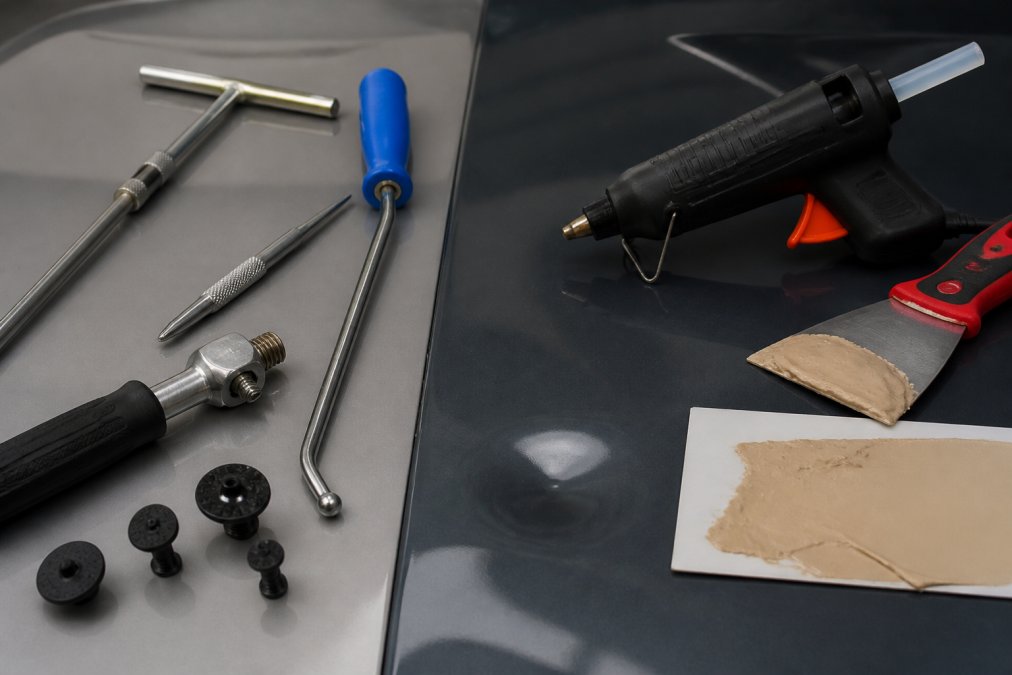
Paintless dent repair (PDR) is a damage-removal technique that restores dented or creased metal panels to their original shape without sanding, filling, or repainting. Technicians use specialized tools, rods, and hooks to access the underside of panels and massage the metal back into place, relying on the metal's natural memory to return to its original form.
A PDR technician locates the dent, identifies the best access point (often from behind the panel through existing openings), and uses precision tools to gradually push and massage the metal outward. The technique preserves the factory finish completely, no paint is touched, no primer is applied, no clear coat is added.
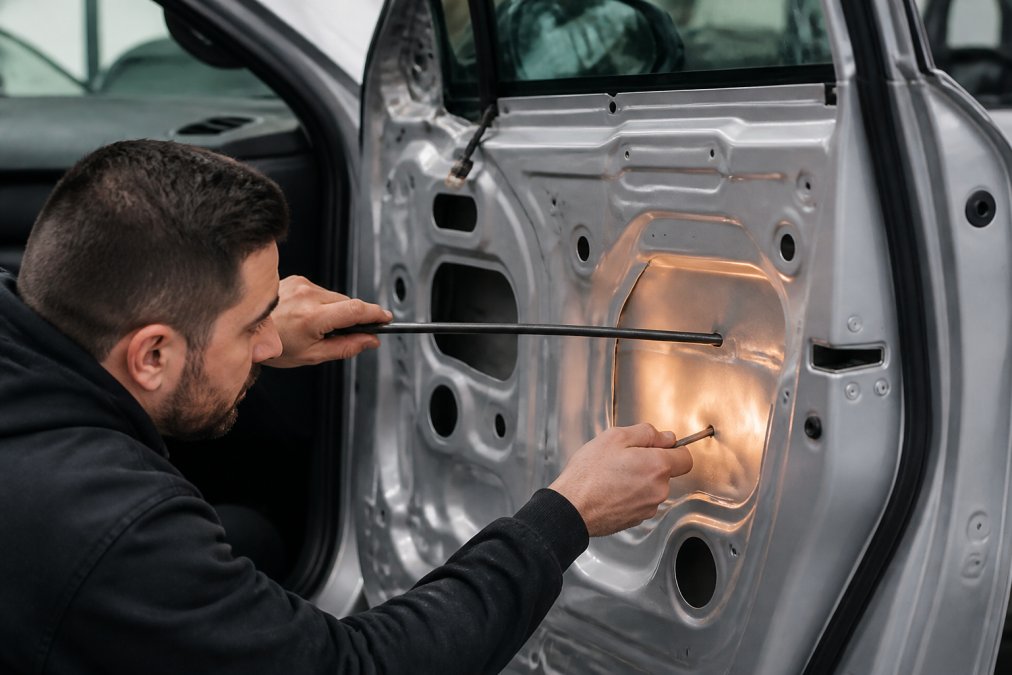
PDR works best on minor to moderate damage where the paint isn't broken and the metal hasn't been severely creased. Door dings, hail damage, crease lines, and shopping cart hits are textbook PDR jobs. The technique fails when the paint is cracked or missing, or when the panel has been severely deformed.
Because no paint is involved, there's no color-matching risk, no overspray, and no worry that your repair will look different under different lighting. Your factory finish remains exactly as the manufacturer intended, which matters enormously for resale value. A car with its original paint commands more money on the used market than one with repainted panels.
How Traditional Body Shop Fillers Work
Body shop fillers are putty-like compounds that fill gaps, gouges, and dents in metal panels, then are sanded smooth, primed, and painted to match the vehicle's original color. The filler bonds to the metal surface and hardens, creating a solid base for the paint system.
The traditional body shop repair process involves multiple steps. First, the technician assesses the damage and determines whether the panel can be straightened or needs replacement. If straightening is possible, they use body hammers and dollies to reshape the metal. Then they apply body filler, products like Evercoat or 3M Platinum Plus, over the remaining imperfections. The filler is applied in layers, with each layer sanded smooth before the next is applied.
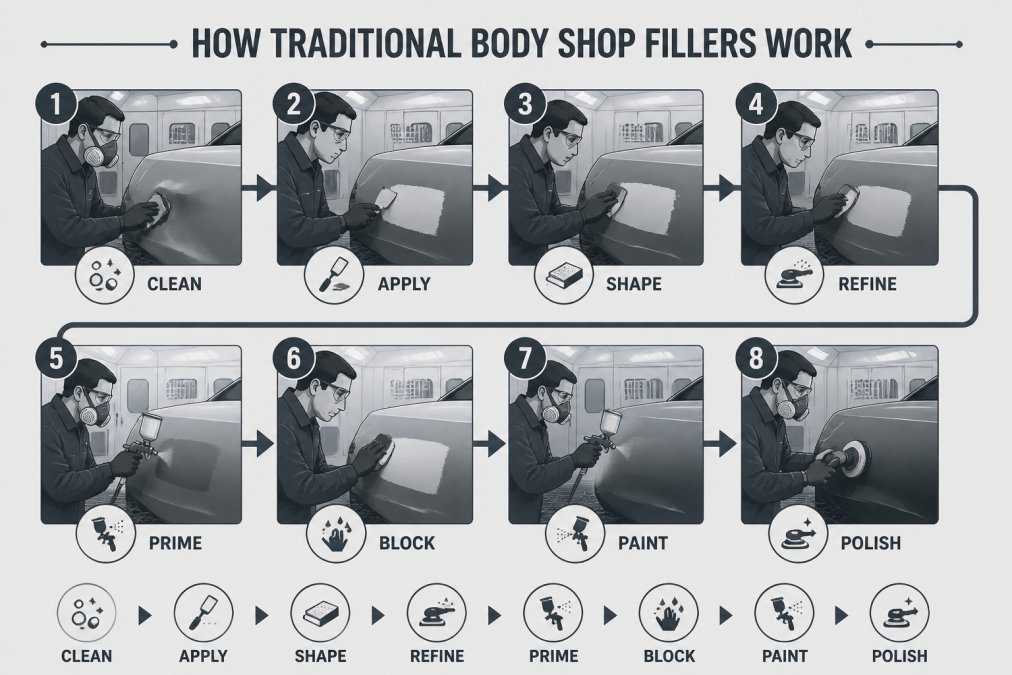
Once the filler is shaped and sanded to match the panel's contours, the technician applies primer, then base coat, then clear coat. This is where color matching becomes critical. Modern paint systems include metallic flakes, pearl effects, and custom tints that can be difficult to match exactly. If the match is off, the repair is visible in certain lighting.
Body shop repairs are necessary for deep dents, sharp creases where the paint is broken, and damage that PDR can't address. The trade-off is time and cost: a full body shop repair takes days or weeks, not hours, and the labor and materials add up quickly.
Benefits of Paintless Dent Repair
Paintless dent repair offers several concrete advantages over traditional fillers, especially for hail damage, door dings, and minor creases. The most obvious benefit is speed. A PDR job that would take a body shop a week can be completed in hours. For vehicle owners who depend on their car for work or daily commuting, this difference is significant.
The second major advantage is factory finish preservation. Your original paint remains untouched. This matters for resale value: vehicles with original factory paint command a premium in the used market. Insurance adjusters and used-car buyers both recognize original paint as a marker of well-maintained vehicles.
Cost-efficiency is another key benefit. For minor damage, PDR is significantly cheaper than body shop work because there's no labor for sanding, priming, or painting. For hail damage affecting multiple panels, the savings compound. A vehicle with 50 hail dents repaired via PDR costs a fraction of what traditional fillers would cost, and your insurance deductible often covers the entire repair.
The durability of PDR repairs is also worth noting. Because the original paint system is preserved, there's no risk of paint failure, color mismatch, or clear coat peeling. Many PDR shops, including 888 PDR, offer lifetime warranties on their work, a confidence level that body shop repairs rarely match.
How Long Does Paintless Dent Repair Take?
The timeline for paintless dent repair depends on the number of dents, their location, and their severity. A single door ding typically takes 30 minutes to an hour. A vehicle with moderate hail damage affecting 10-20 panels might take 4-8 hours. Severe hail damage with 50+ dents can take 1-3 days.
The key advantage is that PDR is measured in hours, not days or weeks. A body shop repair of comparable damage would take 5-10 business days or longer, accounting for drying time between paint coats (sema.org).
Dents on curved panels (doors, fenders, hood) are faster than dents on flat panels (roof, trunk) because the curved shape provides natural access points. Sharp creases take longer than rounded dents because they require more careful manipulation. Dents in areas with limited access, near trim, windows, or panel edges, take more time because the technician has fewer angles to work from.
For hail damage claims, 888 PDR manages the entire insurance process, from initial inspection through final claim settlement, which eliminates delays caused by paperwork back-and-forth.
Paintless Dent Repair Cost 2026: What to Expect
The cost of paintless dent repair varies based on damage severity, panel location, and local market rates. Pricing depends on damage severity and repair complexity. For an accurate estimate on your specific damage, 888 PDR offers free inspections and quotes.
Many insurance policies cover PDR fully, with your deductible applied to the total claim. This means if your hail damage repair is approved for insurance coverage, you may owe nothing out of pocket if the repair cost exceeds your deductible.
For an accurate estimate on your specific damage, 888 PDR offers free inspections and quotes. Once you have a quote, you can file an insurance claim, and the shop can work directly with your insurance carrier to finalize coverage.
The cost advantage of PDR becomes even clearer when you compare it to body shop work. A vehicle with 30 hail dents repaired via traditional fillers would require multiple panels to be sanded, primed, and painted, a process that can cost several thousand dollars and take 2-3 weeks. The same vehicle repaired via PDR costs a fraction of that and is completed in days.
When to Choose PDR vs Body Shop Repairs
The decision between paintless dent repair and body shop fillers depends on damage type, paint integrity, and your priorities.
Choose PDR when:
- The paint is intact (no cracks, scratches, or missing paint)
- The dent is minor to moderate in depth
- You need your vehicle back quickly
- You prioritize preserving factory finish and resale value
- You have hail damage, door dings, or crease lines
- You want to minimize out-of-pocket costs
Choose traditional body shop fillers when:
- The paint is cracked, chipped, or missing
- The dent is severe or involves sharp creases with paint damage
- The metal is severely deformed or requires replacement
- Multiple panels are damaged and structural alignment is questionable
- The damage involves rust or corrosion that requires metal removal
The practical reality is that most hail damage and door dings fall squarely in the PDR category. Body shop repairs are necessary for a smaller subset of damage, usually impact damage, rust repair, or accidents where multiple systems are involved.
Insurance Claims and Long-Term Durability
Insurance claim management is where the PDR advantage becomes most apparent. Most comprehensive auto policies cover hail damage with a deductible (iii.org). When hail hits, your claim is typically approved quickly, and the repair can begin immediately.
Here's what often goes wrong: a vehicle owner files a claim, the insurance adjuster approves a certain amount, and the repair shop completes the work. But if the actual damage is more extensive than initially assessed, the repair shop submits a supplement request. If denied, the vehicle owner is left paying the difference out of pocket.
This is where working with a shop that manages claims directly matters. 888 PDR handles the entire process, from initial inspection through supplement negotiation and final payment. You're not coordinating between your insurance company and the repair shop; the shop does that for you.
Long-term durability comparison: PDR repairs last as long as your vehicle because the original metal and paint are preserved. There's no risk of filler cracking, paint peeling, or color mismatch years down the road. Body shop repairs, when done correctly, also last, but they depend on paint quality and application.
For resale value, original paint always outperforms repainted panels in the used market, regardless of how well the repair was executed. A buyer sees repainted panels as a red flag, even if the repair is flawless. Original paint signals no accident history and no major repairs, which translates to higher resale value.
| Repair Method | Best For | Timeline | Paint Preservation | Cost | Durability |
|---|---|---|---|---|---|
| Paintless Dent Repair | Minor to moderate dents, hail damage, door dings | Hours to 1-2 days | Factory finish intact | Lower | Original paint system |
| Body Shop Fillers | Severe damage, paint broken, metal deformed | 5-10+ business days | Requires repainting | Higher | Depends on paint application |
=== FAQ ANSWERS (audit these too, same rules) ===
[1] Q: Is paintless dent repair cheaper than body shop filler repairs? A: Paintless dent repair typically costs less than traditional body shop repairs because it eliminates the need for filler, sanding, priming, and repainting. PDR focuses on massaging the metal back into shape using specialized tools, preserving your factory finish. Body shop repairs require multiple labor-intensive steps and materials, which increases the total cost. Pricing depends on damage severity and repair complexity, so contact 888 PDR for a free estimate tailored to your vehicle.
[2] Q: Can paintless dent repair handle all types of dents? A: Paintless dent repair works best on dents where the paint is intact and the metal has not been creased too sharply. Small door dings, hail damage, and shallow creases respond well to PDR. However, large dents with sharp creases, cracked paint, or severe damage may require traditional body shop repairs. A professional inspection determines whether PDR is suitable for your specific damage. 888 PDR offers free inspections to assess your vehicle.
[3] Q: How does paintless dent repair preserve resale value compared to body fillers? A: Paintless dent repair preserves your vehicle's original factory finish, which is a major resale factor. Buyers and appraisers recognize that PDR-repaired vehicles retain their OEM paint and structural integrity. Body filler repairs, while functional, show evidence of previous damage and repainting, which can lower resale value. Maintaining factory paint integrity signals that your vehicle has been properly cared for, making it more attractive to future buyers.
[4] Q: What does a lifetime warranty on paintless dent repair actually cover? A: A lifetime warranty on PDR repairs covers defects in the workmanship and the repair itself for the life of your vehicle ownership. This means if the dent reappears or the repair fails due to the technician's work, the shop will fix it at no cost. The warranty typically does not cover new damage from accidents, impacts, or normal wear. 888 PDR's lifetime warranty provides peace of mind that your repairs are protected long-term.
Frequently Asked Questions
Is paintless dent repair cheaper than body shop filler repairs?
Paintless dent repair typically costs less than traditional body shop repairs because it eliminates the need for filler, sanding, priming, and repainting. PDR focuses on massaging the metal back into shape using specialized tools, preserving your factory finish. Body shop repairs require multiple labor-intensive steps and materials, which increases the total cost. Pricing depends on damage severity and repair complexity, so contact 888 PDR for a free estimate tailored to your vehicle.
Can paintless dent repair handle all types of dents?
Paintless dent repair works best on dents where the paint is intact and the metal has not been creased too sharply. Small door dings, hail damage, and shallow creases respond well to PDR. However, large dents with sharp creases, cracked paint, or severe damage may require traditional body shop repairs. A professional inspection determines whether PDR is suitable for your specific damage. 888 PDR offers free inspections to assess your vehicle.
How does paintless dent repair preserve resale value compared to body fillers?
Paintless dent repair preserves your vehicle's original factory finish, which is a major resale factor. Buyers and appraisers recognize that PDR-repaired vehicles retain their OEM paint and structural integrity. Body filler repairs, while functional, show evidence of previous damage and repainting, which can lower resale value. Maintaining factory paint integrity signals that your vehicle has been properly cared for, making it more attractive to future buyers.
What does a lifetime warranty on paintless dent repair actually cover?
A lifetime warranty on PDR repairs covers defects in the workmanship and the repair itself for the life of your vehicle ownership. This means if the dent reappears or the repair fails due to the technician's work, the shop will fix it at no cost. The warranty typically does not cover new damage from accidents, impacts, or normal wear. 888 PDR's lifetime warranty provides peace of mind that your repairs are protected long-term.
Working with 888 PDR means your hail damage, door dings, and crease repairs are handled by specialists who preserve your factory finish, manage your insurance claim from start to finish, and back their work with a lifetime warranty. Get a free inspection and quote today, no obligation, no pressure, just clarity on your repair options and what your insurance actually covers.
This article was written using GrandRanker