
Table of Contents
- What Paintless Dent Repair Is and How Size Matters
- What Dents Can PDR Fix: The Size Spectrum
- Large Dent Paintless Repair: When Size Becomes a Challenge
- Hail Damage Paintless Dent Repair: Multiple Dents and Coverage
- Beyond Size: Factors That Determine PDR Eligibility
- Paintless Dent Repair Cost: What Affects Your Price
- What PDR Cannot Fix: Know the Limits
- How to Assess Your Dent and Get an Accurate Estimate
- Frequently Asked Questions
Last Updated: October 16, 2026
What Paintless Dent Repair Is and How Size Matters
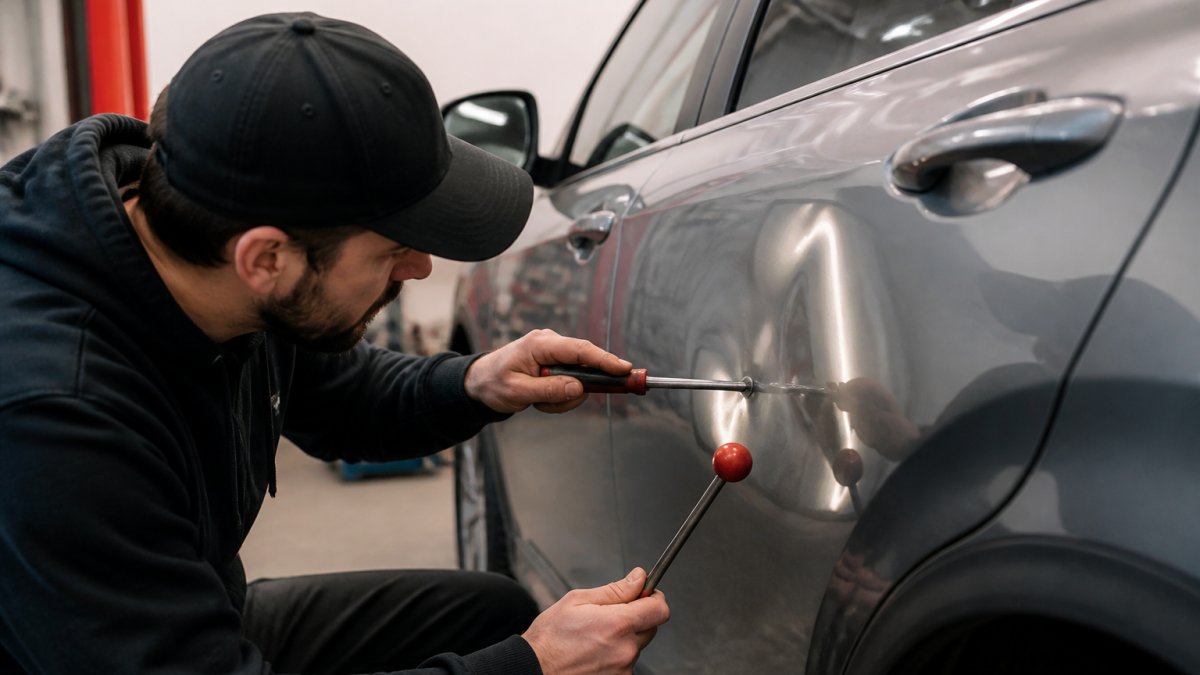
Paintless dent repair (PDR) removes dents without fillers, sanding, or repainting, preserving your car's factory finish and resale value. A technician accesses the back of the panel and manipulates the metal back into shape. Unlike traditional body shop work, what size dents can be fixed with paintless repair depends on several interconnected factors beyond diameter.
At 888 PDR, size alone doesn't determine repairability: a one-inch dent might be easy in one spot and impossible in another. The real factors are paint condition, metal stretch, panel access, and dent shape.
What Dents Can PDR Fix: The Size Spectrum
Small Dents and Door Dings (Up to 1 Inch)
Small dents and door dings are the most common PDR candidates. Damage up to one inch in diameter, shopping cart hits, parking lot dings, minor impacts, typically qualifies if the paint remains intact.
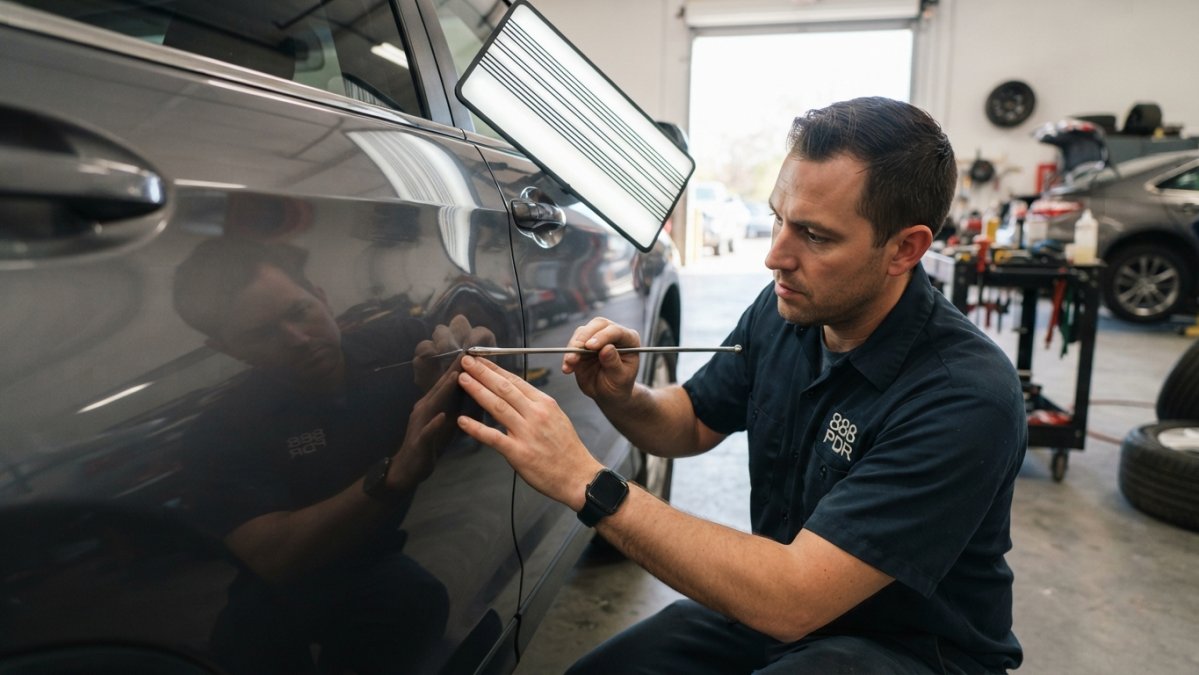
A typical door ding on a sedan or SUV fits this category: localized damage, intact paint, and metal memory working in your favor.
The key limitation is paint condition: if the impact cracked or chipped the paint, repainting is required, moving the job outside paintless repair.
Medium Dents (1 to 3 Inches)
Medium dents from one to three inches are more variable, often resulting from minor collisions, hail, or significant door strikes.
At one to two inches, most dents are still PDR candidates if the metal hasn't stretched and paint is undamaged. Near three inches, metal stretching becomes more likely, and stretched metal can't return to shape through PDR alone.
Location matters at this size. A two-inch dent on a flat door panel is far more repairable than one on a curved hood or fender, where body lines and contours create access challenges.
Larger Dents and Creases (3 to 5 Inches)
Dents larger than three inches are challenging. What size dents can be fixed with paintless repair at this scale depends on depth, metal condition, and whether the damage is a crease or a simple depression.
Creases, sharp, linear dents on door edges or body lines, are particularly problematic. The metal is stressed at a sharp angle and may not return to factory contour even with aggressive PDR work; many require filler and repainting.
Larger dents also risk metal memory failure: if the metal is significantly stretched, pushing it back may improve appearance but won't match factory contour.
Large Dent Paintless Repair: When Size Becomes a Challenge
Large dent paintless repair, damage exceeding five inches, rarely succeeds with PDR alone. Metal stretch is almost always present, panel access becomes difficult, and the risk of incomplete repair rises sharply.
At five to six inches or larger, the metal has typically stretched beyond what PDR tools can fully restore. Technicians can improve appearance significantly, but factory-perfect results become unrealistic. Many shops refuse large PDR work because expectations can't be met.
Panel location and access become critical at this size. A large dent on a door is more accessible than one on a roof, where technicians work from inside with limited room.
Hail Damage Paintless Dent Repair: Multiple Dents and Coverage
Hail damage makes what size dents can be fixed with paintless repair a question of volume, pattern, and cumulative damage rather than individual dimensions. A hailstorm typically creates dozens or hundreds of small to medium dents across multiple panels; each might be PDR-eligible, but density affects overall repairability.
Typical Hailstone Damage Patterns
Most hailstones create dents from half an inch to two inches in diameter, usually PDR candidates, small and shallow with intact paint. The challenge is volume: a single storm can create 50, 100, or even 500 dents across a vehicle.
Density matters. Scattered dents can be addressed individually, but tightly clustered or overlapping dents are exponentially harder, metal pushed inward multiple times is nearly impossible to restore to original contour.
Paint damage from hail is also common: larger or faster-moving hailstones can chip or crack the finish, automatically disqualifying those areas from PDR and requiring conventional repair.
Severe Hail Events and Repair Feasibility
Severe hail, stones larger than golf balls or at extreme velocities, often exceeds PDR capabilities, producing dents exceeding three to four inches, significant paint damage, and overlapping impacts.
A hybrid approach becomes necessary: PDR technicians repair the 60-80% of dents that qualify, while the rest, especially those with paint damage or severe stretch, require conventional body shop treatment, balancing cost, turnaround time, and quality.
888 PDR handles hail damage insurance claims across the Dallas-Fort Worth area and deploys storm response crews after major events.
Beyond Size: Factors That Determine PDR Eligibility
Paint Condition and Factory Finish
Paint condition is the primary disqualifying factor. Any crack, chip, crease, or crazing moves the dent outside PDR scope, because PDR cannot repair paint. If the finish is damaged, repainting, and conventional body shop repair, is required.
Factory paint is also more flexible than aftermarket paint, letting it move with the metal during PDR. A repainted panel, even a partial repaint, may not respond well and could crack or separate during repair.
Checking paint condition is the first step in any PDR assessment.
Dent Depth and Metal Stretch
Dent depth determines whether the metal can be manipulated back to factory shape. A shallow dent, even if it's four inches across, might be repairable if the metal hasn't stretched.
Metal stretch is the real limitation. When a dent is created, the metal is forced inward. If the force is gentle and the dent is shallow, the metal retains its memory and springs back when pressure is reversed.
A technician assesses metal stretch by examining the dent's edges and feeling the metal's response to gentle pressure. Visible ripples or waves around the dent indicate significant metal stretch.
Panel Location and Access
Where the dent is located determines whether a technician can access the back of the panel. PDR requires working from behind the damaged area, pushing or pulling the metal back into shape.
Doors are highly accessible, the interior panels can be removed easily, providing full access to the back surface. Hoods and trunks are similarly accessible.
Quarter panels (the area between the rear door and rear wheel) present significant access challenges on many vehicles. Some quarter panels cannot be accessed without removing substantial portions of the vehicle's structure, making PDR impractical.
Dent Shape: Creases and Body Lines
Dent shape matters as much as size. A simple, rounded depression is far easier to repair than a crease or a dent along a body line.
Body lines (the pronounced edges and contours designed into vehicle panels) create additional complexity. A dent that crosses a body line is harder to repair because the technician must restore both the flat areas and the intentional contours simultaneously.
Dents on curved surfaces are generally easier than dents on flat surfaces, which seems counterintuitive. The curve of the panel actually helps the metal return to shape.
Paintless Dent Repair Cost: What Affects Your Price
Paintless dent repair pricing depends on several variables, and no two estimates are identical. The primary cost drivers are dent size, location, complexity, and the number of dents.
Dent size directly affects labor time. Small dents take 30 minutes to an hour. Medium dents take 1-3 hours. Large dents or multiple dents take proportionally longer.
Location affects cost because difficult-to-access areas require more time and specialized tools.
Hail damage pricing often uses a per-dent model or a total damage assessment. If a vehicle has 50 small hail dents, the shop might charge per dent or provide a flat rate for the entire vehicle. Insurance claims sometimes offer better pricing because the shop works directly with the insurer and can simplify the process.
For specific pricing information and a detailed estimate for your vehicle, 888 PDR offers free inspections. Contact us at (469) 284-0336 to schedule an assessment.
What PDR Cannot Fix: Know the Limits
Paintless dent repair cannot address damage with paint compromise. Any crack, chip, or paint damage requires repainting, which moves the job to conventional body shop work.
Dents on panels that have been previously repaired or repainted are risky PDR candidates.
Severe hail damage with overlapping dents, metal stretch across multiple areas, and widespread paint damage often exceeds PDR capabilities.
Dents on structural components, welded seams, or areas where access is impossible cannot be addressed by PDR. These areas require conventional repair or panel replacement.
How to Assess Your Dent and Get an Accurate Estimate
Start with a visual inspection. Photograph the dent from multiple angles in natural light.
Measure the dent's approximate size. Is it smaller than an inch, between one and three inches, or larger than three inches?
Assess metal stretch by looking at the dent's edges. Are there visible ripples or waves around the dent?
Check panel access. Can you see the back of the panel from inside the vehicle?
For an accurate assessment, contact a PDR specialist for an in-person inspection. 888 PDR offers free inspections and estimates.
Schedule your free inspection by calling (469) 284-0336 or visiting our facility at 4707 LBJ Freeway.
Hail damage and dents can feel overwhelming, especially when you're unsure whether repair is possible or what it will cost. 888 PDR specializes in paintless dent repair and hail damage assessment, offering free inspections and lifetime warranties on all repairs.
Frequently Asked Questions
What size dents can paintless dent repair fix?
Paintless dent repair typically handles dents up to 5 inches in diameter when conditions are right. Small door dings and minor creases under 1 inch are ideal candidates. Larger dents between 3 and 5 inches are often repairable, but success depends on paint condition, dent depth, metal stretch, and panel location. A technician must assess your specific dent because size alone doesn't determine repairability.
Can large dent paintless repair work on hail damage?
Yes, paintless dent repair is effective for most hail damage because typical hailstones create dents in the 0.5 to 1.5 inch range. PDR can address 80-90% of hail dents on affected panels. However, severe hail events with larger or deeper dents, or damage combined with paint cracking, may require conventional body repair. An inspection determines which dents are repairable and which need alternative methods.
Does paint condition affect whether PDR can fix my dent?
Absolutely. PDR requires an intact factory finish or original paint with no cracks, chips, or heavy damage. If your vehicle's paint is cracked, peeling, or has been previously repaired, PDR technicians cannot access the metal safely without damaging the finish further. Paint condition is often the deciding factor, even for small dents. Vehicles with compromised paint typically need traditional body repair with repainting.
What happens if my dent is too deep or too large for paintless repair?
If your dent exceeds PDR limits due to size, depth, metal stretch, or paint damage, conventional body repair is the alternative. This involves using body filler, sanding, and repainting the damaged area. While more time-intensive and costly, it restores the panel's appearance. A free inspection identifies whether your dent qualifies for PDR or requires traditional repair, so you understand your options upfront.
How much does paintless dent repair cost compared to traditional repair?
Paintless dent repair is generally less expensive than conventional body repair because it eliminates labor for filling, sanding, and repainting. Pricing depends on dent size, quantity, location, and your vehicle's panel type. For hail damage, insurance often covers PDR with little or no out-of-pocket cost. Contact 888 PDR for a free inspection and accurate estimate tailored to your specific damage.
Can PDR fix dents with sharp creases or body-line damage?
Sharp creases and body-line dents are among the most challenging for PDR because they require precise metal manipulation and carry higher risk of paint cracking. Many creases can be repaired, but some deep or complex creases may be better suited to traditional repair. Panel location matters too, creases on doors are often repairable, while creases along structural body lines may not be. A technician assesses the crease during inspection.
Will paintless dent repair preserve my car's factory finish and resale value?
Yes, PDR preserves your original factory paint and finish, which maintains your vehicle's resale value better than repainting. No filler, primer, or new paint means your car retains its authentic finish and factory specifications. This is especially important for newer vehicles or those you plan to sell. Buyers and dealers recognize the value of an untouched original finish.