Last Updated: November 9, 2026
Quick Summary
Insurance usually covers OEM paint matching when blending is necessary to complete a covered repair properly, since blending into an adjacent panel is part of the covered loss rather than an upgrade. An OEM parts endorsement does not pay for paint blending, so if blending is missing from your estimate, you need a supplement, not a parts upgrade.
- Paint blending is typically covered when necessary to complete a covered repair properly.
- An OEM parts endorsement does nothing for paint blending on your estimate.
- Document blending requests with the paint code, variant formula, and spray-out card photos.
- Your deductible applies once per covered loss, not to each line item like blending.
- Paintless dent repair avoids the paint question entirely when the finish is not cracked.
Table of Contents
- OEM Paint Matching vs. OEM Parts: Clearing Up the Confusion
- Insurance Coverage for Paint Blending After a Covered Repair
- How to Dispute an Auto Insurance Repair Estimate That Skips Blending
- OEM Parts Insurance Coverage and Paint Codes: What Policies Actually Say
- Hail Damage Paintless Dent Repair Insurance: When Repainting Is Avoided Entirely
- Color Match Variables: Age, Sun Exposure, and Plastic vs. Metal Panels
- Deductibles, Supplements, and Out-of-Pocket Costs for Paint Work
- Get a Free Inspection Before You File Your Paint Claim
- Frequently Asked Questions
OEM Paint Matching vs. OEM Parts: Clearing Up the Confusion
Does insurance cover OEM paint matching services? The short answer: sometimes, and the coverage works nothing like most drivers expect. OEM paint matching is the process of mixing refinish paint to the exact factory color code and variant formula so a repaired panel matches the rest of your car. Does paintless dent repair damage factory paint when the finish is preserved instead of refinished? It is a paint procedure, not a parts purchase. That distinction decides whether your claim pays for it.
This is the mix-up that comes up most often when drivers discuss insurance claims. Drivers hear "OEM" and assume their policy covers anything with those three letters attached.
Here is the reality: OEM parts coverage and paint matching coverage are two separate questions on the same claim. Your policy may promise original equipment manufacturer parts for the replacement bumper, yet say nothing about blending paint onto the door beside it. One is a part. The other is labor and materials.
A common mistake is arguing for OEM parts when the real gap in the estimate is paint blending. Those are different fights with different evidence.
Insurance Coverage for Paint Blending After a Covered Repair
Paint blending is usually covered when it is necessary to complete a covered repair properly. That is the rule to hold onto. If your insurer approved a repair to a fender, and a correct color match requires spraying into the adjacent door, the blending is part of the covered loss, not an upgrade.
The key word is necessary. Insurers generally pay for what the repair procedure requires.
Why Adjacent Panels Often Need Blending
Sun exposure fades paint at different rates across a car, so a freshly mixed color can still read differently next to an older panel.
Blending works by carrying a light coat of new paint into the neighboring panel, which helps the transition blend in. Skipping it can leave a visible panel edge.
So when your estimate shows a repair but no blend time, ask one question: will the finished panel match the car? If the answer is no, the estimate is incomplete.
Here is how blending coverage works on a covered repair, in short form.
| Item | What the article says | Note |
|---|---|---|
| Paint blending | Usually covered when necessary to complete a covered repair properly | Key word is necessary |
| Blending into adjacent panel | Part of the covered loss, not an upgrade | Example: fender repair sprayed into door |
| Why blending is needed | Sun exposure fades paint at different rates across a car | A fresh mix can read differently next to an older panel |
| How blending works | Light coat of new paint carried into the neighboring panel | Helps the transition blend in |
| Skipping blending | Can leave a visible panel edge | Ask if the finished panel will match the car |
| Estimate without blend time | Incomplete if the finished panel will not match | Request documentation and a supplement |
How to Dispute an Auto Insurance Repair Estimate That Skips Blending
Disputing an estimate that skips blending starts with documentation, not argument. Adjusters respond to evidence, and the strongest evidence is a written explanation from a qualified shop plus photos that show why a straight panel-to-panel match will fail.
Follow this sequence:
- Get the shop's reasoning in writing, including the paint code and variant formula used.
- Photograph the repair area in direct sunlight, plus a spray-out card compared against the adjacent panel.
- Submit a supplemental estimate request to the adjuster with those photos attached.
- Ask for the denial in writing if the adjuster refuses.
- Request an independent appraisal or use your policy's appraisal clause if the dispute continues.
For a deeper walkthrough of the approval process, see our guide on how to get insurance to approve dent repair.
Sample Estimate Language and a Documentation Checklist
Vague requests get denied. Specific ones get paid. Here is language you can adapt for a supplement request:
"Repair of the left rear quarter panel requires blending into the adjacent left rear door to achieve a proper color match. Vehicle finish shows measurable fade. Two-stage refinish with blend within panel per manufacturer procedure. See attached spray-out comparison photos and paint code documentation."
And the checklist to attach:
- Paint code from the door jamb or manufacturer label
- Variant formula selected by the shop's paint system
- Spray-out card photo beside the adjacent panel
- Sunlight photos of the repair area and the neighboring panel
- Shop's written statement of the refinish procedure
- Original estimate and the supplemental request
Once the blended repair is done, verify the result yourself. Our paint quality inspection checklist walks through color match, gloss, texture and overspray so you know what to look for before you sign off.
OEM Parts Insurance Coverage and Paint Codes: What Policies Actually Say
OEM parts coverage and paint code accuracy are two different questions, and insurers treat them separately. Understanding how each works prevents you from arguing the wrong point with an adjuster.
Start with the policy language. Because parts requirements and paint matching are separate considerations, Gridline Auto LLC can help clarify how color consistency fits into repair decisions.
Paint codes are a separate matter. Your factory color code is printed on the vehicle identification label, typically in the door jamb, under the hood, or in the trunk, and any competent shop can pull it.
Here is the distinction most guides miss: an OEM parts endorsement does nothing for paint blending. If blending was left off your estimate, the endorsement will not fix it. You need a supplement, not a parts upgrade.
Watch out: some policies include a betterment or depreciation clause that reduces payment for parts on older vehicles. That clause affects parts, not the labor and materials for paint matching, so do not let an adjuster apply it to blending without explanation.
When you review your estimate, look for line items labeled refinish, blend within panel, or adjacent panel.
Hail Damage Paintless Dent Repair Insurance: When Repainting Is Avoided Entirely
Hail damage paintless dent repair insurance claims often avoid the paint question completely. Paintless dent repair, or PDR, pushes dents out from behind the panel without fillers or refinishing. No paint means no matching, no blending, and no dispute over refinish labor.
Comprehensive coverage typically handles hail damage, subject to your deductible (Auto Insurance Basics). If a dent has cracked or chipped the paint, though, that panel usually needs conventional repair and refinishing, and the blending conversation returns.
This is where PDR earns its keep. Preserving the factory finish supports resale value and avoids refinishing, so no paint matching is needed. At 888 PDR, hail repair is our core service, and we manage the claim from first notice of loss through the final supplement. If you are weighing whether your policy responds, our breakdown of whether insurance covers hail damage repair covers the basics.
Color Match Variables: Age, Sun Exposure, and Plastic vs. Metal Panels
Color match accuracy depends on more than the paint code.
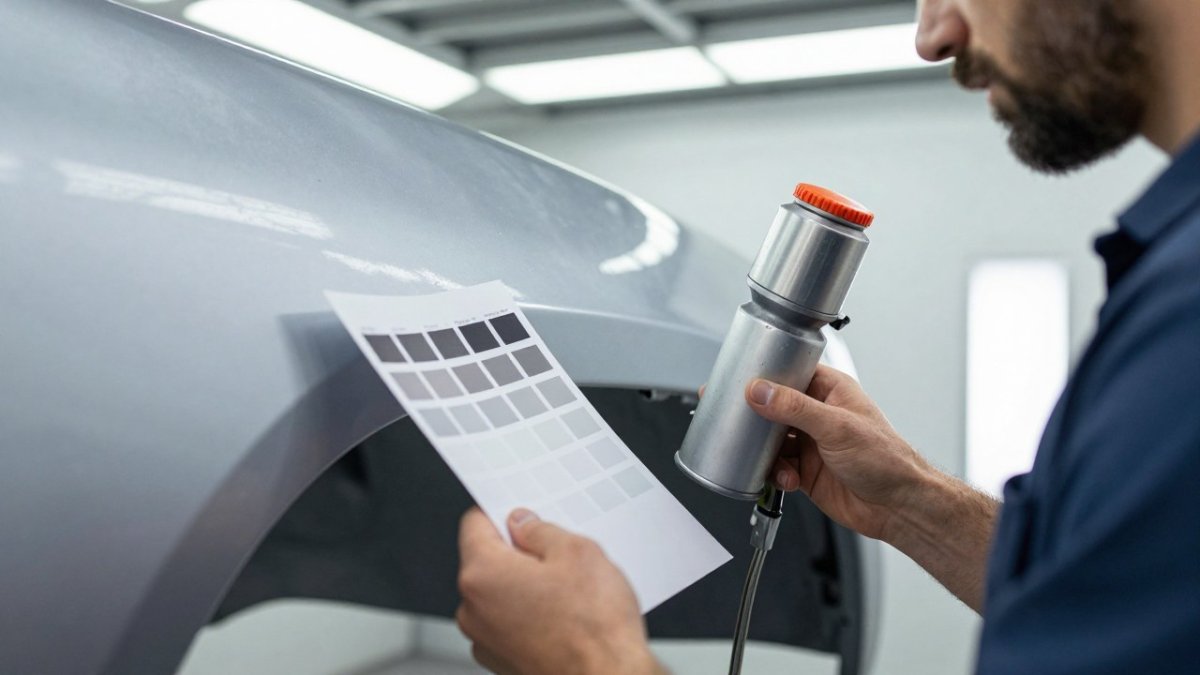
Faded paint is the big one. A car that parks outside for years shifts tone gradually, and the original factory color no longer matches what is on the panel.
Panel material matters too. Plastic bumpers and metal fenders take paint differently because plastic does not conduct heat the same way and often requires a flexible additive in the refinish.
Variant formulas are the manufacturer's way of accounting for batch and plant differences within a single paint code.
Watch out: if your shop skips the spray-out card and paints directly from the code, you may get a panel that matches the factory spec but not your faded car.
For your claim, the practical takeaway is to ask the shop to photograph the spray-out comparison and note the variant selected in the supplement.
Deductibles, Supplements, and Out-of-Pocket Costs for Paint Work
Your deductible applies to the claim, not to each line item, so blending does not carry its own separate deductible. You pay your deductible once per covered loss, and the insurer covers approved repair costs above it.
Supplements are how the estimate grows after the initial approval. The shop discovers hidden damage or a necessary procedure like blending, submits a supplemental estimate, and the insurer reviews it. Approved amounts are paid minus your deductible.
Watch out: if you authorize the shop to do work before the supplement is approved, you may end up covering the difference yourself. Get approval in writing first. If the out-of-pocket gap is the real worry, our guide to deductible assistance for auto repair explains what is legitimate and what is not.
Get a Free Inspection Before You File Your Paint Claim
Before you file anything, get the damage documented by a shop that handles claims daily. A free inspection gives you photos, a written assessment, and a clear answer on whether your repair involves paint matching at all. That paperwork is what turns a denied estimate into an approved supplement.
At 888 PDR, we work directly with all insurance carriers and manage your claim from start to finish. 888 PDR offers free inspections, a lifetime warranty on repairs, and vehicle pickup and delivery. Call (469) 284-0336 to schedule your inspection.
The gap between what an estimate says and what your car actually needs is where claims go wrong. Let 888 PDR review the damage and the paperwork before you sign anything. Get started with 888 PDR and get a straight answer on your paint and dent repair coverage.
Frequently Asked Questions
Are OEM parts covered by insurance?
OEM parts insurance coverage depends on your policy. Many standard policies allow aftermarket or recycled parts for older vehicles, while OEM parts may be covered when the vehicle is newer or when your policy includes an OEM parts endorsement. You can request OEM parts in writing, but the insurer may approve, refuse, or offer a compromise. Review your policy limits and ask your adjuster to confirm the parts language before repairs begin.
Does insurance cover paint blending after a repair?
Insurance coverage for paint blending usually follows the covered loss. If blending is needed to restore a proper color match on adjacent panels, the repair shop should document why and include it in the estimate. The adjuster may approve it, request a supplemental estimate, or deny it based on policy terms. Clear photos, a spray-out card comparison, and written justification from the shop give you the strongest case if the initial estimate leaves blending out.
Can body shops match paint exactly?
No shop can guarantee a perfect match every time, because factory color variation, faded paint, and sun exposure change how a panel looks. A skilled shop uses the paint code, variant formula, and a spray-out card to get close, then blends into adjacent panels for a seamless finish. That is why OEM paint matching is a process, not a single formula. Ask the shop how they test the color before spraying your vehicle.
Does a paint code guarantee an exact color match?
A paint code identifies the factory color, but it does not account for fading, sun exposure, or batch variation at the plant. Two vehicles with the same code can look different after a few years in the sun. Shops use the code as a starting point, then adjust the variant formula and confirm with a test panel. This is also why blending into adjacent panels matters for finish quality.
